Juventus lead the two 2026/27 Europa League winner markets read on 14 October 2026, but the order behind them differs between bookmakers. This guide gives the actual dated prices and their regional context, then asks which football performances support the favourites and where their cases remain incomplete.
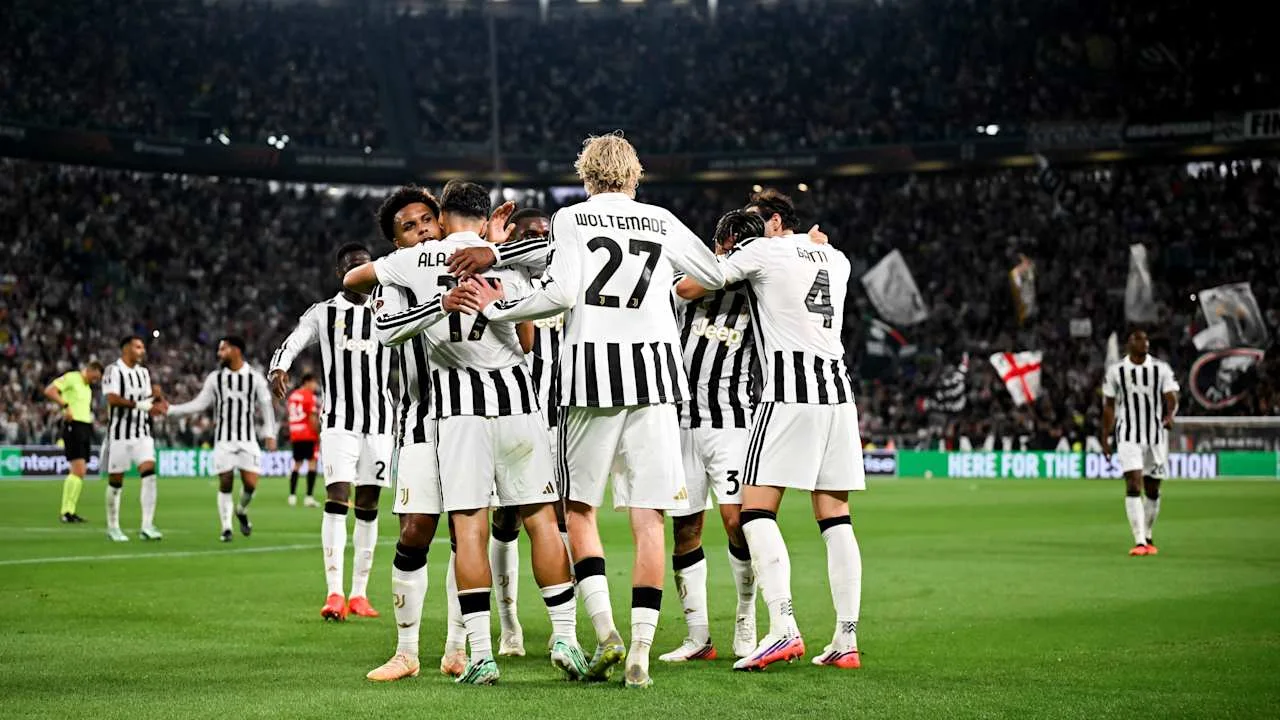
The cover shows Juventus celebrating in their September opening win against NEC. It illustrates a strong start to this campaign; the 2027 trophy has not been decided. An outright winner price concerns the whole tournament, so early goals, squad options and the route through the league-phase table all deserve more attention than the shortest number alone.
Who leads the winner market on 14 October 2026?
Juventus are the shortest-priced team in both bookmaker snapshots read on 14 October 2026. Parimatch's UK winner market shows 6/1, while Sportingbet's international English Cup Winner market shows decimal 7.00. These are prices for winning the 2026/27 Europa League, which ends in 2027, rather than for winning the next match or reaching the final.
The source and edition matter. The UK quotes come from Parimatch's en-gb market. The international quotes come from Sportingbet's English page, whose operator is based in Malta. That does not establish that the same prices or services are available in every country.
| Club | Parimatch UK, fractional | Sportingbet international, decimal |
|---|---|---|
| Juventus | 6/1 | 7.00 |
| Bournemouth | 9/1 | 8.00 |
| Bayer Leverkusen | 8/1 | 8.50 |
| Benfica | 9/1 | 9.00 |
| AC Milan | 9/1 | 11.00 |
The table is a dated snapshot, rather than a live feed. The readable pages do not provide a last-price-update timestamp, and prices can move after this comparison. Its purpose is to show the actual market picture being discussed, with enough context to avoid presenting one quote as a permanent universal ranking.
The order beyond Juventus differs. Bournemouth sit second in the international snapshot but share a UK price with Milan and Benfica, behind Leverkusen. That is a genuine difference between quoted markets, not simply the effect of displaying fractions instead of decimals. It is one reason to separate a factual description of prices from a football judgement.
Our assessment below asks what the leading clubs have demonstrated and what they still need to prove. A price summarises a market's view; it cannot explain a team's progression routes, defensive coverage or selection problems. Those football details help decide whether the current reputation has a convincing basis, without pretending to turn this article into an official probability model.
Juventus, Bournemouth and Leverkusen: three different cases
The three clubs near the front of these markets have different early football arguments. Juventus demonstrated several routes to goal, Bournemouth produced an effective away start, and Leverkusen combined control with set-piece threat. Each performance also leaves a question that one opening result cannot answer. Our judgement is based on those mechanisms, rather than treating a famous name or an old coefficient as a prediction.
Juventus: variety in the route to goal
Juventus's 5–0 win over NEC included Grabara's long pass for González, a McKennie–Alajbegović combination near the box, and substitute Kolo Muani creating a goal before scoring himself. Those are different distances and angles of attack. An opponent cannot prepare only for a short central exchange if a direct pass can also release a runner.
The title case is stronger when the attack retains that variety against a defence that stays compact. A team protecting depth might remove the long-pass opportunity but allow a receiver more time between its lines. A side pressing high can do the reverse. The capacity to recognise which route remains available is more convincing than simply expecting another five-goal score.
The caution is the sample. This was one home game against one opponent, with Juventus able to play from a large lead. Winning a tight away contest or responding after conceding would test other parts of the team. The result supports their place in the discussion; it does not prove that every stage of a spring knockout run will suit them.
Bournemouth: sustaining an aggressive start
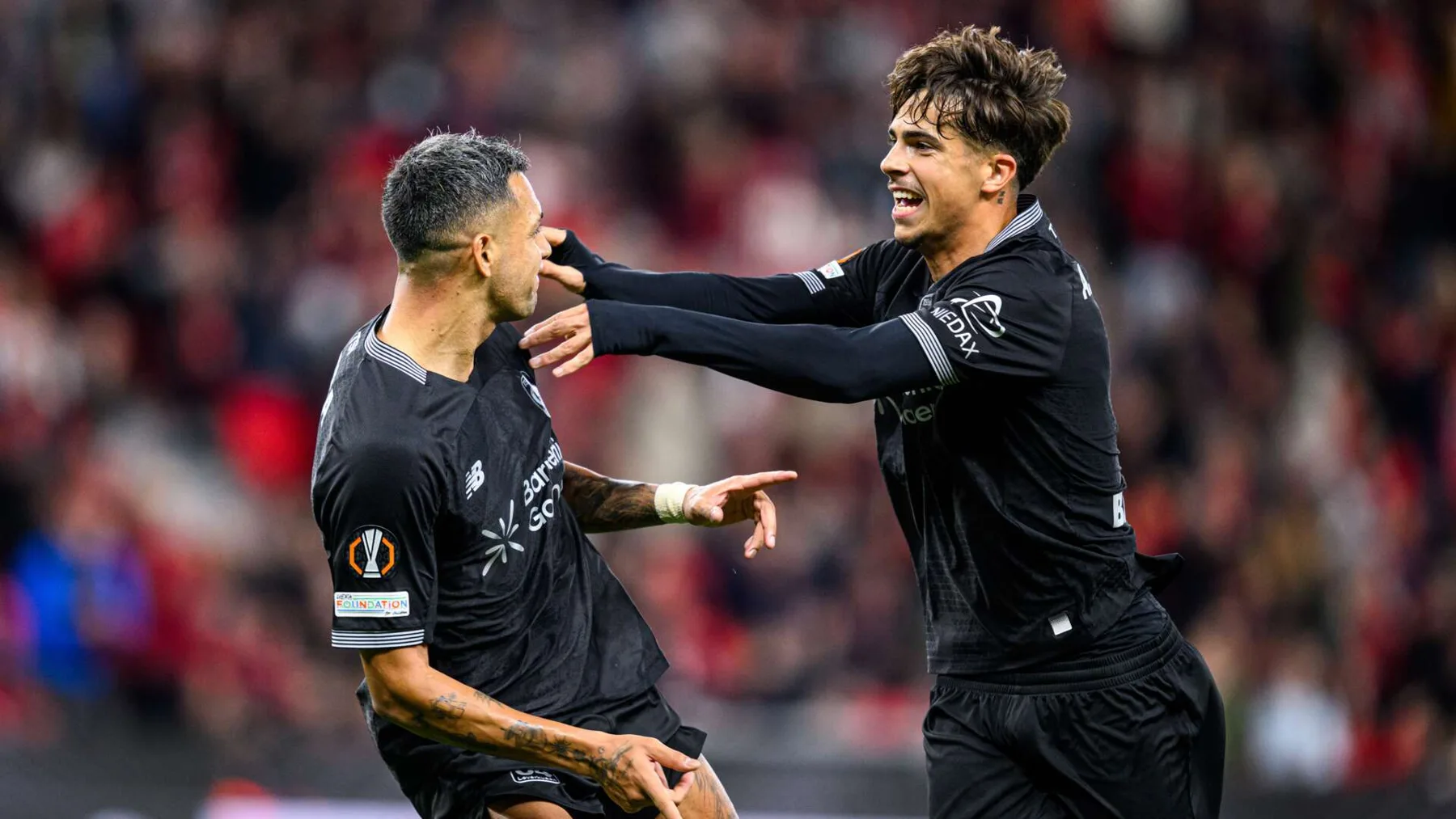
Bournemouth's 2–1 victory at Real Sociedad supplies an away example. The hosts' report records Kluivert and Rayan scoring inside the first twenty minutes, followed by a much stronger Real Sociedad response after the interval. Bournemouth won, but Petrović's saves and the home side's chances were part of the finish.
An early lead changes the opponent's task. A home side may have to commit more players forward, which can create space for further attacks. It also gives the leading team a decision about whether to continue pressing high or manage the game from a more compact shape. The ability to make that choice without losing its attacking outlet matters over a long campaign.
The next proof is therefore sustained control, not merely another energetic opening. A title contender needs to withstand the spell when the opponent finds its rhythm. Bournemouth have shown they can win away in this competition. They still need a larger body of European evidence before one impressive start can support a confident forecast about the final.
Leverkusen: reputation needs current evidence
Leverkusen opened with a 2–0 home win over Celje. An own goal and Medina's finish from a García corner supplied the scoring, while Flekken made important saves. The club also reported six changes from the preceding Bundesliga lineup.
That offers evidence of set-piece danger and options across the squad. A corner can decide a match when open-play possession is not producing clear finishes, and changes need not remove every established connection. The qualification is that a clean sheet can contain threatening opposition moments. For Leverkusen, the stronger title argument would join their attacking pressure to more reliable prevention of those moments, including away from home.
Benfica and Milan: the same match, different questions
The opening head-to-head gives these two contenders a shared reference point. Benfica won 2–0 at San Siro, but the title assessment should ask how that result happened and what each side subsequently demonstrated. A single direct meeting can reveal a matchup without establishing a season-long hierarchy.
Benfica's threat from a carrier and a cross
Milan's opening-round report describes Lukébakio carrying across the edge of the area before scoring and Kamiński finishing El Karouani's delivery. The two goals asked different questions: stopping a player with the ball and tracking a player arriving to meet it.
That variety is useful when the defending team tries to repair one route. Closing the carrier quickly may require a midfielder to leave another space; keeping the midfield compact can leave more freedom for a wide delivery. Benfica's stronger title case would involve producing that choice repeatedly, including when opponents defend deeper or prevent the clean first pass.
The qualification is that Milan also had chances. A missed close-range opportunity before Benfica's second goal shows how a comfortable final margin can contain a delicate phase. The away victory is substantial evidence of a useful attack. It is not evidence that Benfica will always prevent chances or that every European opponent will allow the same decisive touches.
Milan's response needs defensive control
Milan's next league performance supplied a response: a 3–0 win over Lecce, with Pulisic running onto Pavlović's chipped pass, Rabiot finishing a team move and substitute Moreira scoring after a recovery. There were different scorers and a contribution from the bench, rather than an attack resting on a single player.
The question is whether the team can progress while protecting the next defensive phase. A forward run is valuable, but several players leaving together can expose midfield if the pass is intercepted. A clean sheet is encouraging, while the report's important Estupiñan clearance reminds us that it did not mean the opponent never threatened.
We therefore retain Milan in the contender discussion, with a more demanding test than simply scoring again. They need the attacking connections seen against Lecce and a steadier response to the carrier and delivery problems seen against Benfica. Domestic evidence is relevant preparation; it should not be presented as a European win or a complete answer to the opening defeat.
Which outsiders have a credible football case?
In the international snapshot, Crystal Palace are quoted at 13.00 and Real Sociedad at 19.00. Those larger prices make them outsiders relative to Juventus in that market; they do not mean either side lacks a route to a strong campaign. A credible case needs an identifiable way to create chances and an explanation of how the team can survive difficult spells.
Palace's 4–0 opening win over Lech contained an interception from a loose throw-in, a Richards header at a corner, a penalty won by Pino and a late substitute's goal. The first three goals preceded Lech's late dismissal. Reducing the entire score to the numerical advantage would miss the order of events.
The variety is encouraging, while the causes deserve care. An opponent may not repeat the same throw-in error, and a penalty is not evidence that every attack will become an open-play shot. Palace's more convincing title case would be repeated connections that create chances when those individual incidents are absent. It would also need away evidence against opponents capable of moving them backwards.
Real Sociedad's opening defeat gives a different caution. Their Bournemouth report records a stronger second half, combinations involving Guedes and Oyarzabal, and chances for Óskarsson. That is evidence of attacking possibilities inside a lost game. It does not erase the damaging early deficit.
For an outsider, keeping the match close can matter as much as adding another attacking option. A side that frequently has to chase two goals may expose more space and exhaust its useful substitutes early. A side that stays connected can keep its best route available for a decisive phase later. These are football tests for the following rounds, not reasons to assign an unsupported numerical chance.
Neither example supports naming an inevitable surprise finalist. They support watching whether a club's useful attacking mechanisms remain available as the opponent and venue change. That is more informative than selecting the longest price on a list or treating one impressive home score as a complete spring forecast.
Why the league-phase finish changes the title route
A favourite's October price is a view of the whole route, not only the next opponent. Under UEFA's 2026/27 regulations, the 36 clubs play eight different opponents, four at home and four away. The final table determines whether they progress directly, enter an extra tie or leave the competition.
A top-eight place removes an extra tie
The top eight reach the round of 16 directly. Clubs ranked ninth to twenty-fourth enter the knockout phase play-offs, while the remaining twelve are eliminated. The current calendar puts those play-off legs on 18 and 25 February 2027. Avoiding them removes two matches and one opportunity to be eliminated before the last sixteen.
That has a practical effect on the title discussion. A strong team can be capable of beating a play-off opponent and still benefit from not having to do so. The extra matches require selections, travel and recovery between domestic games. An additional tie also brings another period in which a dismissal, poor finish or difficult opponent can end the campaign. This is a route difference, not a claim that resting automatically produces a champion.
The ranking also helps determine knockout positions under the draw regulations. It is therefore misleading to imagine every later opponent being drawn freely from the same unrestricted bowl. A team's league-phase finish has consequences beyond the points total displayed in January.
For now, one opening score is a small part of that table. Juventus's five goals and Palace's four improve their early positions, but neither fixes an eventual top-eight place. Clubs face different opponents across the eight fixtures, so a favourable-looking opening night must be compared with the remaining schedule.
Watch how each contender accumulates points without losing the football connections that support its attack and defence. A higher finish can simplify the route; it cannot replace winning the matches still required. The final remains scheduled for Frankfurt on 26 May 2027, with its participants and winner unknown.
What winner odds mean, and what they do not
Fractional and decimal odds express a quoted return in different ways. Fractional 6/1 converts to decimal 7.00 because the decimal figure includes the original unit as well as the six units of profit. It is therefore the same numerical price as 7.00, rather than a six-versus-seven disagreement. The operator's format explanation makes that distinction.
A reciprocal converts a decimal price into a raw implied percentage: 1 divided by 7.00 is approximately 14.3%. That is arithmetic applied to the quote, not a verified statement that Juventus have exactly a 14.3% chance of winning. Bookmaker prices contain a pricing margin, and the raw implied percentages across a complete market can exceed one hundred percent, as described in the overround explanation.
The shortlist above is not a complete market, so it cannot be used to calculate the whole operator's margin. Even removing a margin would leave a market-derived estimate, rather than a football model validated against the current squads, fixtures and remaining knockout route. A precise-looking percentage should not conceal those differences.
Market names need equal care. Winning the tournament, reaching the final and finishing in the top eight are separate outcomes. A club can achieve either of the latter two without lifting the trophy. Comparing a finalist price with a winner price would therefore answer different questions, even if the same team appears at the top of both lists.
UEFA coefficients are different again. They record European performance over a defined historical period and help organise the competition. They are not bookmaker quotes or tournament-win probabilities. Our draw-difficulty assessment serves a different purpose from this contender feature.
For the football reader, a longer price is a description of the market's ordering, not proof that a club is underrated. The meaningful next step is to inspect the team's actual attacking and defensive evidence, then recognise where the sample or future route still leaves uncertainty.
The evidence that should change the assessment
The next useful update is a football test rather than another rearrangement of decimal prices. UEFA's fixture list places Juventus away to Celta Vigo on 15 October, while Bournemouth host Sturm Graz. Juventus have already shown several ways to finish a home attack; the away setting asks whether those routes remain available when the first forward pass is contested and the crowd belongs to the opponent. The club's Celta preview supplies the immediate match context. Its historical meetings do not tell us how likely the present team is to win the competition.
For Bournemouth, watch what happens after the initial surge. Their opening victory contained both an early advantage and pressure from Real Sociedad later on. Sustained possession after going ahead, support around the ball when the first press is bypassed, and fewer emergency saves would strengthen the argument that their approach can survive a long campaign. Another early goal alone would answer less of that question. These are assessment criteria drawn from the opening match, not claims about an announced starting eleven.
Benfica host Celtic, Milan visit Salzburg and Leverkusen travel to Lech Poznań on the same date. Benfica's ability to move defenders with a carry and then attack a delivery is worth following against a different defence. Milan need a European response that connects their attacking combinations to protection behind the ball. Leverkusen's set-piece threat becomes more convincing as part of a performance that also limits the opponent's opportunities. Bournemouth against Milan on 22 October then provides a direct comparison between two clubs quoted near the front of the market.
A useful title assessment changes when those mechanisms change: a team loses a reliable progression route, strengthens its control after scoring, or puts itself on a materially shorter knockout path. A price change may accompany that evidence, but cannot explain it by itself. The figures above describe two markets read on 14 October 2026. The eventual finalists and winner of the 2026/27 Europa League remain unknown.

Matchnight discussion
Ask a question or share your thoughts with other fans. Comments are reviewed before they appear. Please keep it friendly and leave out personal details.
Read our privacy policy and comment guidelines.
Loading comments…