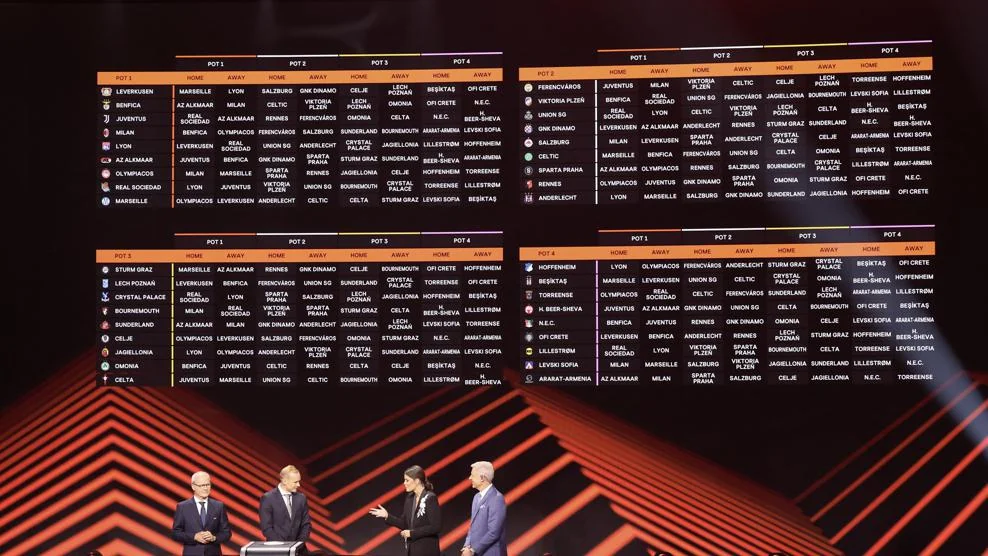
Ferencváros have the hardest 2026/27 Europa League draw by our coefficient-based strength-of-schedule index, while Sparta Praha have the easiest. The comparison averages the published UEFA ranking positions of all eight opponents: a lower average means a more accomplished European schedule on paper. Ferencváros score 70.8; Sparta score 106.9.
That is a historical-opponent index, not an official UEFA ranking and not a prediction. It cannot fully value a powerful newcomer, current form, injuries, travel or the home-and-away split. The tables and club-by-club explanations below show both what the number reveals and where a famous-name reading can deceive.
The coefficient verdict at a glance
By our UEFA coefficient index, Ferencváros have the hardest 2026/27 Europa League league-phase draw. The average world-ranking number of their eight opponents is 70.8, the lowest in the field. Lech Poznań, OFI Crete, Beşiktaş and Crystal Palace complete the hardest five. At the favourable end, Sparta Praha have the highest opponent-rank mean at 106.9, followed by N.E.C., Jagiellonia, Milan and Salzburg.
| Band | Rank | Club | Opponent-rank mean |
|---|---|---|---|
| Hardest | 1 | Ferencváros | 70.8 |
| Hardest | 2 | Lech Poznań | 77.6 |
| Hardest | 3 | OFI Crete | 77.9 |
| Hardest | 4 | Beşiktaş | 78.5 |
| Hardest | 5 | Crystal Palace | 81.5 |
| Easiest | 1 | Sparta Praha | 106.9 |
| Easiest | 2 | N.E.C. | 105.6 |
| Easiest | 3 | Jagiellonia | 102.5 |
| Easiest | 4 | Milan | 100.6 |
| Easiest | 5 | Salzburg | 98.8 |
How to read the number
Lower means harder. UEFA ranks Leverkusen 12th and Ararat-Armenia 224th before Matchday 1, so drawing Leverkusen pulls a club’s opponent average downward while drawing Ararat-Armenia pushes it upward. The decimal is the mean of eight ordinal ranking positions, not projected points, a percentage or UEFA’s own schedule grade.
The table is a historical European-strength baseline. It rewards opponents with sustained UEFA results and can undervalue dangerous newcomers with little coefficient history. It also cannot price a hostile away ground, travel disruption, current injuries or the order of fixtures. Those limits are important enough that “easiest” must remain shorthand for easiest by this specific measure.
How the strength-of-schedule index was built
The input is deliberately simple and public. UEFA published every club’s eight opponents and a coefficient world-ranking number accurate before Matchday 1. We added the eight opponent ranks for each schedule and divided by eight. Because a better club has a lower ranking number, the lowest opponent mean represents the strongest historical schedule.
We also calculated separate four-match home and away means. UEFA’s draw gave every team two opponents from each of four pots, one at home and one away. That pot balance prevents anyone receiving eight top-pot teams, but it does not make schedules equal. The strongest and weakest names inside a pot still differ, and the venue assigned to each opponent changes the practical demand.
What UEFA coefficients measure well
A coefficient captures sustained results in UEFA competition. It does not rise because a club has a fashionable transfer window or a large domestic audience. Leverkusen’s 12th-place coefficient, Benfica’s 21st and Milan’s 27th reflect accumulated continental performance. That makes the list a sensible draw-day baseline: it asks how much proven European opposition each club received.
The method is also reproducible. A reader can take the official opponent list, match each name to UEFA’s pre-Matchday 1 team page and verify the arithmetic. There are no hidden subjective bonuses for a famous stadium or a preferred league.
Where this method can mislead
Ordinal ranking numbers are not equal units of quality. The gap between 12th and 21st need not be the same sporting gap as 152nd to 161st. Coefficients also look backward across several seasons. They react slowly to a new coach, an exceptional academy generation, a sale of key players or a newly promoted club entering Europe with a strong domestic squad.
New or infrequent European entrants are the biggest warning. Crystal Palace, Sunderland and Bournemouth do not have the same long UEFA record as traditional continental sides; their published coefficient positions can understate current resources. Opta’s forward-looking model, for example, gives Sunderland a substantial chance of progressing and treats Palace as a contender. That does not prove the coefficient index wrong—it answers a different question about current team strength.
Finally, the method grades opponents, not the club facing them. Ferencváros having the hardest coefficient schedule does not mean they are projected to finish last. Sparta having the easiest does not mean they will collect the most points. Expected points require both teams’ current strength, venue and matchup; this index isolates draw burden so those factors can be discussed rather than smuggled into an unexplained score.
The five hardest coefficient draws
The top five share a pattern: repeated opponents with established European records and few genuinely soft historical slots. Yet the venue split differs sharply. Lech and OFI receive their strongest coefficient quartets at home, while Ferencváros and Beşiktaş carry a heavier ranked burden away.
Ferencváros sit at the sharpest end
Ferencváros face Juventus, Viktoria Plzeň, Celje and Torreense at home, then Milan, Celtic, Lech Poznań and Hoffenheim away. Their overall opponent-rank mean is 70.8. It is not one monster tie that drives the result; it is the absence of relief across eight different opponents. Juventus and Milan supply elite historical coefficients, Plzeň and Celtic bring repeated league-phase experience, and even the lower-ranked teams occupy strategically awkward slots.
The away mean is 68.8, slightly harder than the 72.8 home mean. Trips to Milan and Celtic concentrate the two most recognisable atmospheres outside Budapest, while Lech add a demanding crowd and Hoffenheim a Bundesliga-level test. Ferencváros can still exploit home meetings with Celje and Torreense, but the index says their route contains fewer low-coefficient opportunities than anyone else’s.
Lech, OFI, Beşiktaş and Palace complete the five
Lech Poznań rank second at 77.6. Their four home opponents average 70.0 because Leverkusen and Ferencváros join Sunderland and Torreense. The away four are numerically easier at 85.3, but Benfica and Union SG remain demanding. This is a good example of why one overall number needs a fixture map: Lech’s hardest historical names do not all require travel.
OFI Crete are only 0.25 ranking places behind Lech in the unrounded mean. Leverkusen, Anderlecht, Lech and Hoffenheim visit Crete; Benfica, Rennes, Sturm Graz and Hapoel Beer-Sheva host OFI. The 69.0 home mean is the hardest home quartet among this five. Home advantage may soften those ties, but it also means OFI must turn the island setting into points against seasoned opposition.
Beşiktaş sit fourth at 78.5. Marseille, Union SG, Crystal Palace and Hapoel Beer-Sheva are their designated home opponents; Leverkusen, Celtic, Omonia and Hoffenheim are away. The difficult part is the away spine—Leverkusen and Celtic pull that split to 73.3. Fan threads quickly labelled the draw brutal and debated possible venue complications, but no unconfirmed relocation assumption is included in this index.
Crystal Palace round out the five at 81.5. Their home list—Real Sociedad, Sparta Praha, Lech and Hoffenheim—averages 74.3, stronger than their away group of Lyon, Salzburg, Jagiellonia and Beşiktaş at 88.8. Palace’s own limited coefficient history makes them a methodological warning elsewhere, but it does not alter the strength ranks of the opponents they drew. The champions of the 2025/26 Conference League have been handed a proven-European home programme from the start.
The five easiest coefficient draws
“Easiest” is relative. Every schedule in this band still contains a Champions League-level name or an experienced Europa League opponent. The advantage is that the strongest historical ties are balanced by more lower-ranked opposition than the competition average.
Sparta and N.E.C. lead the favourable end
Sparta Praha’s eight opponents average 106.9, the highest number and therefore the most favourable coefficient draw. AZ, Rennes, Bournemouth and Lillestrøm travel to Prague; Sparta visit Olympiacos, Salzburg, Crystal Palace and Ararat-Armenia. The two venue means are close—109.5 at home and 104.3 away—so the advantage is not concentrated entirely in one half of the schedule. Olympiacos away is a severe individual test, but the overall slate offers routes to points.
N.E.C. sit just behind on 105.6. Benfica, Rennes, Omonia and Levski Sofia come to Nijmegen, while the Dutch club travel to Juventus, GNK Dinamo, Celje and Ararat-Armenia. The headline trips to Turin and Zagreb can make the draw look harder than it grades. The counterweight is two opponents ranked outside UEFA’s top 200 and a home programme that avoids Leverkusen, Milan and Olympiacos.
Jagiellonia, Milan and Salzburg have room to build
Jagiellonia’s 102.5 mean ranks third-easiest, helped by Ararat-Armenia at home and Levski away. Yet the Polish side also visit Olympiacos and Plzeň and host Lyon. Their draw is favourable in aggregate, not gentle in sequence; dropping home points against the lower-ranked opponent would quickly erase the statistical cushion.
Milan rank fourth at 100.6. The Rossoneri host Benfica, Ferencváros, Sunderland and Ararat-Armenia, then travel to Olympiacos, Salzburg, Bournemouth and Levski. Benfica and Olympiacos ensure the programme has a high ceiling, but two opponents outside the UEFA top 200 lift the mean. Milan’s favourable label therefore rests partly on avoiding another proven giant in those slots, not on facing eight outsiders.
Salzburg complete the five at 98.8. Milan and Leverkusen are the conspicuous dangers, with the German trip especially difficult. Sparta, Palace, Anderlecht and Celje form a competitive middle; Ararat-Armenia and Levski occupy the lowest coefficient positions. That distribution gives Salzburg several matches in which dropped points would be more damaging than a respectable defeat to a favourite.
The practical benefit for these five is opportunity, not entitlement. A lower-ranked opponent can be tactically awkward, especially away, and new clubs may be stronger than their European history suggests. The label becomes valuable only if the side handles the matches where it is expected to lead the game.
Why the famous-name test gets schedules wrong
Supporters naturally scan for badges. Milan plus Benfica looks terrifying; an eight-game list dominated by less televised clubs looks manageable. That shortcut misses both the depth of sustained European performers and the weakness hidden beneath one glamour tie. A schedule is an average burden, not its most marketable poster.
Union SG rank 41st in UEFA’s pre-Matchday 1 list, Viktoria Plzeň 40th and Ferencváros 39th. None has Juventus’s global profile, yet each carries stronger recent coefficient evidence than many familiar clubs from larger leagues. Drawing two of them can be more demanding than drawing one giant alongside several teams outside the top 150.
The new-English-club coefficient trap
Bournemouth, Crystal Palace and Sunderland demonstrate the opposite problem. UEFA lists them 97th, 88th and 96th respectively. Palace are already Conference League holders, while the other two arrive without a deep recent UEFA sample. Their historical ranking numbers do not fully capture Premier League resources, current squad speed or the intensity they can bring at home.
Opta’s forward-looking simulations expose the gap. Its pre-season model gave Sunderland an 82.3% chance of reaching the last 16 and an 8.3% title chance, with Palace winning 7.3% of simulations. Those are team forecasts, not schedule grades, but they show why an opponent-only historical index can make drawing an English newcomer look easier than a current-power model would.
The right response is not to discard coefficients. It is to ask what each tool is measuring. UEFA ranking captures continental memory: performance earned over multiple seasons. A current-strength system responds to domestic results, players and opponent quality now. The badge test mixes both with emotion and television exposure without declaring any method.
This also changes how we read Milan’s “fourth-easiest” schedule. Benfica and Olympiacos are plainly difficult, and Bournemouth or Sunderland may outperform their coefficient positions. The favourable mean is driven by the full eight, including Ararat-Armenia and Levski Sofia outside the top 200. Calling Milan’s route easy without those qualifications would overstate the result.
At the hard end, Ferencváros receive no extra score because Celtic Park is famous, and Palace receive no penalty for opponents with strong coefficients but smaller global followings. That restraint is the index’s advantage. The accompanying current-strength caveat is what stops restraint becoming false precision.
Home, away and travel can reverse the headline
The overall mean treats a high-ranked opponent the same at home and away. Football does not. A club can press more aggressively with its crowd behind the back line, control its routine before a home match and avoid international travel. Away teams manage unfamiliar surfaces, stadium noise and a journey layered onto domestic fixtures.
That is why Lech and OFI should not read identical-looking overall averages in the same way as Beşiktaş. Lech’s home quartet averages a demanding 70.0 but the away four 85.3. OFI’s split is 69.0 at home and 86.8 away. Their strongest historical opponents disproportionately have to visit Poznań and Crete. Beşiktaş are the reverse: 83.8 at home and 73.3 away, with Leverkusen and Celtic among the trips.
A difficult opponent is not equally difficult everywhere
Leverkusen at home remains a high-level problem, but it is not identical to playing in Germany. Likewise, a coefficient cannot express an evening in Piraeus, Istanbul or Glasgow. Crowd pressure changes communication and the emotional cost of a poor first spell. Tactically, a favourite may attack with greater numbers at home, creating both sustained pressure and transition space that would not exist in a more cautious away plan.
Travel also interacts with sequence. UEFA’s league-phase calendar begins on 16–17 September, contains four dates between 15 October and 10 December, then resumes on 21 January before the simultaneous finale on 28 January. A long trip between demanding domestic matches may be harder than the same trip in a clean week. A January away game can meet a club in full domestic rhythm or just returning from a winter break.
We have not converted those effects into invented points. Doing so consistently would require confirmed venues, travel routes, domestic scheduling, rest days and current squad availability. Social discussion after the draw raised concern that a Beşiktaş fixture could move and alter the home-away balance, but the discussion itself acknowledged that no decision was official. The index therefore retains UEFA’s designated home/away list and leaves relocation out until confirmed.
Milan illustrate the other side of the split. Their home opponents average 95.0 and away opponents 106.3, so the coefficient model says the trips are historically easier. Yet away matches at Olympiacos, Salzburg, Bournemouth and Levski bring four very different environments. The number should guide attention to the schedule; it should not erase the work required in those stadiums.
For supporters, the useful reading is two-stage. Begin with the overall coefficient burden to compare all 36 draws, then locate where the strongest opponents sit. A hard draw with the sharpest names at home may be more playable than its ranking suggests. A middling draw that sends a club’s toughest tests away can be much more fragile, especially if those trips cluster around domestic pressure.
How to update the ranking once matches begin
Keep this coefficient index frozen at its stated date. It describes the information available before Matchday 1 and allows the calculation to be reproduced. If a club improves, collapses or changes coach in October, that affects the difficulty experienced on the pitch; it does not change which draw looked difficult on 15 September.
Add live evidence as a second layer. Start with confirmed Europa League results and the current league-phase table, but do not substitute one early win for a strength model. Teams face different opponents, so a six-point start can reflect excellent performance, favourable fixtures or both.
Opponent-adjust the observation. Beating Leverkusen carries different information from beating the lowest-ranked club, while drawing away can be more valuable than the same score at home. Then examine whether the result came from a repeatable process: creating central chances, escaping pressure, protecting transitions and sustaining intensity. A fortunate deflection counts fully in the table but should not automatically transform the schedule assessment.
Availability matters too. The side named in an August draw may arrive without its leading striker or with a new centre-back partnership. Conversely, a low-coefficient newcomer may settle rapidly and reveal that its inherited ranking was misleading. Record the circumstances rather than quietly rewriting the original method.
By Matchday 3 or 4, a current-strength model can be more useful for forecasting qualification. Name the model and its date, and keep its output separate from our coefficient baseline. Expected points combine the team’s own level with its opponents; strength of schedule should continue to describe the opponents alone. Mixing those ideas is how a difficult draw becomes confused with a pessimistic team prediction.
Finally, update logistical facts as UEFA confirms them. A venue change, altered kick-off or compressed domestic turnaround can materially reshape one fixture. The live match calendar should control those details. The ranking is most useful as a starting map: it identifies where the historical burden lies, then tells you which early results deserve closer inspection.
Use the ranking as a baseline, not a verdict
The coefficient index makes one useful pre-season question reproducible: whose eight opponents carry the deepest recent UEFA history? It does not decide who will qualify. Keep the original score frozen, then compare it with results, performances, venue context and current-strength models as the league phase develops. The gaps between those measures will often explain more than any single easiest-or-hardest label.
Matchnight discussion
Ask a question or share your thoughts with other fans. Comments are reviewed before they appear. Please keep it friendly and leave out personal details.
Read our privacy policy and comment guidelines.
Loading comments…