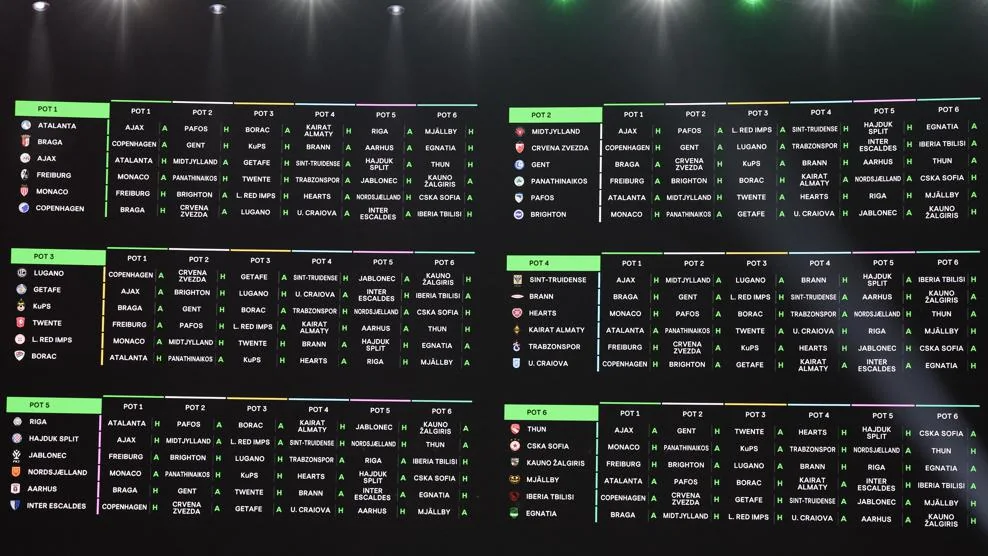
The UEFA Conference League league phase opens on 15 October 2026. These early Matchday 1 predictions favour Brighton at home to Kauno Žalgiris, Atalanta at home to Pafos and Ajax away to Hajduk Split, with a draw preferred between Copenhagen and Braga. They cover four selected games, with the reasons and the main threat to each call explained below.
Research cutoff: 30 September 2026. The previews combine confirmed UEFA fixtures with official club and competition reports from the current season. They are qualitative editorial judgments, not bookmaker odds, model probabilities or confirmed team news for matchday. Read them as arguments about how a match could develop: the most useful prediction names both the route to the preferred result and the evidence that would make you reconsider it.
Matchday 1 is on 15 October: what the forecasts assume
UEFA's official league-phase fixture list places the opening matches on Thursday 15 October 2026. The four contests examined here are confirmed fixtures, rather than possible pairings from an unfinished draw. They offer different questions: whether a home favourite can turn possession into chances, whether an outsider can attack the space left behind, and whether a relatively balanced game rewards patience.
The competition gives those decisions a particular weight. Under UEFA's current match rules, each club meets six opponents once, with three home matches and three away. A poor opening evening cannot be repaired in a return leg against the same opponent. Equally, one victory is only the first contribution to a six-game points total. A prediction should therefore consider how a side can win this individual match without pretending that Thursday settles its entire European campaign.
These previews use information available on 30 September. They are early editorial assessments, with no claimed knowledge of the starting elevens on 15 October. The useful distinction is between a reported result and the mechanism that might carry into another match. A qualifying win shows that a club negotiated a particular opponent; it does not prove that the same approach will work against a different press, a different striker or a stronger midfield.
Read each lean together with its condition. A home-win preference becomes less persuasive if the expected attacking combinations are unavailable, while a draw preference can weaken if one side loses the players needed to escape pressure. Domestic results also come against different opposition, so simply comparing the last score on each club's record can mislead. The purpose here is to identify the contest that would make a forecast hold up, then explain the route by which it could fail. No numerical confidence, betting price or supposed certainty is attached to those judgments.
Brighton vs Kauno Žalgiris: pressure must become clear chances
Early prediction: Brighton to win. The strongest argument is their demonstrated ability to create chances at home through more than one route. The qualification is that an opponent protecting its penalty area can ask a different question from Arsenal: Brighton may need patient combinations after the first wave of pressure, rather than assume another high regain will deliver an immediate breakthrough.
The home side's route to control
Brighton's 19 September report of the 3–0 Arsenal victory supplies a concrete starting point. Pascal Gross, Babis Kostoulas and Chema Andres scored. The account describes a high turnover producing a saved Kostoulas volley, combination play before Gross's opener, and a corner headed in by Andres. Those are separate ways of asking a defence to make decisions, rather than three identical finishes.
For this matchup, the interesting question is whether Brighton can keep an extra passing option available when Kauno crowd the middle. If the visitors withdraw, an unsupported forward may receive with several defenders around him. A supporting midfielder arriving as the ball travels can instead offer a return pass or draw a marker away. This is the attacking pattern to look for, not a claim that a particular starting lineup has already been selected.
Pressure should also have a stopping point. Brighton's report includes Arsenal breakaway chances despite the clean sheet. Sending another player forward is useful only if the remaining defenders can cover the first pass out. A home side repeatedly recovering the ball without allowing a dangerous escape would strengthen the win forecast; possession followed by rushed shots and open counterattacks would weaken it.

The visitors' route to an upset
Kauno should not be treated as a side with only one possible scoreline. The Lithuanian federation's results table records a 5–0 win over Džiugas on 6 September, a 5–1 win over Sūduva on 9 September and a 1–0 away win at Panevėžys on 13 September. These selected results show both emphatic and narrow victories. They do not establish that the visitors can reproduce either margin against Brighton, or reveal a complete tactical identity.
The upset route therefore depends on actions within this game. After winning possession, Kauno need a recipient who can keep the next pass alive. Clearing into an isolated forward invites another home attack; finding a teammate with support can make Brighton turn and retreat. Even a brief spell of controlled possession can let the visiting defence move up together instead of spending the entire evening around its own box.
That makes Brighton the preferred winner, with the first clean Kauno escape a useful warning signal. An early visiting goal would change the space available to both sides and force the hosts to balance urgency with protection. The evidence supports a home-win lean more clearly than a clean-sheet call or an exact winning margin.
Atalanta vs Pafos: the favourite still needs protection behind the attack
Early prediction: Atalanta to win, with a narrower edge than a comfortable-win forecast suggests. Their current evidence includes finding a decisive goal in tight games. It also includes opponents remaining dangerous late on. That combination supports a preference for the hosts while making the defensive position behind their attacks central to the preview.
This is Maurizio Sarri's Atalanta: the club appointed him in June. Predictions built around an older coach's system risk describing the wrong team. More useful is the 27 August qualifying report: Gianluca Scamacca's touch after a corner earned a 1–0 win over Hapoel Tel-Aviv following a goalless first leg. Marco Carnesecchi then turned a late effort onto the post. Progress required both the breakthrough and its protection.
The same distinction matters in Bergamo. A fullback advancing or a midfielder joining the box can provide another target, but the next player must judge whether to follow or remain available behind the ball. If Pafos get the first pass through that cover, an attack that looked promising can turn into a retreat toward Atalanta's own goal. The home advantage is more convincing when the team can restart attacks without conceding those races.
There is also evidence for patience. Atalanta's 31 August win against Bologna arrived through Lazar Samardžić's 96th-minute strike. That result does not guarantee another late winner; it does warn against assuming that a level score after an hour proves the favourite has exhausted every route to goal.
How Pafos can make the favourite work
Pafos have a relevant example of recovering from trouble. Their official Dinamo City report records a 4–2 victory after extra time on 27 August. Ken Sema answered an early concession, while a Nikolas Ioannou header and extra-time goals from Moumi Ngamaleu and Anderson Silva contributed to progression. The extra-time qualification matters: this was not four goals scored within the length of a league-phase match.
For the visitors, the practical opportunity is to make Atalanta defend several kinds of delivery. A ball toward a forward's feet and a cross toward a runner demand different decisions from a defender. The qualifying account gives examples of Pafos scoring through different actions; the forecast is that retaining those alternatives could make an aggressive home team hesitate before committing its remaining cover.
That attacking possibility should not be confused with guaranteed scoring. Pafos's 7 September domestic meeting with Olympiacos Nicosia finished 0–0. A chance still needs a legal, accurate finish. Atalanta remain the early selection, but Pafos scoring first would expose the main weakness in a confident home-win call: the hosts would need to increase attacking numbers while still denying the visitors a supported escape.
Hajduk Split vs Ajax: the first clean escape can change the game
Early prediction: Ajax to win, with significant resistance from Hajduk. Ajax's away qualifying performance supplies an attacking case, but their concessions in the same tie prevent this from becoming a straightforward clean-sheet forecast. The central question is how the visitors turn an initial pass beyond pressure into a supported attack, and how Hajduk respond when that happens.
Ajax's official account of the 20 August trip to Sion records a 4–2 win, with all four goals coming in the second half. Tolu Arokodare headed in after an Abdellah Ouazane delivery and later assisted Davy Klaassen. These examples matter because a forward receiving the ball can be part of the move's continuation, not just its final shot. A pass that brings a supporting player into the contest can remove the advantage of the defender arriving first.
That is the route Ajax would want against an assertive home start. If the first receiver has only a defender on his back and no teammate nearby, Hajduk can push up behind the challenge. If he can set the ball back or turn it toward a runner, the home midfield must change direction. The space for the next pass then matters more than the crowd's reaction to the first tackle. This is a conditional reading of the matchup, rather than a claim that Hajduk always press in one prescribed shape.
Hajduk's own recent evidence makes that defensive support a serious issue. In their 3–0 defeat at Rijeka on 20 September, the opening goal came from a counterattack, and the third followed a ball recovery and a run toward the goalkeeper. The account also records Hajduk chances from deliveries into the area. It describes a team that created openings but suffered when the play moved the other way, rather than a match in which it offered no attacking threat.

Ajax also have a warning in their 5–3 home return against Sion. Scoring freely did not stop the opposition scoring three. In Split, repeatedly trading attacks would make the result more volatile than the away-win lean implies. Ajax's preferred scenario is to keep a nearby passing option after escaping the first challenge, then finish the move without exposing the centre when possession changes.
Hajduk's extra-time victory over Raków shows why a setback should not be treated as the end of their challenge. They qualified after a 2–2 first leg and a 3–2 away win after extra time. For this single match, however, the available response must arrive within 90 minutes and stoppage time. An early Hajduk lead would let them ask Ajax to advance into a less comfortable balance; an early Ajax lead could make the home side's attacking choices expose precisely the space this preview identifies.
Copenhagen vs Braga: a close contest turns on midfield control
Early prediction: a draw. Copenhagen have a specific home attacking performance to build on, while Braga reached this stage without conceding in their playoff. Neither fact settles a meeting between these two sides. The draw preference rests on the possibility that both can protect the central passing routes well enough to make the other work for a breakthrough, rather than on an assertion that their squads are identical in quality.
What the recent European results establish
Copenhagen's 4–1 home win over Inter Turku on 27 August followed a goalless away leg. Their detailed club report explains an important division of work: William Clem held a more defensive central role while Mads Emil Madsen played further forward. The move for the second goal involved escaping pressure, a midfield combination, a wide run and Madsen arriving to finish.
That evidence makes midfield control a practical question. Copenhagen need someone available behind the ball as another player advances; otherwise a promising combination can leave the next opposition receiver unchallenged. The report describes that balance in one August lineup. It supplies a useful role to examine on 15 October, without confirming that the same players will start or occupy exactly the same positions.
Braga's qualification provides a different kind of result. UEFA's official results record a 2–0 home victory over Austria Wien followed by a 0–0 away draw, with Liga Portugal confirming progression. A scoreless return protected an existing aggregate advantage. Copenhagen begins at 0–0 with no such buffer, so the same result would have a different meaning: one league-phase point rather than the completion of a successful tie.
Why the opening goal would change the forecast
The recent domestic outcomes also favour a restrained reading. Liga Portugal records Jonas Wind scoring Braga's sole winning goal against Estoril in its 14 September report, then a goalless draw at Santa Clara on 20 September. Those outcomes do not justify inventing a dominant possession figure or predicting an automatic away goal. They suggest keeping narrow margins firmly in the range of plausible outcomes.
At level scores, both teams can choose to retain a midfielder behind an attack and make the opponent complete another pass. Once one trails, that choice becomes harder. Advancing the additional player may improve the chance of reaching the box, but it also changes who can challenge the next clearance or receive a safe return pass. The team ahead may gain room for an outlet without becoming better at every other part of the game.
The most revealing early sequence could therefore be a loose ball after an attack breaks down. Which side has a player positioned to collect it, and can that player move the next pass forward? Repeated possession that travels only sideways can conceal difficulty progressing. A clear advantage in those second actions would be a reason to move away from the draw lean toward that team; an isolated early goal would instead require reassessing the new game state.
What could change before the opening Thursday
The gap between a 30 September preview and a 15 October match is meaningful. FIFA's approved international calendar introduced a combined late-September and early-October window from 2026, allowing four matches across 16 days. International involvement can change the preparation available to a club, but the calendar alone does not establish that a particular player is tired, injured or unavailable. Those conclusions require individual, current evidence.
There is club football to assess as well. Braga's official fixture list currently places a meeting with Sporting on 9 October, before the Copenhagen trip. Its performance and the subsequent team news could alter the basis for the draw lean. The same reasoning applies when assessing any of the selected teams' next games: distinguish a changed role or an unavailable player from an ordinary substitution made for that particular opponent.
Close to Thursday, start with the actual squad announcement and the coach's latest briefing. Then ask whether the roles described in these previews are still available. Brighton's analysis needs support around the first receiver, Atalanta's needs protection when numbers move forward, Ajax's needs a way to continue the move after escaping a challenge, and Copenhagen's needs balance between advancing and holding midfielders. Replacing a famous name is not automatically decisive; losing the function that made the forecast plausible can be.
Confirmed starting teams should be the final check. A listed substitute cannot be assumed to provide the same influence from the opening minute, while a player starting in a different position may change the passing options around him. Avoid filling those gaps with an imagined formation, an old injury list or a predicted minute limit. The match previews remain useful because they identify questions to test against the confirmed team, rather than depend on a lineup invented two weeks early.
Use our season schedule guide for the wider calendar and the TV and streaming guide to plan viewing in your territory. Before following a forecast, check the official match listing again. This article's research cutoff remains 30 September; later confirmed information should take priority when it changes the assumptions behind an individual call.
Across these four games, the key distinction is between creating an advantage and keeping it. Brighton and Atalanta need to convert their home opportunities without giving opponents a supported escape; Ajax need attacking combinations that survive pressure; Copenhagen and Braga need midfield decisions that still make sense after the first goal. Those contests give the early predictions a useful test when the opening Thursday arrives.


Matchnight discussion
Ask a question or share your thoughts with other fans. Comments are reviewed before they appear. Please keep it friendly and leave out personal details.
Read our privacy policy and comment guidelines.
Loading comments…