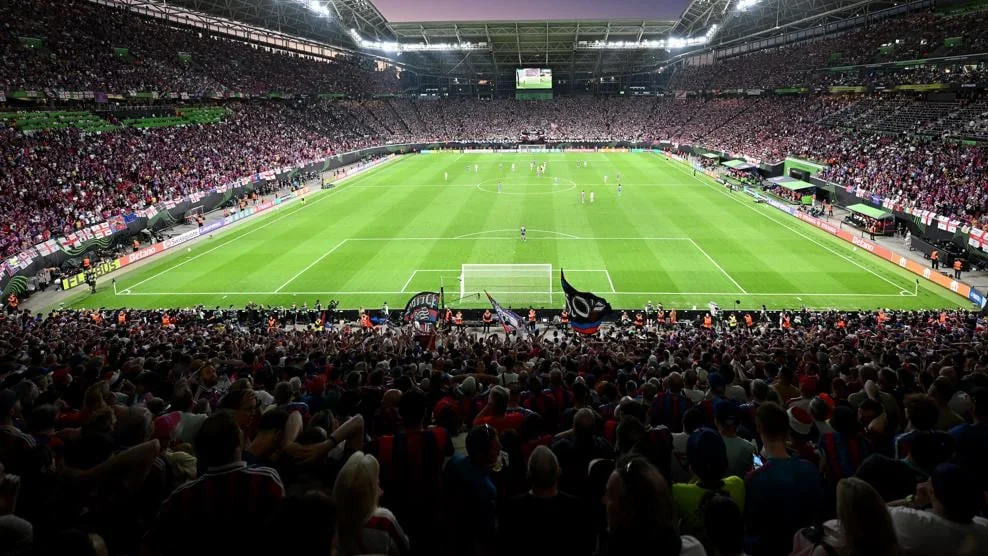
The 2026/27 Conference League league phase runs from 15 October to 17 December 2026. Its knockout rounds begin in February and the season ends at Beşiktaş Park in Istanbul on 2 June 2027. Six games, not eight, decide the 36-team league ranking.
This is a planning and format guide based on information confirmed through 7 September 2026. It explains why the compact calendar changes squad management, how rank shapes the bracket and which final details are still unknown. UEFA says dates can change, so match-specific arrangements should always be checked again.
The 2026/27 Conference League calendar
The league phase begins on 15 October 2026, ends on 17 December 2026, and the final is scheduled for 2 June 2027 at Beşiktaş Park in Istanbul. The compact autumn is the defining feature: all six league games are played within nine weeks, with no January matchday.
| Stage | Dates | Fan meaning |
|---|---|---|
| League phase | 15 & 22 Oct; 5 & 26 Nov; 10 & 17 Dec | Six single matches, three home and three away |
| Knockout play-offs | 18 & 25 Feb 2027 | Ranks 9–24 contest an extra round |
| Round of 16 | 11 & 18 Mar | Top eight enter here |
| Quarter/semi-finals | 8 Apr–6 May | Two-legged ties shape the Istanbul field |
| Final | 2 Jun | One match at Beşiktaş Park |
UEFA's complete fixture list uses Central European time and includes early slots where needed. Kairat Almaty, for example, has 16:30 CET home kick-offs in the published list. That is a reminder to convert each appointment rather than assuming every Thursday follows one television window.
The two one-week gaps at the start and finish make momentum powerful. A club can move from no points to six before supporters have settled into the competition, then face the same quick turn in December when the table is tight. The three-week break between Matchdays 3 and 4 offers the only substantial reset. Coaches can adjust a press or recover players there; after 26 November, the last three fixtures arrive in 22 days.
The winter gap is different. Clubs finish the league phase before Christmas but wait two months for the play-offs. Top-eight teams wait until March. That creates an unusual contrast: the autumn rewards immediate cohesion, while the knockout phase tests whether form and squads survive a long interruption. A side impressive in October may look different after a January transfer window.
Supporters should also keep “2026/27” and “final 2027” together. Search results often split them, but they describe the same season. UEFA says dates remain subject to change, so use this grid for planning and return to the official match entry before booking inflexible travel. The site currently has Europa League tools only; it does not pretend those pages contain Conference League fixtures.
The published opponents also reveal how broad the travel map is. On Matchday 2, Kairat Almaty hosts Panathinaikos at 16:30 CET while Ajax meets Atalanta and Brighton travels to Jablonec. The same matchday connects Kazakhstan, Greece, the Netherlands, Italy, England and Czechia. That variety is central to the competition's appeal, but it makes a blanket “Thursday night” description inadequate. Local dates, flight distances and recovery times vary substantially.
For television viewers, the staggered windows are a feature. Early games can lead into later games, but an individual club does not always occupy the same slot. Fans in the Americas may watch in the afternoon; supporters across Asia can cross midnight. Save a fixture in the time zone of the device you will use, and recheck when clocks change. A CET label is a source-time convention, not the time shown on every wall clock.
For travelling supporters, plan each away match from the named venue rather than the city alone. Qualifying and scheduling constraints can produce venue changes, and an early kick-off may reduce same-day transport options after full time. Flexible accommodation is especially useful during the two October matchdays, when confirmation and travel demand arrive close together.
The final matchday needs its own viewing plan. Eighteen simultaneous games mean the league table can move after every goal. Choose the club feed as the primary screen, keep the live ranking available, and identify the eighth and 24th-place boundaries. The schedule's most dramatic evening is not necessarily a famous head-to-head; it is the collective pressure produced when 36 clubs complete their six-game samples at once.
How the six-match league phase works
Six pots, six opponents
The 36 clubs were divided into six pots of six using club coefficients. Each team drew one opponent from every pot, creating six single matches rather than three home-and-away pairings. Pots were paired—one with two, three with four, five with six—to balance where fixtures are played. Across each pair, a club receives one home game and one away game. It finishes with three at home and three away.
UEFA's draw explanation also says same-association games are excluded in principle and a club may face at most two opponents from another association. This produces variety, but not identical difficulty. Ajax's six assignments and Egnatia's six assignments come from the same pot structure, yet form, travel and home venue can make the lived challenge quite different.
That is the main difference from the Europa League. Both use 36-team rankings, but Europa League clubs play eight opponents selected from four pots; Conference League clubs play six opponents selected from six pots. A fan should never paste one competition's matchday count into the other. The shorter Conference schedule makes each dropped point proportionally more expensive and gives a coach fewer games to repair an experiment that fails.

One table and three rank bands
All 36 teams earn three points for a win and one for a draw in one ranking. The top eight go directly to the round of 16, ninth to 24th enter February's knockout play-offs, and 25th to 36th are eliminated. This is a league-phase table, not six traditional groups. Clubs beside each other may never play, so the table measures performance across different six-opponent samples.
Rank changes workload. Eighth receives a two-match February break; ninth does not. Sixteenth is seeded in the play-offs; 17th is not. Twenty-fourth survives, while 25th has no transfer into another UEFA competition. Consequently, a late goal on 17 December can be worth much more than the point it appears to add. Goal difference and official tie-breakers may place a side across one of those boundaries.
The simultaneous final matchday is built for that uncertainty. Fans should note the eighth, 24th and 25th positions before kick-off and follow more than their own score. A draw elsewhere can change the target from protecting a lead to chasing another goal. The six-game format compresses the story: by the time a pattern is obvious, only one or two matches may remain.
Actual draw cards show why venue balance is not identical challenge. Ajax hosts Atalanta, Getafe and Thun, then travels to Midtjylland, Sint-Truidense and Hajduk Split. Brighton hosts Monaco, Universitatea Craiova and Kauno Žalgiris while visiting Panathinaikos, Getafe and Jablonec. Both receive one opponent per pot and a three-three venue split, yet their football questions differ: hostile away settings, long journeys and the strength of home visitors all change preparation.
The honest way to compare them is to state criteria rather than declare a winner by reputation. Consider opponent form at the date of the match, travel distance, recovery before domestic fixtures and where the strongest opponents are played. Coefficient pots create the draw framework; they do not freeze September assumptions into December reality. A team improving under a new coach can become harder than its pot number suggested.
That also explains why raw point totals need context. Six points from two away wins may indicate more than six points earned in two favourable home fixtures, but the official ranking values them equally. Editorial analysis can describe the route; qualification remains governed by points, goal difference and the published tie-break order.
The knockout calendar from February to May
February play-offs
The first knockout dates are 18 and 25 February 2027, but only clubs ranked ninth to 24th play. Ninth and tenth are paired against 23rd and 24th; 11th and 12th against 21st and 22nd; 13th and 14th against 19th and 20th; 15th and 16th against 17th and 18th. The seeded club normally hosts the second leg.
This is why a league-phase finish has texture beyond qualified or eliminated. Ninth faces two more games than eighth but retains a favourable corridor. Twenty-fourth survives, yet it must confront a side near the top of the play-off band and usually travels for the decisive leg. The draw selects within prescribed pairs rather than mixing all 16 clubs freely.
All knockout rounds before the final are two-legged and settled on aggregate under Article 20. The first leg creates the game state; it does not award half a qualification. Supporters should track aggregate score and remember that away goals do not provide the old tie-break shortcut.
How league rank shapes the bracket
The top eight enter for the round of 16 on 11 and 18 March. They too are arranged by rank pairs, from first/second down to seventh/eighth, against the relevant play-off winners. Quarter-finals follow on 8 and 15 April; semi-finals on 29 April and 6 May. The bracket becomes readable once these positions are drawn.
Under the official draw system, league positions one to four are due to host quarter-final second legs, and first and second retain that principle for the semi-finals. If a lower-ranked team knocks one of them out, it inherits that bracket position. Seeding is not recalculated after every upset.
For coaches, that turns December goal difference into spring logistics. A higher finish can remove February travel and place decisive legs at home. For fans, it means the final table should be read as the first version of the knockout bracket. The six autumn matches are not discarded when knockout football begins; their ranking continues to shape opponent range, venue order and rest.
The 27-day pause between the semi-final second legs and the 2 June final is unusually generous compared with the weekly two-leg rhythm. Finalists can finish domestic duties and recover, but they also risk losing competitive rhythm. The calendar changes from paired tactical contests to one match in Istanbul, where there is no return leg to correct a poor opening hour.
The Istanbul final and a practical fan plan
Beşiktaş Park on 2 June 2027
The sixth Conference League final is scheduled for Wednesday 2 June 2027 at Beşiktaş Park. The stadium sits on the north side of the Bosphorus and is Beşiktaş's home. UEFA describes a capacity of around 40,000 and a setting beside Dolmabahçe Palace, the clock tower and mosque—a spectacular location, but also one where matchday access will need precise local guidance.
This will not be the venue's first UEFA showpiece. Liverpool and Chelsea drew 2-2 there in the 2019 Super Cup before Liverpool won on penalties. Aston Villa then beat Freiburg 3-0 in the 2026 Europa League final. The stadium has therefore tested final-day operations, mixed supporter allocations and the demands of a global broadcast.
The date belongs to the 2026/27 season despite falling in June 2027. That is the correct way to connect season and final searches. If the score is level after 90 minutes, the official final guide confirms two 15-minute extra-time periods, followed by penalties if still level.
Confirmed and still pending
Date, city and stadium are confirmed planning anchors. The finalists, public ticket process, supporter allocations, fan meeting points, exact kick-off and territory-by-territory viewing details are not facts to invent in September 2026. UEFA explicitly says viewing information will be available closer to the final. A useful guide must show that uncertainty rather than convert it into false precision.
Fans can save the date and study flexible travel, but a refundable booking has value before either finalist is known. Ticket demand changes dramatically with the clubs involved, and allocation rules matter more than a resale site's promise. Follow UEFA and the finalist clubs when sales open. A listing that claims a guaranteed official seat before those channels announce allocations needs especially careful scrutiny.
The sporting calendar helps with timing. Semi-final second legs are on 6 May, leaving 27 days before the final. Only then will supporters know who is travelling. That gap is longer than the intervals between earlier knockout legs, allowing clubs to complete domestic fixtures and recover, while organisers publish team-specific arrangements.
For the winner, the night carries a further reward: a 2027/28 Europa League league-phase place if it has not already qualified for the Champions League or Europa League domestically. For many clubs, that makes Istanbul both the end of one European journey and the start of the next. The best fan plan respects that uncertainty: lock in what UEFA has confirmed, keep the rest flexible, and update each detail from the competition or club once it becomes real.
A compact competition with lasting consequences
Six autumn results decide whether a club rests, plays in February or exits Europe. Keep the matchday dates, rank bands and Istanbul final in one timeline; that is the clearest way to follow the season.
Matchnight discussion
Ask a question or share your thoughts with other fans. Comments are reviewed before they appear. Please keep it friendly and leave out personal details.
Read our privacy policy and comment guidelines.
Loading comments…