
Who are Torreense? Sport Clube União Torreense are a club from Torres Vedras whose men's team made the 2026/27 Europa League while still playing in Portugal's second division. They earned the place by beating Sporting 2-1 after extra time in the Taça de Portugal final—their first major men's trophy and the gateway to their first UEFA campaign. That apparent contradiction is the point of the story: the cup opened Europe independently of league promotion. This guide explains the final, the promotion play-off that followed, a century of club history, two different home grounds, the changing squad and an eight-match European programme running beside a 34-round domestic season.
Torreense at a glance
Sport Clube União Torreense are a 109-year-old club from Torres Vedras, north of Lisbon. Their men's team play in Liga Portugal 2 but qualified for the 2026/27 UEFA Europa League by winning Portugal's domestic cup. The campaign is the club's first in European competition.
| Identity | Verified detail |
|---|---|
| Full name | Sport Clube União Torreense |
| Founded | 1917 |
| Home city | Torres Vedras, Portugal |
| Domestic level | Liga Portugal 2 in 2026/27 |
| Regular ground | Estádio Manuel Marques, 2,431 seats |
| European status | First campaign; 2026/27 Europa League league phase |
| European home | Estádio Municipal de Leiria for the league phase |
The club's official history places its foundation in 1917, when football had been brought to Torres Vedras by English workers connected with local oil exploration. The present full name arrived later, but the Torreense identity remained rooted in the city. Manuel Marques, opened in 1926, is still the compact physical centre of that identity.
Two qualifications matter here. “Second division” describes the men's team's current domestic competition, not a separate version of the club; “Europa League” describes the European place earned through the cup. A club can hold both statuses because domestic league promotion and cup qualification are decided by different routes.
Venue warning: do not use the regular club address to plan a European trip. Torreense's own 2026 notice moves the league-phase home programme to Leiria. The match-specific venue on the ticket and fixture page controls.
For dates, opponents and changing results, use the site's Torreense fixtures page. The profile below concentrates on the less changeable questions: how a club outside Portugal's top flight reached Europe, what history sits behind the upset, and what the double campaign now demands.
One cup final changed Torreense's place in Europe
An early goal, an extra-time penalty and a 2-1 shock
Torreense arrived at the Estádio Nacional on 24 May 2026 as a Liga Portugal 2 side facing Sporting, the holders and an established top-flight power. The imbalance made the result historic, but not inexplicable. beIN Sports' final report describes an aggressive start from Torreense, and the underdogs were ahead after only four minutes. Javi Vázquez delivered the corner and Kévin Zohi supplied the finish.
That lead did not turn the match into a comfortable procession. Sporting equalised through Luis Suárez in the 54th minute and controlled long passages, forcing Torreense to protect their shape and look for release through counterattacks. Luis Quintero and Álex Alfaro gave those breaks a running threat, which mattered because simply retreating for the rest of the contest would have invited pressure without an outlet.
The decisive incident came in extra time rather than a penalty shoot-out. Maxi Araújo conceded a penalty and was sent off in connection with the play; Stopira converted from the spot. The scorer was 38, a veteran defender and captain taking the highest-pressure kick in the club's modern history. Torreense held the 2-1 advantage and completed an upset built from an early set play, long spells of resistance and one final moment of composure.
The trophy delivered direct Europa League access
The final did more than add the first major men's trophy to Torreense's honours. Portugal's cup-winner route carried them into the Europa League, entirely separate from whether they won promotion through Liga Portugal 2. That distinction is the key to the apparent contradiction: a club can remain in the second division at home while qualifying for UEFA competition through a national cup.
By September, the place was not a provisional story or merely a ticket to summer qualifying. UEFA's league-phase access list identifies Torreense as Portugal's direct entrant, and the club appears among the 36 teams. There was no need to win a two-leg Europa League qualifier before meeting the established names in the draw.
Direct entry also removed a major layer of sporting and financial uncertainty. Torreense could plan for four European home dates, four away trips and guaranteed exposure to the league phase rather than budget around a summer tie that might end the campaign. For a club preparing outside the top division, that certainty affects venue arrangements, squad depth and supporter travel long before the first whistle in Europe.
That direct route magnified what one match changed. Before the final, Torreense's season could still be remembered as a strong second-tier campaign and a remarkable cup run. After Stopira's penalty, they held a trophy, a first European campaign and eight league-phase fixtures. The promotion play-off remained a different contest with a different prize; Europe had already been earned at Jamor.
Why Torreense are still a second-division club
Third place opened a promotion play-off, not automatic promotion
Torreense's league campaign was strong enough to keep promotion alive but not to send them up automatically. On the final day, they beat Vizela 4-0 and finished third in Liga Portugal 2. The league's own report described the result as a podium finish followed by the play-off route.
That route paired the second-tier challenger with Casa Pia, the top-flight club trying to preserve its status. Torreense were not promoted for reaching the tie, and Casa Pia were not relegated simply by entering it. Two legs still had to decide which club would occupy the place in the next Liga Portugal season.
The first leg ended 0-0 on 20 May. That score left neither side with a cushion and placed the decisive return beyond the Taça de Portugal final. Torreense therefore entered the biggest cup match in their history with promotion unresolved, not already won or lost.
The goalless draw also kept the two ambitions administratively separate. UEFA access came through the cup, while domestic status would be settled only against Casa Pia. Winning at Jamor could not promote Torreense, just as losing the play-off could not take away a cup winner's European place. Understanding those independent routes removes the false idea that UEFA somehow selected a second-tier club as a special invitation.
Casa Pia closed the top-flight route four days after the cup final
| Date | Match | What it settled |
|---|---|---|
| 20 May | Torreense 0-0 Casa Pia | Promotion play-off remained level |
| 24 May | Torreense 2-1 Sporting, after extra time | Portuguese Cup and Europa League place won |
| 28 May | Casa Pia 2-0 Torreense | Casa Pia retained top-flight status |
The return leg came only four days after Torreense lifted the cup. Casa Pia won 2-0, and Liga Portugal confirmed that the top-flight side stayed up. Torreense's domestic route ended with an aggregate 2-0 defeat after the scoreless opening leg.
The four-day turnaround was plainly demanding, but the calendar is not proof that the cup final caused the defeat. There is no need to invent fatigue data, medical evidence or a psychological explanation. Casa Pia won the deciding match; Torreense had faced an exceptional sequence; both statements can be true without turning timing into causation.
Losing also shaped the following season's workload. A promoted Torreense would have combined Europe with Portugal's top flight; the actual club had to pair eight UEFA league-phase dates with another Liga Portugal 2 promotion campaign. That is not necessarily an easier combination. It still involves domestic travel, recovery and pressure to improve a third-place finish while the squad adapts to opponents from stronger European leagues.
That is how Torreense began 2026/27 with two labels that sound incompatible but are not. They remained a Liga Portugal 2 club because the promotion play-off was lost. They entered the Europa League because the domestic cup had already been won. One result did not cancel the other.
The century before Torreense's first European match
Torres Vedras roots and a 1917 foundation
Torreense are new to UEFA competition, not new to football. The club's official history dates the foundation to 1917 in Torres Vedras. Its account says English workers connected with local oil exploration brought the game to the city, where a group of young enthusiasts formed Sport União Torreense.
“Clube” was added to the name for legal reasons in the second half of the 1940s, producing Sport Clube União Torreense and the SCU abbreviation seen on UEFA pages. The team had already moved from Campo da Várzea to the site of today's Estádio Manuel Marques in 1926. Those details root the club in a place and a community, rather than reducing it to the anonymous label of Europa League underdog.
The 1956 cup final was the old high-water mark
Torreense first reached Portugal's top division by winning the national second-tier championship in 1954/55. Their debut top-flight season then produced two benchmarks that lasted for decades: seventh place, which the club identifies as its best first-division finish, and a Taça de Portugal final against Porto at Jamor.
Porto won that 1956 final 2-0. Torreense did return to the top level in 1963/64 and again in 1990/91, but no later men's side reached the same cup stage until 2026. That 70-year gap explains why the Sporting final felt like more than one successful knockout run. It returned the club to the setting that had defined its national peak, then changed the ending by adding the trophy and a European place.
1917
Club founded in Torres Vedras.
1954/55–1956
Second-tier champions, first promotion and first Portuguese Cup final.
2021/22
Liga 3 champions in the modern climb.
2026
First Portuguese Cup win and first UEFA qualification.
A Liga 3 title rebuilt the route upward
The modern ascent has a clear competitive marker. Torreense's honours page records the club as Liga 3 champions in 2021/22. That title restored a route into Portugal's professional second tier and created the platform from which the men's side could challenge for promotion four seasons later.
It would be too neat to draw a straight causal line from a third-tier title to beating Sporting. Squads change, league campaigns turn and cup draws create their own tests. The more defensible point is institutional: Torreense had climbed to a level where a third-place Liga Portugal 2 finish and a deep national-cup run were possible in the same season.
That context changes how the first European campaign should be viewed. It is a sudden leap in opponent quality and visibility, but it comes from a club with more than a century of local history, earlier top-flight chapters and a recent promotion project. The surprise is the speed and scale of the 2026 breakthrough, not Torreense's existence.
Two home grounds define the 2026/27 story
Manuel Marques is the club's compact home in Torres Vedras
The clearest way to understand Torreense's unusual season is to separate home in the emotional sense from home in the UEFA fixture list. Estádio Manuel Marques remains the club's base in Torres Vedras. Torreense's official facilities page says the ground opened in 1926 on Rua Cândido dos Reis, in the heart of the city, and has 2,431 seats.
That is a deliberately intimate scale. The covered west stand, south stand and visiting north stand hold a crowd small enough for the club's local character to be visible rather than abstract. Manuel Marques is where Torreense's identity, regular support and domestic routine meet. It is therefore the reference point when the club describes a European game elsewhere as being played “at home.”
The available club material does not say that one particular UEFA rule or failed inspection forced the relocation, so there is no reason to invent a technical explanation. What can be established is simpler: Manuel Marques is Torreense's compact everyday home, while the official European programme uses a different venue.
Leiria is the stage for Europa League nights
Torreense's July Torres Pass Europa notice explicitly places all of the club's league-phase home matches at Estádio Municipal de Leiria. Supporters can buy one pass for the four home dates there. Away access remains separate: pass holders receive priority to buy travel and tickets, but only within the availability and conditions set for each trip.
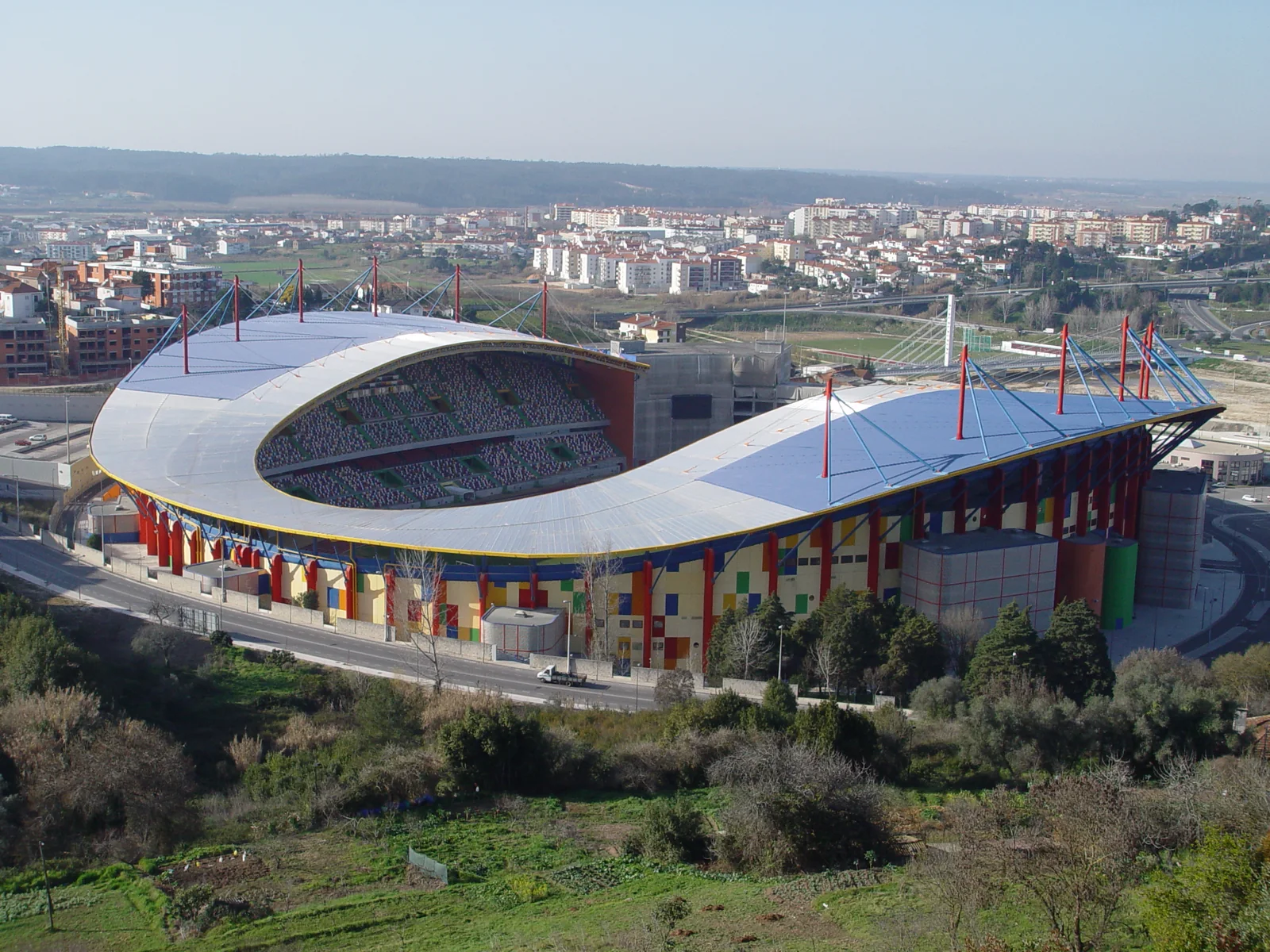
The arrangement creates a genuine split in the season. The players carry a Torres Vedras club into a larger, unfamiliar setting; supporters must turn a ground in another city into a recognisable home end four times. That distance does not erase the club's roots, but it changes the practical meaning of home advantage. Matchday routines, travel and the distribution of tickets all have to be rebuilt for Europe.
Leiria should not be presented as a substitute identity. It is a stage chosen for the UEFA campaign, while Manuel Marques remains the place that explains who Torreense are. The contrast is part of the story: a team from one of Portugal's smaller professional grounds now welcomes Sunderland, Celtic, Ararat-Armenia and Olympiacos on a European platform designed for a much bigger occasion.
What kind of team will opponents meet?
The cup-winning spine mixes age and experience
Torreense's best introduction is still the cup final, because it showed who accepted responsibility when the match became uncomfortable. Javi Vázquez supplied the corner for the early goal, Álex Alfaro carried a counterattacking threat, and captain Stopira converted the extra-time penalty at 38. Those roles point to a side that could trust senior decision-makers without being built entirely around veterans.
The current UEFA squad page preserves that mixed-age character. Stopira is joined by 34-year-old David Bruno and 33-year-old Amine Oudrhiri, while Mohamed Ali Diadié, Nuha Jatta and Adama Baradji are among the younger options. Carlos Simões is listed as coach. Experience is present, but it sits inside a group that still has to learn European football together.
Wide speed and aggressive pressure created the upset route
The Sporting final report describes an aggressive opening press, followed by organised defending and counters involving Luis Quintero and Alfaro. That sequence offers a practical blueprint for facing richer Europa League teams. Torreense did not need to dominate possession to dictate the first moment, score from a set play and stay dangerous after being pushed deeper.
That does not make one match a permanent tactical identity. Some opponents will press Torreense first; others may allow them more of the ball and demand patient construction. The transferable elements are clearer than any fixed formation: intensity at the start, disciplined distances when protecting space, direct running after turnovers and enough set-piece quality to turn limited territory into a chance.
For European opponents, the warning is that Torreense have already won an elite mismatch this way. For Torreense, the warning runs in the other direction. Eight league-phase games provide time for analysts to identify triggers and close counterattacking lanes. Surprise can open a campaign, but repeatable defensive decisions and varied possession plans are what keep it competitive.
The 2026/27 squad is an evolution, not a frozen final XI
The May winners and the September European group are not identical. Zohi, who scored after four minutes, and Quintero, one of the reported counterattacking outlets, do not appear on UEFA's current display. Meanwhile, registered forwards such as Dany Jean, Manu Pozo, Jorge Aguirre, Musa Drammeh, Karem Zoabi, Malik Abubakari, João Marques and Baradji enter this European chapter with roles still to be established.
Torreense's own registration notice also names A-list and B-list players. That breadth matters in a season split between promotion ambitions and UEFA travel, but a registered name is not proof of match fitness, minutes or depth-chart rank. Rotation will be a coaching choice, not an automatic consequence of appearing on a list.
The useful conclusion is therefore more measured than a predicted best XI. Torreense carry several decision-makers from the cup upset, have added or registered a wider group for the new season, and possess an observed method for surviving against stronger opposition. The unresolved test is whether that method can evolve as personnel, travel and domestic pressure change from week to week.
Eight Europa League fixtures create a second-season problem
The opponent list moves from Lillestrøm to Olympiacos
The first European chapter is not a short qualifying tie. UEFA's confirmed league-phase schedule gives Torreense eight different opponents across four away trips and four games in Leiria. The debut comes at Lillestrøm on 17 September; Olympiacos closes the sequence at home on 28 January 2027.
17 Sep · Away
Lillestrøm
15 Oct · Home
Sunderland
22 Oct · Away
Ferencváros
5 Nov · Home
Ararat-Armenia
26 Nov · Home
Celtic
10 Dec · Away
Real Sociedad
21 Jan · Away
Lech Poznań
28 Jan · Home
Olympiacos
The opponent names show the breadth of the jump. Torreense travel to Norway, Hungary, Spain and Poland, while teams from England, Armenia, Scotland and Greece come to Leiria. The club's own calendar announcement describes a campaign that starts in Scandinavia and finishes at home. Dates and venues were checked on 15 September 2026; readers should use the Torreense team page for later changes and results.
Success cannot be measured only by qualification
Reaching this stage already changed the club's history, but it is a poor endpoint for judging the season. A more useful test is whether Torreense remain competitive after opponents have studied them, learn between matchdays and make Leiria function like a home. Progress could appear in game management and repeatable performances even if the table does not deliver a knockout place.
The other half of the test sits in Portugal. Torreense's domestic calendar contains 34 league rounds, and the UEFA dates land inside that promotion campaign. October places Sunderland and Ferencváros around domestic matches; January schedules league fixtures on the weekends surrounding trips to Lech and the Olympiacos finale. Those domestic dates can move, but the workload problem will remain.
That is why the 2026/27 story is larger than a novelty result against a famous visitor. Carlos Simões must decide when to retain a settled side, when to use the registered squad and how to protect recovery across travel. A successful first European year will leave Torreense more capable, keep their domestic objective credible and turn the cup-final breakthrough into a platform rather than an exhausting exception.
Torreense are more than a one-match curiosity. The Sporting upset gave a 1917 club the breakthrough its earlier generations never reached, but it also created a demanding second season inside the first. Every European night must coexist with the attempt to rise from Liga Portugal 2. The lasting measure will be whether the team can learn, compete and keep that domestic route intact. Check the Torreense team page for current fixtures and results as the campaign develops.



Matchnight discussion
Ask a question or share your thoughts with other fans. Comments are reviewed before they appear. Please keep it friendly and leave out personal details.
Read our privacy policy and comment guidelines.
Loading comments…