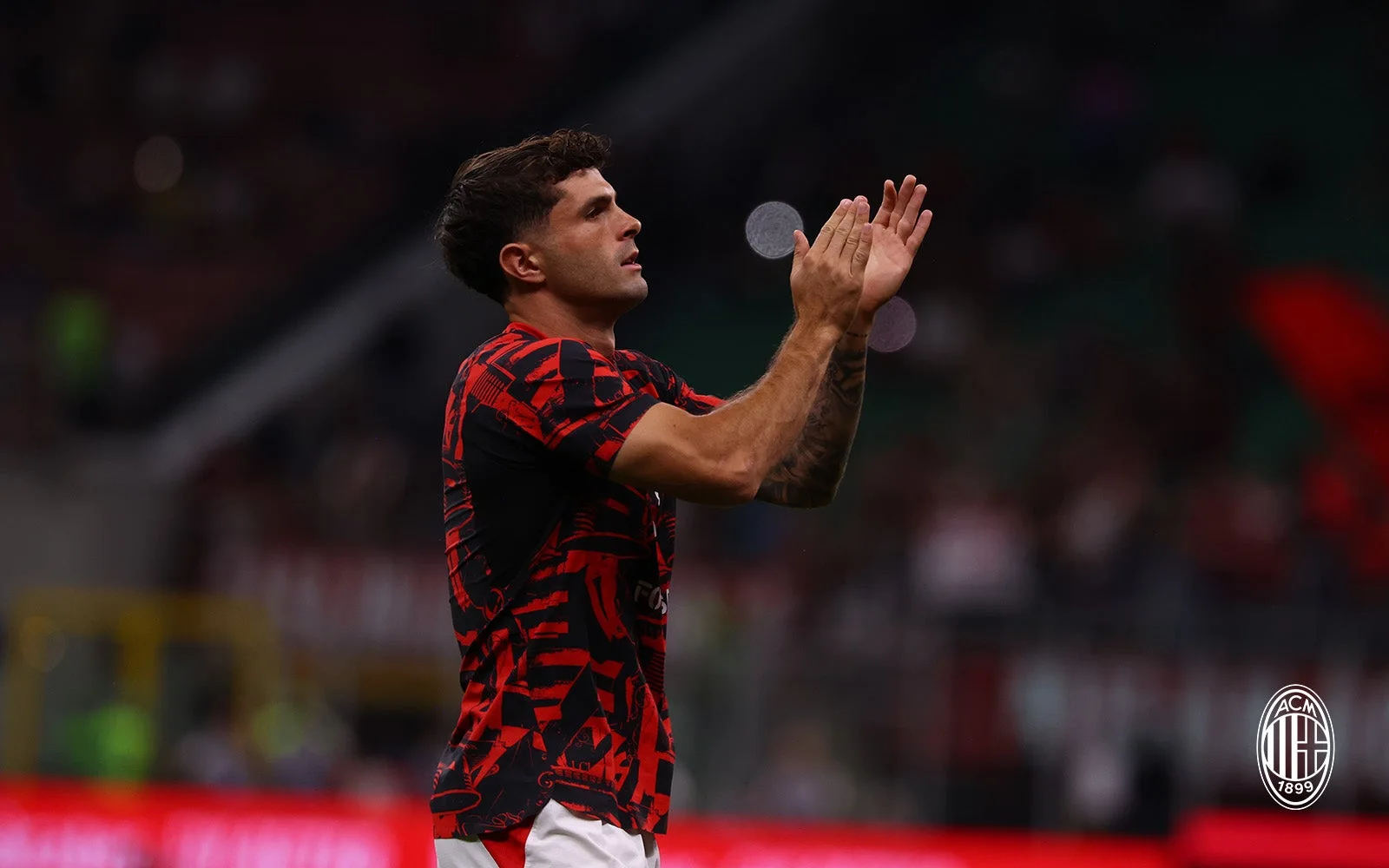
Christian Pulisic gives AC Milan two connected attacking options: receiving between the lines and running beyond the defence. His role can change with the formation and the score. Recent matches against Lecce, Sassuolo and Benfica show how those options work, while his older Europa League goals illustrate why a finishing contribution still needs to be read alongside the team's control.
Where Pulisic plays for Milan now
Christian Pulisic is an AC Milan attacker whose role can move between a wide starting position, an inside attacking position and a place behind the striker. The most useful current example is the visit to Sassuolo on 11 October 2026: Milan described him operating behind Gonçalo Ramos in a 4-4-1-1. That is a specific job in a specific match, rather than a permanent statement that he must always play as a central forward.
Milan's official biography lists him as a midfielder and confirms his arrival in 2023. Data providers can apply different position labels because they classify appearances and starting zones differently. Those labels are useful navigation aids, but the game becomes clearer when you ask where he receives, where he runs and which opponent has to follow him.
A wide attacker can begin near the touchline and still finish a move centrally. An attacking midfielder can begin behind the striker and still sprint beyond him. In the first case, the wide starting position may draw a full-back away from the centre; in the second, the striker may hold a centre-back while the next runner attacks the remaining gap. The eventual shot location does not erase the work that created the space.
For Milan, this flexibility is useful only when responsibilities fit together. If Pulisic moves inside, another player can maintain width and stretch the defensive line. If he comes towards the ball, someone else needs to threaten the space behind the defenders. Otherwise the movement can put two attackers in the same crowded area without giving the passer a new option.
That is the central question for his European role this season. He can be both a receiver and a runner, and those two actions ask different questions of a defence. Watch how the first action sets up the second rather than deciding his position from one lineup graphic. The examples below explain the distinction through reported Milan matches, with the older European games kept separate from the current campaign.
The Lecce goal: running beyond the striker
Pulisic's first league goal of 2026/27 came against Lecce on 20 September. The interesting part is the pair of chances that preceded the wider 3–0 result. Milan's official report records Ramos putting him through in the 11th minute, when Falcone saved, followed three minutes later by a chipped Pavlović pass over the defence that Pulisic controlled and finished.
A short combination and a ball over the defence
Those two openings show different ways for an attacker to reach a similar dangerous area. A striker's short pass can connect the player coming towards possession with the teammate running past him. The defence then has to decide whether to follow the receiver or hold its line. The longer delivery asks another question: can a runner reach space behind the line before the defenders turn and recover?
The common element is movement beyond the player initially responsible for occupying the centre-backs. Pulisic does not have to wait for the attack to arrive at his feet. If he always drops towards midfield, Milan may retain the ball but remove a threat behind the defence. If he always runs away from it, the passer may lack a nearby outlet. Choosing between those actions is part of his contribution, even when the final pass comes from a defender rather than a conventional creator.
Why the run needs width around it
Milan's published formation placed Pulisic and Saelemaekers behind Ramos, with Chukwueze and Estupiñan in the wider line. Our tactical reading is that this offers several different reference points for a defence. A wide player can keep a full-back occupied while an inside attacker moves across the space between that full-back and the nearest centre-back. The benefit depends on those movements being timed together; the formation number alone cannot produce it.
The sequence also avoids a common misunderstanding about ball carriers. A player can influence an attack while touching the ball only at its decisive point. Running can make a defender retreat, open a passing lane for someone else or stop an opponent stepping into midfield. Pulisic's eventual control and finish were visible outcomes of a move in which the earlier delivery mattered too.
The European implication is a conditional one. If an opponent presses Milan high, a run behind it can punish the space left behind. If the opponent stays deep, Milan may need the short combination and a second runner instead. Lecce supplies an example of attacking options, not proof that every Europa League defence will give Milan the same openings.
Playing between midfield and defence at Sassuolo
At Sassuolo, Pulisic's starting role behind Ramos offered a different reference point from the run that produced his Lecce goal. A player between the opposition's midfield and defence can receive facing a midfielder who is recovering and a centre-back who must decide whether to leave the defensive line. That position has value because it makes two lines coordinate their response.
The club's match report gives a concrete attacking example after Sassuolo equalised. Pulisic played Chukwueze through, but the winger could not beat the goalkeeper while slightly off balance. It was a route to a chance without a goal or an assist. Looking only at the scoring columns would lose that part of Pulisic's contribution.
Our reading of the role is that Milan can use the central receiver to connect a forward-facing pass with a runner coming from elsewhere. If a centre-back steps towards the receiver, another attacker can move behind him. If the defender holds his position, the receiver may have room to turn or play across the defensive line. The pass has to arrive with enough time for a choice; a player nominally between the lines can still be trapped if the ball arrives too slowly.
Dropping deeper changes the problem again. Pulisic can help connect midfield to the attack, but the team then needs someone to occupy the space he has left. Without that replacement movement, an opposing centre-back can step forward confidently, knowing that no runner threatens the gap behind him. This is why a clever movement must be judged alongside the teammate's response.
He left the game in the 78th minute, with Cisse coming on, and the match finished 1–1. The reported central role and through-pass show a creative contribution; they do not prove that Milan controlled every phase or deserved a particular final score. For fans comparing his positions, the useful difference is that he can create a chance for the next runner as well as be that runner himself.

What a European substitute can change
Pulisic's current Europa League campaign began with a second-half appearance against Benfica, not a starting role or a goal. Milan's 16 September report records his introduction for Hutchinson at half-time. He later forced Trubin into saves in the 62nd and 81st minutes. Milan still lost 2–0.
This is a useful distinction between an attacker improving the threat and a team repairing the whole performance. Pulisic supplied attempts that required a goalkeeper's response. Benfica had also extended their lead before those attempts, giving the visitors a different incentive from a team chasing an equaliser. A promising cameo should therefore be read alongside the score and the opponent's choices.
A substitute can change the relationship between a defender and a receiver. If the new attacker comes short rather than making the previous player's run, the defender may have to follow further from his line. If he immediately attacks behind, the defender may have to retreat and give Milan's passer more time. Those are different ways to move the opposition; neither requires the substitute to beat a player one against one on every possession.
The most effective change also needs the rest of the attack to respond. A teammate can run beyond a player receiving to feet, or offer a short return to a runner who has been forced wide. If the new forward receives alone and has to turn through two defenders, introducing a better individual may barely alter the team's available options. The new movement matters more when it creates a connection.
For a side behind in a European league-phase match, there is a further balance. Adding another attacker may increase the chance of reaching the box while exposing space after a turnover. A saved shot and an open counter can occur in successive moments. Benfica demonstrates why Pulisic's threat and Milan's defensive control must be assessed separately: the forward can contribute to a response without making the final result or every phase of the game favourable.
Slavia Prague and the difference between threat and control
Pulisic has already shown different finishing routes in the Europa League, but the examples belong to the 2023/24 campaign. In the first leg against Slavia Prague on 7 March 2024, he added Milan's fourth goal by making the decisive close-range touch after Leão's individual work. In the return, he received Leão's pass, moved inside and finished with his left foot. Milan's first-leg report and return-leg account describe those actions.
The first finish matters because an attack needs a player following the move into the scoring area. A winger beating his marker can create danger without making the final outcome certain. The goalkeeper might get a touch, the finish might travel across the goal, or a defender might recover. A second attacker arriving provides another chance to turn that danger into a goal.
The second finish asks a different question of a defender. The receiver can use the first touch to bring the ball inside and find a shooting angle. Closing the outside route may not be enough if the defender allows the next touch towards the centre. For Milan, those two examples show that Pulisic can threaten as an arriving finisher and as a player taking responsibility after receiving.
Read the red card and the two legs together
The match conditions place clear limits on the comparison. Slavia lost Diouf to a red card in the 26th minute of the first leg and Holeš in the 20th minute of the second. Milan won 4–2 at home and 3–1 away, a 7–3 aggregate result. These were not ninety-minute tests against eleven opponents in both games.
The first leg is especially useful as a warning against confusing a good attacking contribution with complete control. Slavia scored twice despite the numerical disadvantage. Milan could create and score while still allowing the opponent a route back into the tie. That combination supports recognising Pulisic's finishing without using his goal as proof that every team problem had been solved.
For the present campaign, the transferable idea is the variety of his attacking actions. The opponent, coach, teammates and match format are different. Milan cannot expect a historical red card or aggregate advantage to reappear. They can seek the same useful connection between an attacker creating space and another recognising when to occupy it.
Goals and assists need a defined sample
Pulisic's statistics are most informative when the competition, minutes and date are stated together. As read on 14 October 2026, FotMob's Serie A record lists three appearances, 192 minutes, one goal and one assist for 2026/27. His European appearance against Benfica belongs to a separate competition sample. Adding its minutes to a league-only denominator would distort any rate calculated from the league figures.
Current-season numbers versus a career record
For longer context, Milan's biography reports 42 club goals in 134 appearances by June 2026. It also describes 15 goals in his first Milan season and 17 in the following one. Those are club records across competitions, not totals for one Serie A season or this autumn's European fixtures. The dated June snapshot should not be relabelled as a live October total.
A small sample can change quickly. One additional finish would double a tally of one goal without establishing that the player's underlying role had transformed. A per-ninety-minute rate expresses production over a common time unit; it does not turn a handful of appearances into evidence of what will happen over a full season. Starting against a deep defence and entering a match already stretched also supply different opportunities.
The match examples explain what the columns miss. Pulisic's pass to Chukwueze at Sassuolo did not become an assist because the chance was not finished. His saved attempts against Benfica did not become goals. Those moments still help assess whether he reached useful spaces or connected with the next attacker. The distinction prevents the score sheet from becoming the whole analysis.
His earlier Chelsea chapter, including the 2021 Champions League success, shows a substantial European background. It does not determine his present selection or guarantee a return to a particular scoring rate. For a Milan supporter, the useful combination is a defined numerical sample and a clear description of how the chances arose. Either element alone can give a misleading picture.
The work before and after Milan lose the ball
An attacking role also includes choices before the opponent gets comfortable possession. When a forward approaches a defender, the angle of the approach can matter as much as its speed. Running directly at the ball may leave a simple pass into midfield; approaching while blocking that route can encourage the defender towards a more predictable wide pass. The next teammate then needs to be ready to apply pressure there.
These are practical viewing questions, not a claim that a published team sheet proves Pulisic made a particular number of successful presses. To assess his work, watch whether the opponent has to turn backwards or play into a crowded area, and whether Milan's midfield follows the forward's movement. One attacker sprinting without support can create a gap that a composed opponent exploits.
The Lecce win shows the value of separating individual contributions. Moreira won possession and raced through for the third goal, after Pulisic had already been substituted. Earlier, Estupiñan made an important clearance to preserve Milan's defensive position. Those incidents are in the official report. They belong to those teammates, while helping explain the collective setting of Pulisic's goal.
After Milan lose the ball, an inside attacker faces another decision: pressure the nearest receiver or recover towards the pass that could open the centre. The appropriate action depends on the support behind him. If a teammate can close the ball, narrowing towards an available opponent may be more valuable than adding a second unsuccessful challenge. If the receiver is isolated, immediate pressure may prevent the counter before it begins.
For the remaining European campaign, the strongest version of Pulisic's role would connect these responsibilities with his attacking variety. Milan need runs beyond the defence, a receiver between the lines and coordinated work when possession changes. As of 14 October, his next European selection is still to come. Judge each actual appearance through those connections and the recorded results, rather than expecting one player's goal tally to explain the whole team.
Matchnight discussion
Ask a question or share your thoughts with other fans. Comments are reviewed before they appear. Please keep it friendly and leave out personal details.
Read our privacy policy and comment guidelines.
Loading comments…