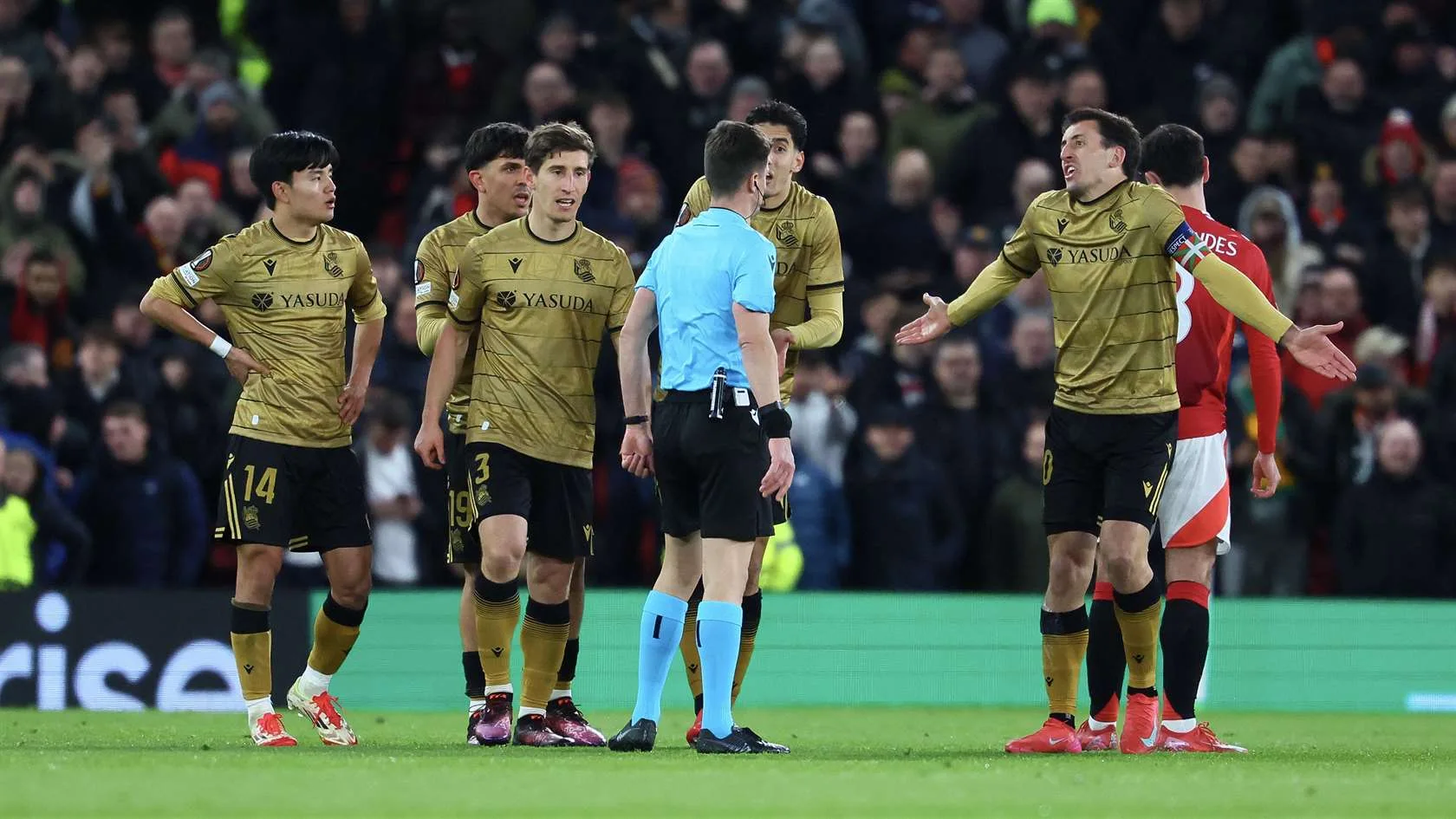
Mikel Oyarzabal is Real Sociedad's number 10 and first captain, with a role that joins attacking movement, combinations and finishing. Understanding him requires more than choosing between the labels winger and striker. His documented club and Spain examples show how coming towards the ball, continuing into the box and supporting pressure can belong to the same forward's game.
Oyarzabal's club and position in 2026
Mikel Oyarzabal plays for Real Sociedad, wears number 10 and is the club's first captain for 2026/27. He is a left-footed attacker who can connect play and arrive in the penalty area. His official club profile gives his height as 1.81 metres and identifies his birthplace as Eibar. Those are the straightforward answers to the club and profile searches.
The position needs more explanation. The club profile uses a midfielder label and describes linking play, defensive contributions and arriving in the box. A forward's actual job can include all those actions. Being listed under one broad heading does not mean that he spends every match in a conventional central-midfield position, and wearing number 10 does not automatically make someone the team's attacking midfielder.
For fans, the useful distinction is between the starting position and the movement after the ball travels. A player starting wide may become the central finisher. A player starting centrally may come towards midfield to release a winger. The opponent then has to decide who follows him and who protects the space that opens. Those interactions explain the role more accurately than a single word on a profile page.
The captaincy adds continuity to that football role. The August 2026 captaincy announcement reported by AS places him first in the group. It confirms a responsibility within the team; it does not guarantee that he will start every match or reveal the private instructions he gives teammates.
The European question is therefore what the team can do around his movement. Who provides width when he moves inside? Who runs beyond when he comes short? Who supports the first pressure when Real Sociedad lose possession? Answering those questions keeps a player feature tied to football rather than turning it into a list of personal details or unconfirmed transfer destinations.
Why a central forward can still play like a winger
A central starting position does not remove the skills of an attacker used to combining from wide areas. Oyarzabal can still come towards the ball, link a pass and move into the next space. The important question is how that movement relates to the other attackers. If all three move towards possession together, the defence can step forward without worrying about a runner behind it.
Coming towards the ball
A forward coming short can give midfield a target beyond the opponent's first pressure. If a centre-back follows him, that defender leaves space that a winger or midfielder can attack. If the centre-back stays, the forward may receive with room to turn. The move therefore asks a defensive question even before the receiver decides which pass to make.
The useful next action depends on the pressure. A quick lay-off can release the teammate facing forwards; holding the ball can give a runner time to arrive. Keeping it too long can allow the opponent to close both routes. These are viewing criteria for Oyarzabal's role, rather than a claim that one identical sequence happens every time he drops towards midfield.
The team also needs someone to keep the defensive line occupied. A midfielder making a late run can do that while a winger maintains width. Without the complementary movement, dropping short may simply put another Real Sociedad player in the already crowded area near the ball. The movement's value comes from the new option it creates.
Arriving beyond the defender
The opposite action is to attack behind the marker or arrive across him near goal. Here the passer needs an early signal and a delivery the runner can reach. Waiting until the forward is completely free may be too late, because the defensive line has already turned to recover. The runner and passer have to recognise the same opportunity.
UEFA's March 2025 analysis against United provides a teammate example: substitute Óskarsson threatened from an early Becker cross and by moving ahead of his marker. Those actions belong to Óskarsson, not Oyarzabal. They demonstrate why Real Sociedad can seek different forward movements within one match.
For Oyarzabal, the broad test is whether coming short and going beyond remain connected. A defender who expects only a short pass can follow more aggressively; one who expects only a run can retreat early. Varying the action gives the team a better chance of finding space, provided the other attackers preserve the necessary width and support.
The Euro 2024 winner explains his movement
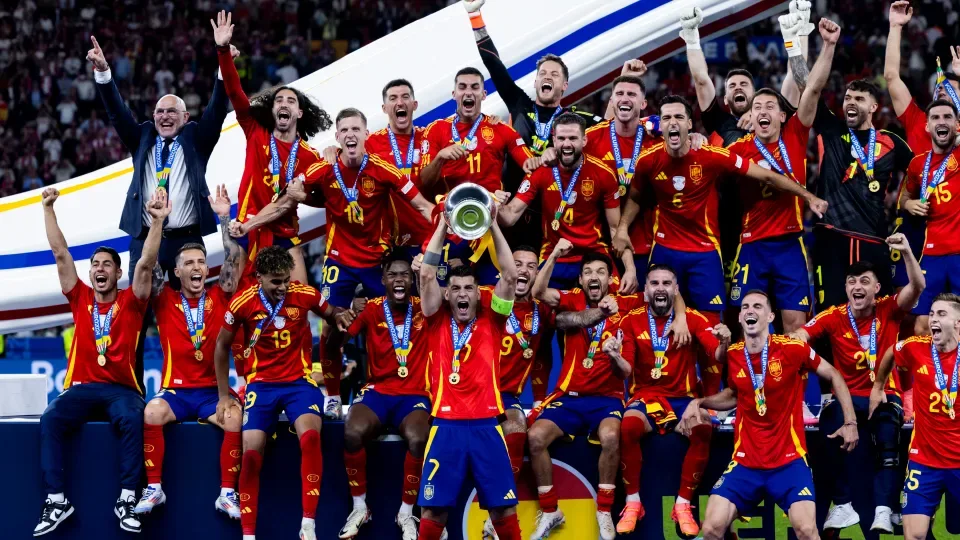
The winning goal against England in the Euro 2024 final is a clear example of Oyarzabal's movement. He replaced Morata in the 68th minute and met Cucurella's delivery for the 86th-minute winner, according to UEFA's final report. Spain won 2–1. This is a national-team example from July 2024, rather than a Europa League match or evidence of Real Sociedad's current lineup.
The Spanish federation's account describes Oyarzabal finding Cucurella on the left before taking advantage of the return delivery. That is the key connection: he helped move the ball wide and continued into the area where the next pass could become a finish. Stopping after the first pass would have removed the receiver for the final action.
Our interpretation is that the goal explains the value of a forward who participates and then arrives. Passing does not have to mean withdrawing from the scoring area. The first involvement can change the defenders' attention, while the next movement brings the attacker back towards goal from a different angle. The move needs a teammate who recognises the return option as well as a runner who follows it.
A close-range finish can look simple when isolated from the preceding play. In a match, the attacker has to arrive at the same time as the ball without becoming an obvious stationary target. The delivery also has to avoid the goalkeeper and reach a space the defender cannot comfortably cover. Those conditions make the movement and pass part of the goal's explanation, rather than treating the final touch as the entire skill.
The lesson for watching Oyarzabal at club level is a question, not a promise. Does he continue into a useful space after linking with a wide teammate, or remain too far away to join the finish? Real Sociedad have different teammates and face different opponents. The final supplies a documented example of his attacking possibilities, while leaving the current team's execution to be assessed on its own evidence.
Penalties and open-play goals tell different stories
Two important Oyarzabal goals illustrate why a scoring total needs context. His penalty against United levelled the first leg of the 2025 Europa League round of 16. His penalty against Athletic decided the delayed 2019/20 Copa del Rey final, played on 3 April 2021. The federation's final report records the 58th-minute goal in a 1–0 win. The season attached to the cup and the date of the match are different.
A penalty goal has the same value on the scoreboard as an open-play goal. Its route is different: the taker begins from a fixed location with a direct contest against the goalkeeper. The Euro 2024 winner involved a pass wide, continued movement and a delivery to finish. Recognising that distinction helps explain what part of an attack the forward supplied.
It also prevents a false conclusion about chance creation. A penalty conversion shows execution of that particular opportunity; it does not prove that the team repeatedly opened the defence through its passing. The player who earned the penalty and the player who converted it can be different. Without checking the original incident, a profile should not automatically award the scorer credit for both actions.
For a supporter comparing periods of form, ask whether a rise in goals came with more open-play chances, more penalty attempts or simply better finishing of a similar sample. Those possibilities suggest different things about the role. A forward can contribute intelligently while waiting for a goal, and a converted penalty can decide a difficult match in which the team created little else.
The same care applies to success rates. A percentage needs the number of attempts and the period being measured. It should also separate penalties during matches from shootout kicks, which do not enter normal match-goal totals. Oyarzabal's important conversions deserve recognition on their actual merits. They should not be used to invent a universal accuracy figure or to replace an assessment of his work away from the spot.
Real Sociedad against United: the European context
The 2024/25 United tie gives a more demanding European context than a list of Oyarzabal goals. Real Sociedad drew the home leg 1–1, with his 70th-minute penalty bringing them level. UEFA's technical observer assessment described United finding runners behind La Real's high line and the home team's stronger pressure after the equaliser.
That creates a real tradeoff for an attacking captain. A forward can help start pressure and make the opposition uncomfortable, but the defenders behind that pressure need protection. If an opponent escapes the first challenge, a high line can turn a passing success into an immediate run towards goal. The attacking intention and the defensive consequence belong in the same assessment.
An equaliser did not settle the tie
Oyarzabal scored another penalty early in the return at Old Trafford, but Real Sociedad lost 4–1 and went out 5–2 on aggregate. The club's return-leg report confirms his goal and the final score. It also records Aramburu's dismissal. The club strongly contested refereeing decisions; those complaints are the club's position, not a neutral finding that the decisions were incorrect.
The score explains why one successful attacking action cannot define a European tie. Converting an early penalty gave Real Sociedad an advantage, but the team still had to defend the next attack, build another possession and react when the game changed. Playing with ten men altered the spaces each remaining player had to cover. A forward's contribution should be recognised without making him responsible for every later event.
The first leg also left a different decision from a single league-phase fixture. A draw at home kept a two-legged tie open; it did not award a place in the next round. Current league-phase points are accumulated against different opponents, so treating an autumn draw as a preserved aggregate position would misunderstand the format.
The historical lesson is therefore about connecting phases and keeping the score's context. Oyarzabal supplied important goals while the collective task remained unresolved. For his present European role, ask whether his movement helps Real Sociedad progress and whether the pressure around him remains organised enough to prevent the opponent exploiting the space behind it.
The captain's role in pressure and recovery
Captaincy should be connected to observable responsibilities rather than imagined dressing-room speeches. For an attacking player, one practical responsibility is making his movement understandable to the teammates following him. A forward beginning pressure can give the team a reference: where the next pass is likely to go and when the midfield should step towards it.
Oyarzabal's first-captain status establishes his place in the group's leadership. It does not make every unsuccessful press his personal error or prove that he controls the coach's instructions. The football question remains collective: whether the first action is supported closely enough to influence the opponent's next choice.
The first pressure needs a second player
A forward can approach the ball while restricting the pass into central midfield. If the defender then goes wide, another player must close that receiver. If the second player remains too far away, the first forward's effort can be bypassed with a simple sequence of passes. Moving together is what turns an individual chase into a team attempt to recover possession.
UEFA's March 2025 analysis of the United draw highlights another consequence. Pressure encouraged longer goalkeeper deliveries, after which the contest moved to first and second balls. Forcing a long pass therefore did not automatically mean Real Sociedad had won possession. The team still had to compete for the next contact and move the recovered ball away from pressure.
For Oyarzabal's role, that creates a useful second task after the initial press. He can offer an available receiver when a teammate recovers possession, or occupy a defender so that another attacker has space. A recovery followed immediately by another crowded pass may simply restart the duel. Finding a teammate facing forwards gives the team a better chance to turn effort into an attack.
These are lessons from a historical team performance and general mechanisms to watch now. Real Sociedad's present selection and instructions must be assessed through current games. The strongest captain's contribution would make both the attacking movement and the recovery movement easier for teammates to support, while preserving enough cover if the opponent escapes.
What to watch in this Europa League campaign
The current campaign already provides an example of the questions around Oyarzabal. Real Sociedad lost their opener 2–1 to Bournemouth on 17 September 2026. The club report records two first-half goals conceded, a second-half Sergio Gómez goal and a Guedes–Oyarzabal counter-attack combination that created an opening without a finish.
That combination is more useful for understanding the attacker than simply observing that he did not score. It connects two players in a forward move, while leaving a question about the final action. Could the receiver release the ball earlier? Was there support for another pass? Did the runner arrive with a usable angle? The report establishes the chance, but a detailed answer about every touch would need more evidence than a scoring summary.
Oyarzabal was replaced by Sučić in the 74th minute. Real Sociedad continued to create opportunities, including Óskarsson chances. Those later actions belong to the players involved; they should not be folded into a personal performance account for someone already off the pitch. They also show why a team can improve its threat without changing the final outcome.
As of 14 October, trips to Union SG on 15 October and Lillestrøm on 22 October remain future fixtures, confirmed in UEFA's schedule. His starting role and minutes in them are not confirmed by a September lineup. The opponent's approach and Real Sociedad's available players will affect which movement is most useful.
Watch three connected things in each actual appearance: whether he offers a receiver beyond midfield, whether another attacker runs when he comes short, and whether the team remains compact when its first pressure fails. Those observations bring his club and national examples into a sensible present-day evaluation. The goals matter, but the role is broader: making an attack easier to connect while helping the team manage what happens when that attack ends. Keep the results and individual match context alongside any description of form.

Matchnight discussion
Ask a question or share your thoughts with other fans. Comments are reviewed before they appear. Please keep it friendly and leave out personal details.
Read our privacy policy and comment guidelines.
Loading comments…