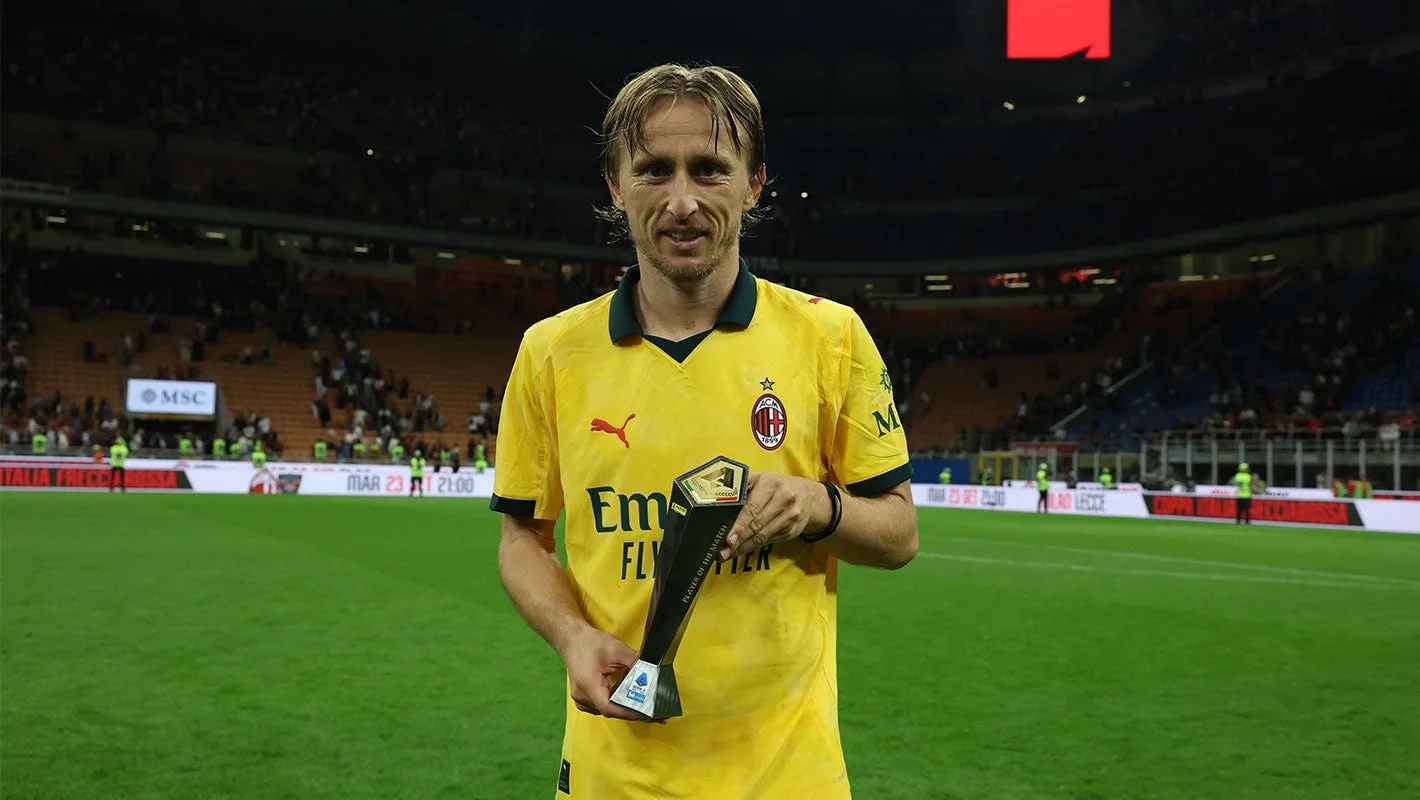
Luka Modrić plays for AC Milan in 2026/27, with a contract until 30 June 2027 and the number 14 shirt. His value is best understood through the next pass, the movement around him and the defensive space Milan leave behind. His recent Serie A appearances, earlier Milan match examples and European selection record show why those details matter more than treating a famous career as a guarantee.
Why Modrić is still an AC Milan player in 2026/27
Luka Modrić remains an AC Milan midfielder for 2026/27, wearing number 14. Milan's 23 July 2026 announcement confirmed a contract until 30 June 2027. That is the current answer to the question about his club; the original transfer announcement belongs to the previous summer.
There are two dates to keep separate. Milan announced his arrival on 14 July 2025, initially for one season with an option for another. The later statement confirmed the additional season. An old article describing an option therefore tells only part of the story. Equally, a contract running until June 2027 does not establish a retirement date. It establishes the period of an agreement, rather than what the player will do for the rest of his life.
The extension gives Milan continuity in a position where understanding the next receiver matters. A midfielder can learn which defender wants the ball returned, which forward moves towards it and which teammate runs beyond that forward. Those connections can help a team move through pressure without requiring every possession to become an individual dribble. They still have to work against the opponent on the night: reputation cannot make a passing lane stay open.
Milan reported 37 appearances and two goals in his first season with the club. Those are useful club milestones, but they are not a measure of his current Europa League scoring record. For a player who operates before the final pass, the revealing question is often whether the attack reaches a useful position at all. Goals and assists describe important outcomes; they leave much of the preparation uncounted.
That is the right starting point for watching him at 41. Judge the location and timing of his involvement, the options that appear after he receives, and the protection his team retains when a pass fails. The signing is confirmed. His influence in any particular game must be demonstrated by what happens on the pitch.
How his midfield role creates the next pass
The useful description of Modrić is a midfielder who can connect possession to the next useful action. That includes passing from deep, supporting a teammate under pressure and arriving further forward when a combination opens. It does not require him to occupy exactly the same square in every system. The opposition's midfield line, Milan's available runners and the score can all change where the useful space lies.
Receiving below the press
A deep receiver gives the centre-backs a choice between playing into midfield and playing around it. The critical detail is his angle. If he stands directly behind the opposing forward, the passing lane disappears even though the two Milan players look close on television. Moving a few yards sideways can separate the defender watching the ball from the midfielder trying to mark the receiver.
After receiving, a return pass can be productive when it makes the opponent step forward. The next defender may then have time to find an attacker behind that first line. A sideways pass is therefore neither automatically timid nor automatically intelligent: ask what it changed. If every opponent remains comfortable and the next player receives under the same pressure, the team has preserved the ball without improving the attack.
A concrete historical counterweight to the idea of a purely decorative passer is Milan's Bologna assessment from September 2025. The club recorded 37 completed passes from 44 attempts and four tackles won in a 1–0 victory. That one match combined circulation and recovery; it does not establish a season-long ranking or describe the current coach's instructions.
Changing the point of attack
The longer pass matters when the opponent has crowded one side. Switching towards an unmarked teammate can make the defending winger run back towards his own goal and give the receiving player a moment to choose a cross, carry or short combination. The pass is only useful if the receiver can control it before that advantage closes. Length alone does not make it a good ball.
There is also a shorter route through a compact defence. In Milan's February 2026 win at Pisa, the club described Ricci's lay-off and Modrić's lifted winning finish. The midfielder became the next runner rather than staying behind the move. Our interpretation is that this is why the label of deep playmaker should describe his starting responsibility, not prohibit him from exploiting space near goal. The combination also needed another player to provide the return ball.
What the Sassuolo assist actually tells us
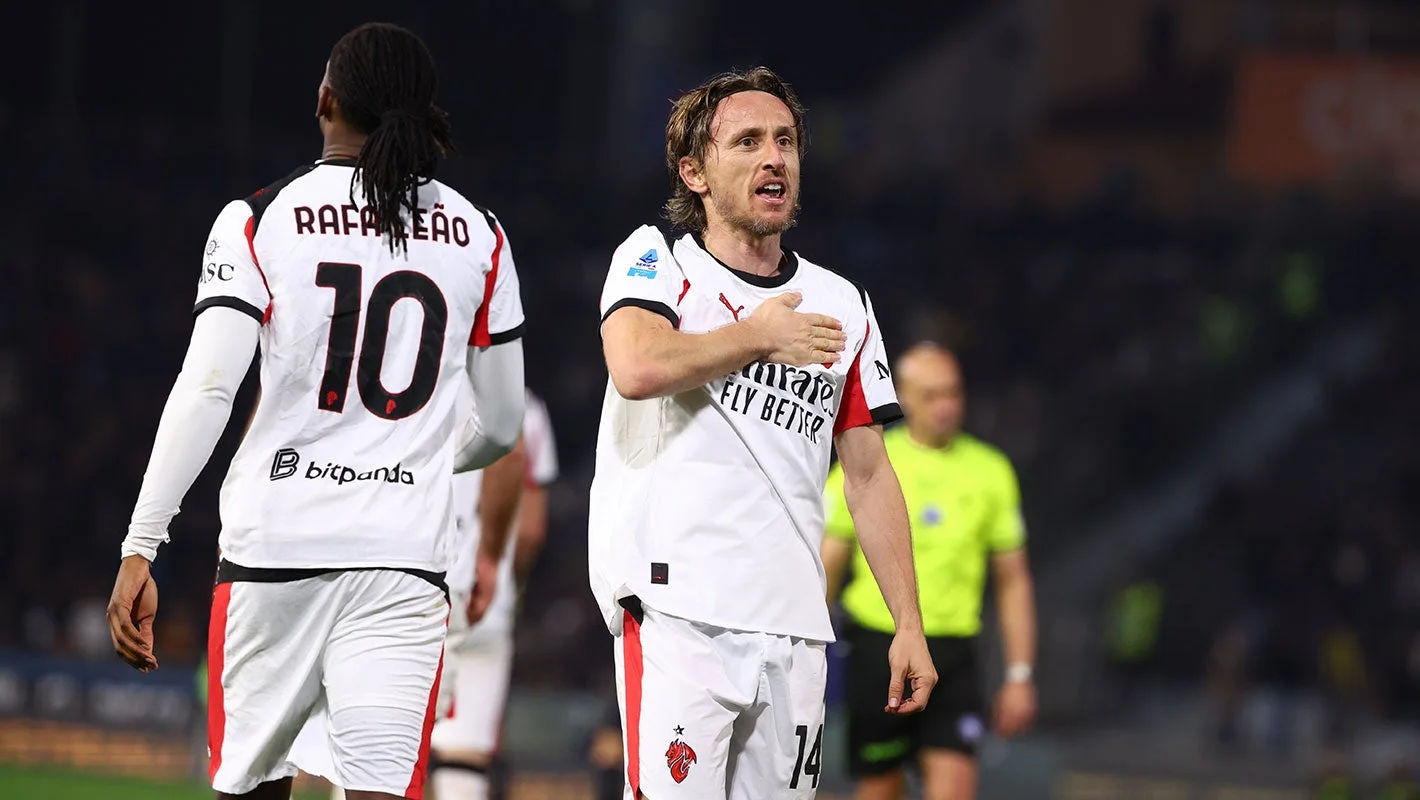
The 1–1 draw at Sassuolo on 11 October 2026 gives a useful recent example of both Modrić's contribution and the limits of judging a match through one player. FotMob credits him with an assist during his 45 minutes. That is a recorded attacking outcome in Serie A, rather than an assist from a European fixture or a career total.
Milan's own account places his entrance at half-time, replacing the booked Estupiñan. Rabiot scored in the 63rd minute, before Odenthal equalised five minutes later. The account also describes chances before the interval. Milan's attacking improvement therefore cannot all be attributed to a substitution made after those chances had already occurred.
For the viewer, an assist is the beginning of the interesting question. Did the receiver have a clear route to goal, or did his own action transform a difficult position? Did the provider draw a defender away, or simply find someone already free? Those alternatives attach different meanings to the same event in a statistics column. The club narrative does not explain every detail of Modrić's delivery, so it would be wrong to manufacture a particular pass shape from the assist credit alone.
The change also illustrates why a substitution list should not be read as a literal positional diagram. Replacing a left-sided defender does not by itself show that Modrić spent the half playing left-back. Other players can move when a substitute enters. To understand the new arrangement, look at where the defenders stand during settled possession and who stays behind the attacking midfielders, rather than following only the name that disappears from the team sheet.
Finally, creating a goal and controlling a game are related but different achievements. Milan still surrendered their lead. The more balanced assessment is that Modrić contributed to a positive attacking moment inside a contest that remained unstable. Keeping both parts of that picture makes his performance easier to understand than either celebrating the assist as a complete solution or dismissing it because the team drew.
The defensive work around a veteran playmaker
Milan cannot assess their midfield simply by asking which player can pass most accurately. A pass can be completed while leaving the receiver surrounded, and an attack can look threatening while leaving the centre empty behind it. The defending that follows a lost ball depends on the positions of several players, not only the reputation of the midfielder nearest the turnover.
The September visit to Lazio illustrates the selection problem. Milan's official starting line-up placed Modrić and Rabiot in the central pair of a 3-4-2-1. After the draw, Amorim explained that a game of repeated runs backwards and forwards did not suit Modrić, as reported in Sky Sport's post-match interview coverage. This is a specific explanation of that match, rather than a declaration that he cannot defend.
Protecting the space behind the ball
With two central midfielders, the movement of one affects the other. If the partner runs beyond the forwards, the remaining player may have to cover the passing lane to an opposing striker while also approaching the ball. He cannot occupy both spaces simultaneously. A defender stepping forward or a wide player narrowing in can share the job; without that support, even a correctly positioned midfielder can face an impossible choice.
The same principle works in attack. A runner can give Modrić a progressive option, but a supporting player should remain available if the pass is blocked. That second position is valuable twice: it offers a safe return while Milan have possession and reduces the space for an immediate counter when they lose it. Keeping everyone behind the ball would remove the attacking threat; sending everyone forward would remove the recovery structure.
Benfica's opening-round victory exposed problems with a carrier and a delivery into the box. Those are distinct defensive tasks. Modrić did not play that night, so blaming him would be inaccurate; assuming his return alone would solve them would be equally weak. The practical test is whether Milan can involve his passing without asking one midfielder to chase every loose ball across an open pitch.
Career milestones without misleading career totals
Modrić's career explains why his Milan performances attract attention beyond Italy. The milestones also need clean boundaries. A club appearance total is different from a national-team total, and a team trophy is different from an individual award. Combining figures from biographies updated at different dates can produce an impressive-looking number that does not describe any consistent sample.
From Tottenham to six European titles
His move to Tottenham came in 2008, followed by Real Madrid in 2012 and Milan in 2025. Madrid's completed club record lists 597 appearances, 43 goals and 28 trophies during 2012–2025, including six European Cups. Those numbers belong to the Madrid chapter; they should not be presented as his complete professional or international totals.
The most relevant connection to Milan is the variety of situations a long midfield career entails. A player can have to receive while his team is being pressed, support an attack against a deep block and help protect a lead late in a tie. Experience can improve the speed of recognising the problem. It cannot guarantee that the next opponent will allow the same solution or that teammates will make the required run.
That is why the European medals provide context for a role, rather than a forecast of another medal. Milan need his choices to fit their current structure. Asking him to recreate an entire former team would ignore the different defenders, midfield partners and attackers around him. The transferable skill is making a good next decision under pressure, not reproducing the past by reputation.
Croatia and the 2018 turning point
With Croatia, 2018 supplied a different sort of landmark. The team reached the World Cup final, and Modrić received the tournament's Golden Ball, as recorded by FIFA after the final. He also won The Best FIFA Men's Player award that year. These are recognitions of performances in their own period, not a measure of his present physical capacity.
For someone searching for his total career goals and assists, the responsible approach is to specify club or country, competitions and cutoff date before adding anything. The tactical question is more rewarding here: which part of that accumulated experience helps Milan create or defend the next phase? That keeps the career story connected to the football instead of allowing a trophy list to replace an assessment.
Why age and minutes matter in a European week
Modrić was born on 9 September 1985, making him 41 during this season's autumn European programme. Age is relevant because a midfield job can contain very different kinds of exertion. Receiving with time and support is not the same task as repeatedly recovering towards goal after a teammate loses possession. Both can occur in a single half, which is why the match structure matters alongside the player's birthday.
His recent domestic use shows that minutes are being distributed in different ways. He started the 3–0 win over Lecce and was replaced by Musah after 76 minutes, according to Milan's match details. At Sassuolo he came on after the interval. These are actual selection decisions in particular games, not evidence of an announced rule that he can play only a certain number of minutes each week.
A substitute's role can be different from a starter's. If an opponent has spent an hour pressing, its first line may arrive less quickly at the next receiver. A technically secure midfielder could then help his team hold possession, move the opponent sideways and prevent another immediate defensive spell. Against a side that has retreated to protect a lead, however, the problem changes: the team needs forward movement to accompany the passing, not simply a larger number of touches.
Starting him can offer another benefit, allowing Milan to establish connections before the match becomes frantic. The tradeoff is deciding who provides the running around him and how the team responds if the opponent breaks that initial control. Neither a start nor a bench appearance is inherently the superior use. The appropriate choice depends on the players available, the opponent's behaviour and the state of the game.
Fans should also avoid turning every substitution into a medical conclusion. A team sheet and a match report can confirm participation; they cannot reveal private recovery data. The sound assessment asks whether his minutes served a clear football purpose. An effective half can be more valuable than an exhausted full match, while an early withdrawal can expose a structural problem that goes beyond one veteran.
How to judge his Europa League contribution
For the current European campaign, begin with participation rather than assumptions. Modrić was listed among the substitutes in the official opening selection. FotMob's appearance record confirms he did not play. Domestic appearances and six Madrid European titles cannot be converted into minutes he did not play.
As of 14 October, the next European test is the visit to Salzburg on 15 October. His selection and role remain questions for that game. UEFA's 2026/27 calendar also places another league-phase round on 22 October. That creates a decision about how to distribute players across a busy period; it does not establish that any particular coach will rotate.
When he plays, watch the two actions after his first touch. Can Milan find a player beyond the opponent's midfield, or does the next receiver immediately have to return the ball? Can a forward turn towards goal, or is he forced to protect possession with his back to it? Those details distinguish useful progression from a sequence that looks tidy without changing the defending team's problem.
Then watch what happens if the move stops. If Milan recover the clearance and build again, the supporting positions have helped sustain pressure. If one intercepted pass releases an opponent directly towards the centre-backs, the team may have attacked with too little cover. Modrić's quality can contribute to solving the first problem; it cannot automatically solve the second when the surrounding distances are wrong.
The most convincing European contribution would join those phases: secure receiving, a useful forward option and a team still able to defend the next ball. Follow completed games through the results and the campaign through the league-phase table, while keeping individual minutes separate from team points. Milan have retained an exceptional career's experience. What matters now is how that experience helps this team play its next match.
Matchnight discussion
Ask a question or share your thoughts with other fans. Comments are reviewed before they appear. Please keep it friendly and leave out personal details.
Read our privacy policy and comment guidelines.
Loading comments…