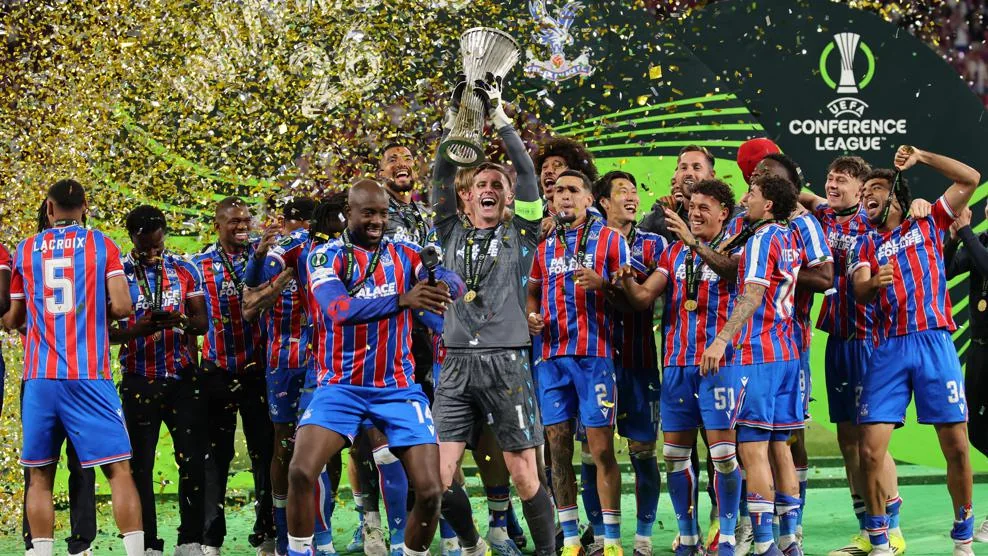
Roma, West Ham, Olympiacos, Chelsea and Crystal Palace are the first five UEFA Conference League champions. Each club has won once, so there is no repeat champion through the completed 2025/26 season. Crystal Palace are the current titleholders after beating Rayo Vallecano 1-0 in the 2026 final.
This guide uses season labels in the winners table. A final played in May 2026 completes the 2025/26 edition, just as Roma's May 2022 victory belongs to 2021/22. Keeping both labels visible prevents a calendar-year search from being mistaken for a separate tournament.
Start with the complete list for champions, runners-up, scores, venues and coaches. The sections that follow explain the decisive moments, early club and country records, what the title changes for the next season, and why the history begins in 2021 rather than 2000.
Every UEFA Conference League winner at a glance
Five editions had been completed by September 2026, and each produced a different champion. Roma were the inaugural winners, followed by West Ham, Olympiacos, Chelsea and Crystal Palace. The full UEFA Conference League winners list is below; it uses season labels in the first column and the calendar year of each final in the second so that searches for either format lead to the same answer.
| Season | Final year | Champion | Runner-up | Result | Final city |
|---|---|---|---|---|---|
| 2021/22 | 2022 | Roma | Feyenoord | 1-0 | Tirana |
| 2022/23 | 2023 | West Ham | Fiorentina | 2-1 | Prague |
| 2023/24 | 2024 | Olympiacos | Fiorentina | 1-0 aet | Athens |
| 2024/25 | 2025 | Chelsea | Real Betis | 4-1 | Wrocław |
| 2025/26 | 2026 | Crystal Palace | Rayo Vallecano | 1-0 | Leipzig |
How to read the list: a European club season spans two calendar years. Crystal Palace are therefore both the 2025/26 champions and the winners of the 2026 final. The same convention applies to every row. In the result column, aet means “after extra time”; Olympiacos scored in the 116th minute rather than winning a shoot-out. A scorer marked with p in UEFA's match record scored from a penalty, which is also different from a post-match shoot-out.
The pattern is unusually clean because the competition is young: five finals, five champions and no repeat winner. The scores also show why a plain list needs a little context. Four finals were decided by one goal, while Chelsea's 4-1 win is the only multi-goal margin so far. Those facts describe the first five editions; they are not a forecast for the next final. The official UEFA winners archive is the controlling source for new rows after future finals.
Roma and West Ham created two different winning templates
The first two champions both won by a single goal, but the games did not ask them to solve the same problem. Roma scored before half-time and protected the lead against growing pressure. West Ham traded second-half goals with Fiorentina, then found the competition's defining late break. Looking at those mechanisms is more useful than treating both scorelines as interchangeable 1-goal victories.
Roma, 2021/22: the first name on the trophy
Nicolò Zaniolo supplied the inaugural final's only goal in Tirana. In the 32nd minute, he controlled Gianluca Mancini's delivery and lifted his finish over Justin Bijlow. Roma did not then cruise through an uneventful hour. UEFA's report records Mancini diverting the ball against his own post after the interval and Rui Patrício pushing Tyrell Malacia's long-range attempt onto the woodwork.
That sequence explains the shape of Roma's win. As Feyenoord committed players forward, Roma became compact and defended deeper. Chris Smalling, later named Player of the Match by UEFA's technical observers, repeatedly interrupted the pressure in front of Patrício. Roma's possession was not the story; taking a first-half chance and defending the resulting game state was.
The 1-0 win carried two pieces of history. Roma claimed their first major UEFA club competition title, and an Italian club lifted a UEFA club trophy for the first time since Inter's 2009/10 Champions League victory. More fundamentally for this list, Roma established the beginning of the lineage: every later winner follows the name recorded in Tirana.
West Ham, 2022/23: an unbeaten run finished at the death
The Prague final remained scoreless until a handball allowed Saïd Benrahma to convert a 62nd-minute penalty. Fiorentina responded almost immediately: Giacomo Bonaventura controlled Nicolás González's knock-down and drove an angled finish past Alphonse Areola in the 67th minute. That five-minute exchange reset the contest rather than settling it.
The decisive moment came as extra time appeared likely. Lucas Paquetá threaded a pass through Fiorentina's defence, Jarrod Bowen accelerated into the open channel and finished in the 90th minute. UEFA's observer panel described Bowen as West Ham's outlet on counterattacks even when his side was not on top. The label matters: the winner was not a random clearance but the final execution of a route West Ham had kept available.
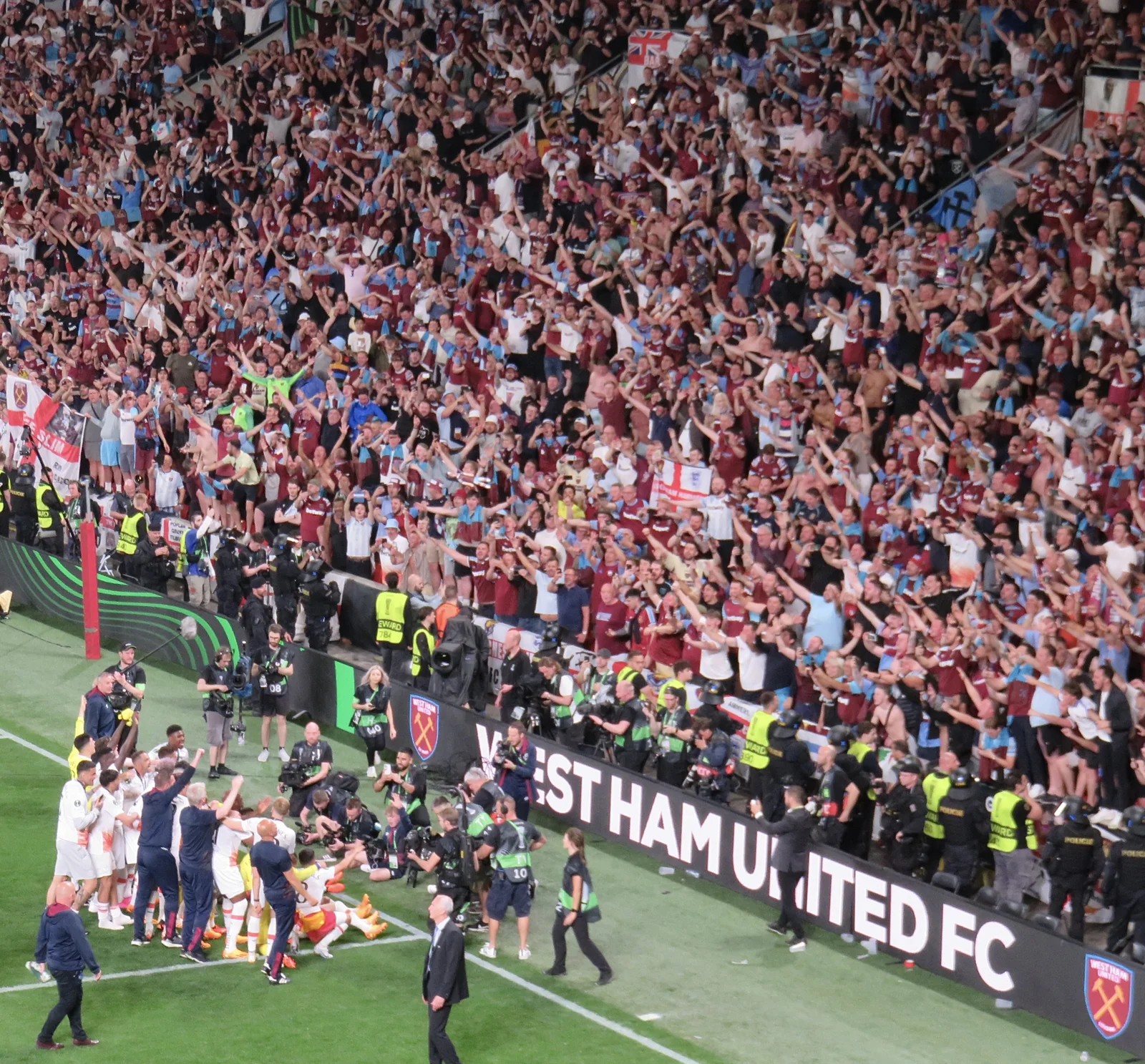
West Ham completed the whole campaign, qualifiers included, with 14 wins and one draw. “Unbeaten” is the accurate description; “perfect” would erase that draw. Their first major continental trophy since the 1964/65 European Cup Winners' Cup therefore came from sustained consistency and a final-minute transition. Roma's version of control had been defensive preservation after an early breakthrough. West Ham's was patience without the ball until the decisive lane opened.
Olympiacos and Chelsea expanded what a UECL title could mean
The third and fourth finals widened the competition's historical range in opposite ways. Olympiacos delivered a national first in a match decided almost at the end of extra time. Chelsea arrived with a long UEFA honours list, fell behind, then used a forceful second half to complete a set no other men's club had assembled.
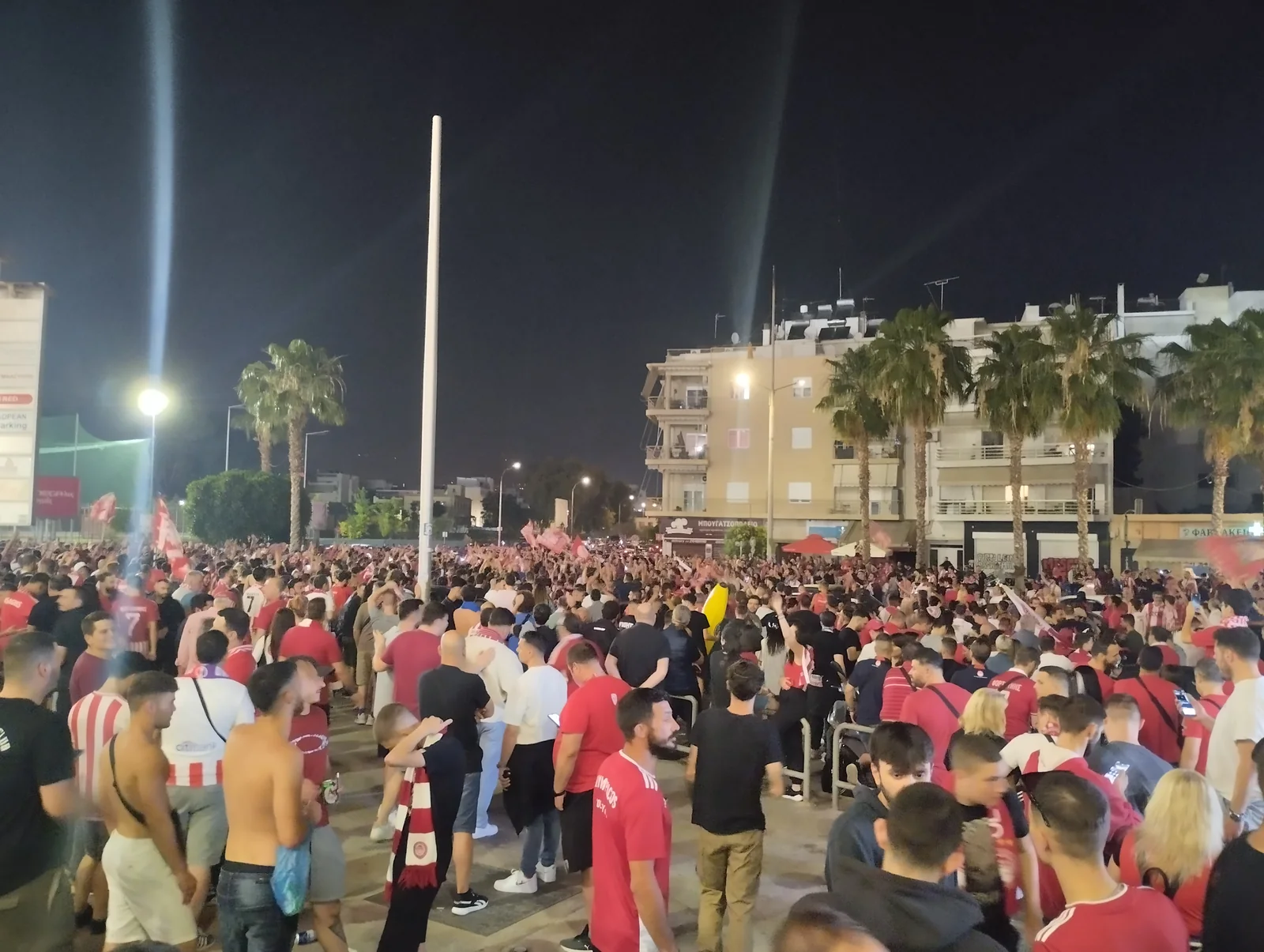
Olympiacos, 2023/24: extra time and a Greek first
Fiorentina and Olympiacos remained scoreless for 115 minutes at AEK Arena. The decisive action began after an initial cross was cleared and Olympiacos quickly recovered possession. Ayoub El Kaabi escaped his marker, attacked Santiago Hezze's next delivery and headed in the 116th-minute winner. It was a small separation created at the moment Fiorentina's line was moving out, not simply an aimless late ball.
UEFA's analysis gives the move useful campaign context. Olympiacos scored 19 goals after transferring into the Conference League from the Europa League, and eight of those goals originated from crosses. That is a deliberately narrow statistic—it covers that phase of their European season, not every Olympiacos goal in all competitions—but it shows that the final winner came through a familiar route.
The clean sheet mattered just as much. UEFA's observers highlighted communication in wide defensive situations, pressure on the ball, energetic tracking and a compact block. Olympiacos did not need to be described as dominant to be deserving champions. They kept the contest alive, made one late crossing sequence count and became the first Greek club to win a major UEFA club competition.
Chelsea, 2024/25: a comeback completed the UEFA set
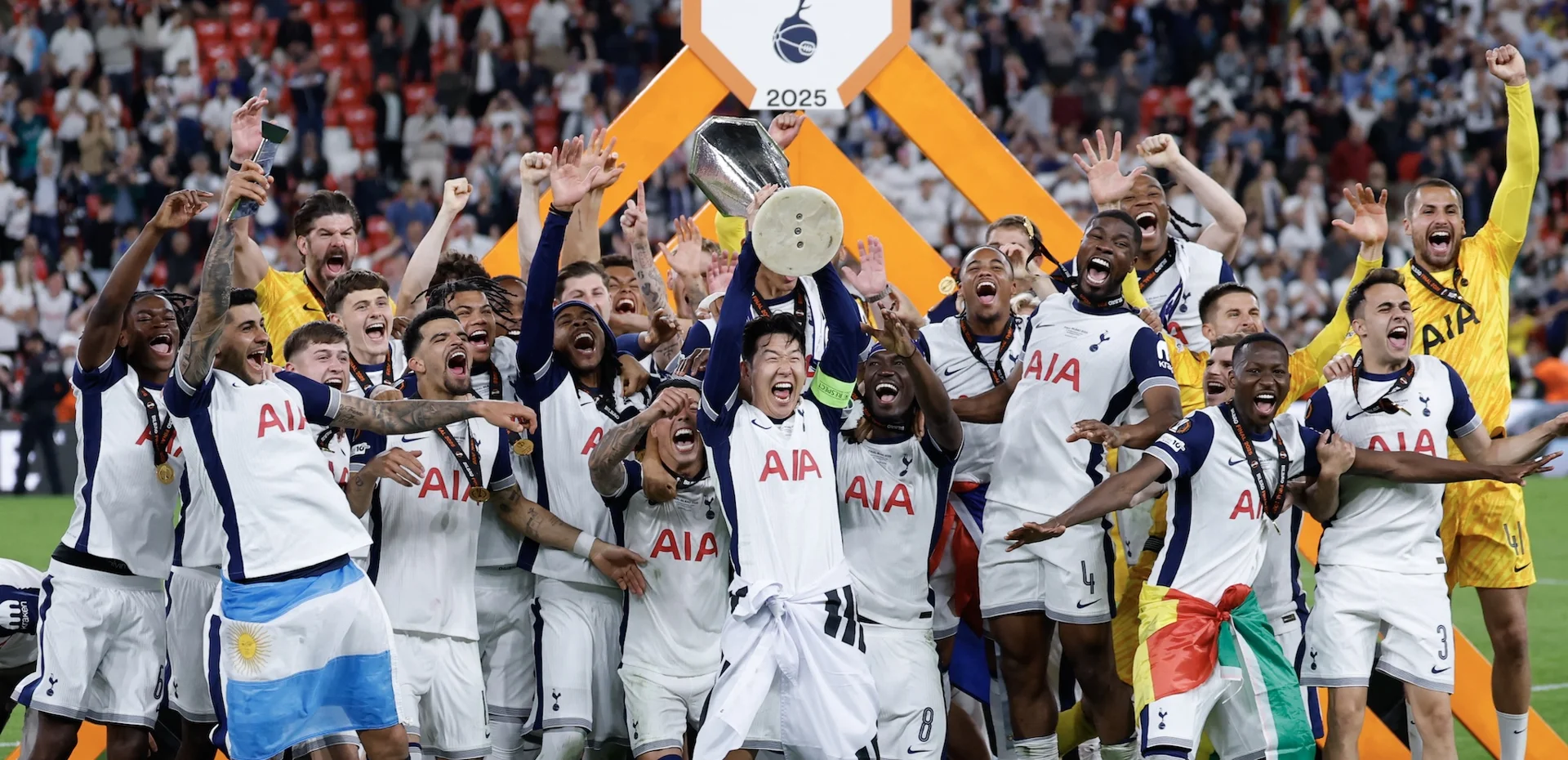
Chelsea's final in Wrocław demanded a reversal. Abdessamad Ezzalzouli put Real Betis ahead in the ninth minute, and Chelsea's 65% share of first-half possession brought little tangible danger. Reece James entered at the interval, the pressure sharpened, and Cole Palmer found the final action that had been missing. Enzo Fernández headed in Palmer's cross on 65 minutes; roughly six minutes later, Palmer created again for Nicolas Jackson.
The substitutions kept changing the match. James improved Chelsea's handling of transitions and second balls, while Kiernan Dewsbury-Hall supplied fellow substitute Jadon Sancho for the third goal in the 83rd minute. Moisés Caicedo made it 4-1 in added time. The result remains the only final among the first five editions decided by more than one goal, yet it started with Chelsea trailing for most of an hour.
Winning made Chelsea the first side to collect all five major UEFA men's senior club trophies: the Champions League, Europa League, Conference League, Super Cup and the former Cup Winners' Cup. The precise claim is important. It does not mean Chelsea won every competition that ever existed; it means the Conference League completed UEFA's defined five-trophy set. Olympiacos had used the trophy to open a country's account. Chelsea used it to close a club's collection.
Crystal Palace became the fifth champion in 2026
Crystal Palace added the fifth and newest name to the list by beating Rayo Vallecano 1-0 in Leipzig on 27 May 2026. The score matches the narrow margins of three earlier finals, but Palace's place in the record book is distinctive: they won the trophy in their debut season in a major UEFA club competition.
The winner came six minutes after half-time at the end of a 14-pass move. Adam Wharton carried the ball through the middle and shot from the edge of the area. Augusto Batalla blocked the attempt, but Jean-Philippe Mateta anticipated the rebound and forced it in. Wharton was later named UEFA's Player of the Match; the technical observer analysis credits him with creating the goal and Palace's two other biggest chances.
Rayo had a vivid reply when Yeremy Pino's free kick struck both posts without crossing the line. Batalla then denied Mateta a second goal, and Palace defended the closing pressure without allowing a clean equalising finish. Those episodes explain why a 1-0 entry should not be read as a routine procession. Palace found the central opening and then survived the final's most dangerous swing.
Why the 2026 result matters to the winners list
Palace became England's third Conference League champion, after West Ham and Chelsea; all three clubs are from London. UEFA also distinguishes their brief 1998 Intertoto Cup participation from this debut campaign in a major UEFA competition. That wording keeps the historical claim accurate.
This capsule deliberately stops at the record consequence. For the sequence of chances, midfield mechanisms and post-match takeaways, read our full 2026 Conference League final review. On this page, the durable answer is simpler: Crystal Palace are the 2025/26 champions and the winners of the 2026 final.
What five finals reveal about winning the Conference League
A list of champions is more useful when the results are read together. Across the first five editions, the Conference League has produced several narrow finals but no single formula for becoming champion. Roma protected an early lead, West Ham struck at the end of a level contest, Olympiacos lasted into extra time, Chelsea transformed a match after the interval, and Crystal Palace converted a second-half breakthrough. The shared feature is the trophy, not an interchangeable style.
Fine margins, not repeatable scorelines
Four of the five finals were decided by one goal. Roma beat Feyenoord 1-0 in 2022, West Ham beat Fiorentina 2-1 in 2023, Olympiacos beat Fiorentina 1-0 after extra time in 2024, and Crystal Palace beat Rayo Vallecano 1-0 in 2026. Chelsea's 4-1 win over Real Betis in 2025 is the exception and the only final in this five-season sample decided by more than one goal. The full result sequence can be checked against UEFA's official winners and finals record.
Only the Olympiacos–Fiorentina final required extra time, and none of the five reached a penalty shoot-out. That is a historical count, not a forecast. Three 1-0 scorelines can emerge from very different matches, and five finals are too few to establish a durable probability for the next one. The sensible conclusion is narrower: four champions had almost no margin for error on the scoreboard, while Chelsea alone created a comfortable winning gap.
Fiorentina show why appearances and titles are different records
Fiorentina are the first club to reach two Conference League finals, yet they do not appear in the champions column. West Ham beat them in 2023 when Jarrod Bowen scored in the 90th minute. A year later, El Kaabi's 116th-minute goal gave Olympiacos the trophy after extra time. Those consecutive defeats make Fiorentina the clearest warning against treating final appearances and titles as the same statistic.
Record-reading rule
Fiorentina lead the first five editions for final appearances with two. Roma, West Ham, Olympiacos, Chelsea and Crystal Palace share the title lead with one each. A club can therefore lead one table while remaining absent from the other.
This distinction also keeps comparisons fair. Reaching two finals demonstrates sustained knockout performance, but the winners list answers a stricter question: who completed the campaign by lifting the trophy? For Fiorentina, the honest record is two appearances, two runner-up finishes and no Conference League title through 2026.
Club, country and coach records after five editions
Conference League records remain unusually open because the competition has crowned a new club and a new coach every season. The only clear separation so far appears at association level, where three English winners have created an early lead. Every figure below is measured through the completed 2025/26 competition, not through an unfinished future season.
No club has won twice
Roma, West Ham, Olympiacos, Chelsea and Crystal Palace each hold one title. That means there is no sole “most successful” Conference League club: all five share first place in the trophy count. UEFA's official history hub likewise shows one as the leading title total.
This is not contradicted by Fiorentina reaching two finals. Their appearances in 2023 and 2024 lead that category, but both ended as runner-up finishes. Until a former champion lifts the trophy again, the club winners table is a five-way tie rather than a hierarchy.
England leads the country table
Assigning each official champion to its national association produces a simple country count: England has three titles, while Italy and Greece have one apiece. West Ham became England's first winner in 2023, Chelsea added the second in 2025, and Crystal Palace made it three in 2026. Roma supplied Italy's title in the inaugural season; Olympiacos supplied Greece's in 2024.
| Country | Titles | Winning clubs |
|---|---|---|
| England | 3 | West Ham, Chelsea, Crystal Palace |
| Italy | 1 | Roma |
| Greece | 1 | Olympiacos |
This table is a calculation from UEFA's five-club winners list, current through the 2026 final.
Five winning coaches, five distinct routes
The coaching roll is as varied as the club list: José Mourinho with Roma, David Moyes with West Ham, José Luis Mendilibar with Olympiacos, Enzo Maresca with Chelsea and Oliver Glasner with Crystal Palace. Each owns one Conference League title. Their honours in other competitions do not turn any of them into a multiple UECL winner.
The routes help explain why the names matter. Mourinho managed a low-scoring inaugural final and became the first coach to win all three current men's UEFA club competitions. Moyes took an unbeaten West Ham campaign to its last-minute reward. Mendilibar arrived at Olympiacos in February and redirected a difficult season toward a historic first senior men's European trophy for Greece. Maresca used Chelsea's depth and a decisive second-half adjustment to reverse the 2025 final. Glasner's structured 5-2-3 then gave Palace a platform for their 2026 breakthrough.
Five editions are not enough to declare one coaching model superior. They are enough to show that this trophy has not belonged exclusively to one league, budget level or career path. The clean record is five clubs, three countries and five winning coaches.
What winning the UECL changes for the following season
The title is not only a line in a historical table. It creates a European route for the next season and can replace a club's expected qualifying path with direct entry to a higher competition. That consequence is why the winner must be understood in the context of both the completed campaign and the one that follows.
The Europa League place is conditional
Under Article 3.07 of the 2026/27 Conference League regulations, the titleholder is admitted to the following Europa League league phase. UEFA's plain-language final guidance adds the important condition: that Europa League destination applies when the winner has not qualified for the Champions League through its domestic competition.
The qualification reward is therefore firm, but its destination depends on the club's domestic finish. A champion that earns a Champions League place takes the higher route; it does not enter both competitions. If the titleholder's domestic result would otherwise place it in the Conference League, UEFA rebalances that access list instead of awarding the same club two entries. The trophy secures a European upgrade, not a duplicate place.
Short answer
The Conference League winner moves into the next Europa League league phase unless it has earned Champions League entry through domestic competition. Always check the regulations for the season concerned because access rules can change.
A trophy can redraw a club's sporting plan
Direct league-phase admission changes the calendar immediately. In the current Europa League format, a club plays eight different league-phase opponents across eight matchdays, with one home and one away opponent drawn from each of four seeding pots. For 2026/27, those dates run from September into January. That is a longer planning window than a short qualifying tie and it removes the need to earn this particular European place through Conference League qualifiers.
The practical implications extend beyond the fixture list. This is an editorial inference from the verified competition structure: sporting staff must plan squad availability, player registration and cross-border travel for eight guaranteed league-phase dates against Europa League opposition. The club may also need to balance those matches with domestic league and cup commitments. Exact budgets and recruitment decisions remain club-specific, so the title alone does not justify invented financial projections.
Crystal Palace provide the clearest 2026 example. UEFA reserved one 2026/27 Europa League league-phase slot for the Conference League titleholder and listed Palace among the 36 teams. Their name on the winners list thus connects directly to a new eight-match European programme the following season.
Why there is no Conference League winners list since 2000
Some searches ask for Conference League champions since 2000 or even an all-time list stretching through the twentieth century. The useful correction is chronological, not semantic: this UEFA competition is only five seasons old. Older European trophies have their own records and should not be inserted into a UECL table to make it look longer.
The competition began in 2021/22
UEFA introduced its third season-long men's club competition in 2021/22 under the name UEFA Europa Conference League. Roma won the inaugural final in May 2022, so the correct winners chronology begins with the 2021/22 season. There are no UECL champions from 2000 to 2021 because the competition did not yet exist.
That missing period cannot be filled with winners of the European Cup Winners' Cup, UEFA Intertoto Cup or UEFA Cup/Europa League. Those tournaments had different identities, qualification systems and honours. A club may own trophies from more than one lineage, but each belongs in its own historical list. UEFA's official competition lowdown fixes the starting point at 2021/22.
Europa Conference League and Conference League are the same lineage
The wording changed after three seasons, but the history did not reset. UEFA announced in June 2023 that “Europa” would be removed from the competition name from the start of 2024/25. UEFA then described 2024/25 as the fourth edition and the first under the abbreviated name. That sequence makes the continuity explicit.
One competition, two official names
2021/22–2023/24: UEFA Europa Conference League. From 2024/25: UEFA Conference League. All five champions belong to the same record.
Roma, West Ham and Olympiacos therefore sit in the same winners lineage as Chelsea and Crystal Palace. “UECL” also remains a practical search abbreviation even though the current official name is shorter. For a fuller explanation of the name, level and format, see our UECL and Conference League explainer.
The complete answer is consequently compact: five editions, five champions, and a continuous archive beginning in 2021/22. Any page claiming UECL winners before that season is combining competitions that UEFA records separately.
The Conference League winners list is short enough to state in one breath—Roma, West Ham, Olympiacos, Chelsea and Crystal Palace—but each row represents a different route to the trophy. Four finals were settled by a one-goal margin, Fiorentina became the first two-time finalist without winning, and England built the early country lead with three champions.
This archive is current through the 2026 final. After each future final, it can be extended by one verified season row while preserving the distinction between the season label, final year and current competition name. For live dates and results, use the site's current Conference League schedule coverage; for history, the five completed editions above remain the fixed record.
Matchnight discussion
Ask a question or share your thoughts with other fans. Comments are reviewed before they appear. Please keep it friendly and leave out personal details.
Read our privacy policy and comment guidelines.
Loading comments…