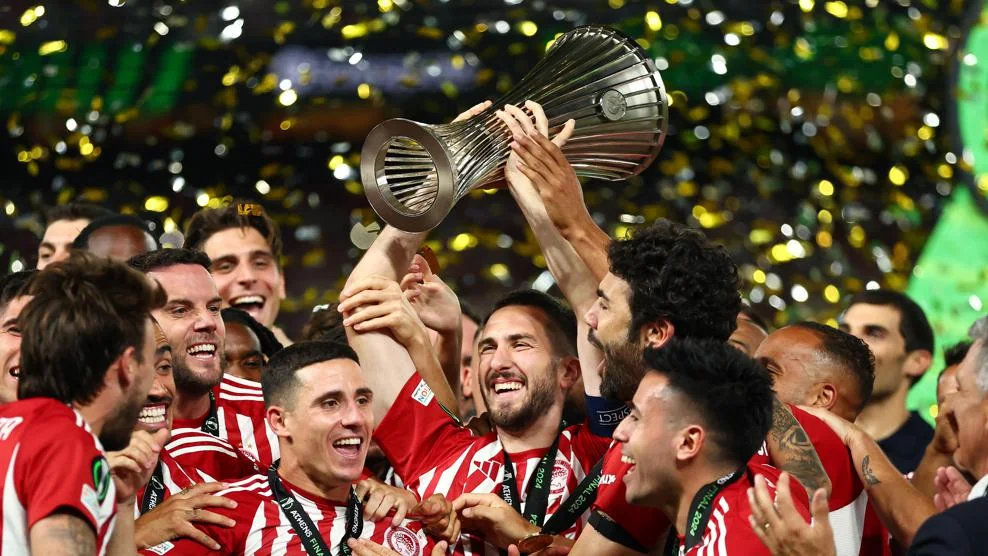
UECL is the familiar abbreviation for the competition launched as the UEFA Europa Conference League and now officially called the UEFA Conference League. It is UEFA’s third season-long men’s club tournament, built around broad access, Thursday fixtures, a six-match league phase and its own knockout bracket.
This guide uses the current format and rules as of 7 September 2026. It explains why the old name still appears, how clubs arrive from domestic competitions and summer qualifying, and where the structure separates from the Europa League. The aim is to help you identify the right match, table and season without decoding regulatory language.
UECL in one line
It is a separate UEFA club competition: 36 teams share one league-phase table, each plays six different opponents, and 24 advance to the spring knockout bracket.
What UECL means and why the competition exists
UECL means UEFA Europa Conference League, the name used when UEFA launched its third season-long men’s club competition in 2021/22. The official name has since been shortened to UEFA Conference League, but UECL remains a useful and widely understood abbreviation. It separates Conference League references from UCL, the familiar shorthand for the Champions League.
Why old pages still say Europa Conference League
The name change took effect in 2024/25. UEFA said removing “Europa” would help the tournament develop a stronger identity of its own. Nothing was merged or abolished: results from the first three seasons still belong to the same competition history, and the trophy remained the Conference League trophy. A search for “Europa Conference League” may therefore lead to a perfectly valid match from 2022 or 2023, while a current draw or table will normally use “Conference League.”
This is also why search results can look inconsistent without actually disagreeing. “UECL,” “Europa Conference League” and “Conference League” often point to the same tournament at different moments in its naming history. The date is the clue. Before 2024/25, the longer name is historically correct; from 2024/25 onward, the shorter official name is the better label.
A third European competition with its own route and trophy
Conference League sits alongside the Champions League and Europa League in UEFA’s men’s club calendar. Calling it a third competition describes its place in that structure, not the quality of every team in it. Clubs can arrive from major domestic leagues, smaller associations, cup competitions or qualifying transfers. Once they meet, they compete for one trophy under one set of rules.
UEFA introduced it to give more clubs and more national associations a realistic chance to play sustained European football. The effect is easy to see in the map. During its first years, clubs from Armenia, Bosnia and Herzegovina, Estonia, the Faroe Islands, Gibraltar, Iceland, Kosovo, Liechtenstein and Lithuania reached a UEFA men’s group or league phase for the first time. The New Saints and Larne later brought Wales and Northern Ireland into that experience in 2024/25.
For those clubs, six confirmed league-phase matches are different from one summer qualifier. Supporters receive several home and away nights; players face varied styles; clubs can build coefficient points and revenue over an autumn. The competition also puts recognisable sides into venues they may never visit through the Champions League. That mix, rather than a single level of fame, is central to its character.
Conference League and Europa League still share much of their Thursday-night identity. Their branding and broadcast packages are connected, and their qualifying routes can intersect. They remain separate competitions: separate league tables, different match counts, different finalists and different trophies. If a broadcaster lists “UEL/UECL,” read it as coverage of two tournaments in the same window, not one combined event.
Fan shorthand that works
Use Conference League for the current name, Europa Conference League when discussing seasons before 2024/25, and UECL when a compact label is useful. All three can be understood in context.
How clubs qualify for the Conference League
There is no single domestic finish that means Conference League in every country. UEFA’s access list allocates places across its member associations, while domestic cup results, league positions and clubs qualifying for higher competitions can change who occupies those places. The practical rule for a fan is to start with the official European allocation published by the club or league, then check the qualifying round at which that club enters.
Domestic performance opens the door; qualifying decides the place
A club can earn an entry through a domestic cup or a qualifying league position, depending on its association. That entry is usually a place in summer qualifying, not a guaranteed autumn schedule. Associations higher on the access list tend to enter clubs later, while teams from other leagues may begin in the first qualifying round. Rebalancing can occur when a cup winner has already qualified for another competition, so a copied league-position chart can become outdated.
The qualifying rounds are knockout ties played home and away. Goals are combined across both legs. If the aggregate is level after normal time in the return, the teams play extra time and then penalties if required. Winning moves a team to the next round; losing normally ends its Conference League run. A club starting in round one can therefore need four aggregate victories to reach the league phase.
Champions path, main path and the Europa League safety net
UEFA divides the qualifying draw into two branches. The champions path gives relevant domestic champions redirected from higher UEFA qualifying a route against clubs with a comparable entry story. The much larger main path contains non-champions who qualified through domestic performance, together with teams transferred from specified Europa League rounds. The branches meet in the same league phase; neither awards a different trophy or status.
A transfer after defeat is sometimes called “dropping down,” but it is not an improvised consolation. The access list defines in advance which losers enter which competition and round. For 2026/27, 24 clubs won Conference League play-offs. Another 12 lost Europa League play-offs and entered the Conference League league phase directly, completing the 36-team field.
This connected summer ladder explains why a club can appear in Europa League qualifying results and then in the Conference League draw. Our 2026/27 Europa League qualifiers guide follows that upper route. Once the league phases begin, the old group-stage habit of expecting another mid-season drop-down is wrong: clubs do not move from the Europa League league phase into the Conference League knockouts.
Earn entry
Domestic sporting performance creates the initial European place.
Survive summer
Home-and-away ties narrow the field through four possible rounds.
Reach 36
Play-off winners and designated Europa League transfers form one table.
Qualification therefore measures two things: what a club achieved at home and what it survived in Europe. A prestigious name does not skip a round because of reputation, and an early starter is not worth fewer points once the league phase begins. Every qualifier enters the table on zero.
Conference League format versus the Europa League
The two competitions now look similar on a table screen: 36 clubs, one ranking and the same three broad qualification bands. Their workload is different. A Conference League club plays six league-phase matches against six opponents; a Europa League club plays eight against eight. That two-game gap changes the draw, the calendar and the cost of one poor result.
| Feature | Conference League | Europa League |
|---|---|---|
| League-phase clubs | 36 | 36 |
| Matches per club | 6 | 8 |
| Home / away | 3 / 3 | 4 / 4 |
| Draw pots | 6 pots; one opponent from each | 4 pots; two opponents from each |
| Top eight | Round of 16 | Round of 16 |
| Ranks 9–24 | Knockout play-offs | Knockout play-offs |
| Ranks 25–36 | Eliminated | Eliminated |
One table does not mean one round-robin schedule
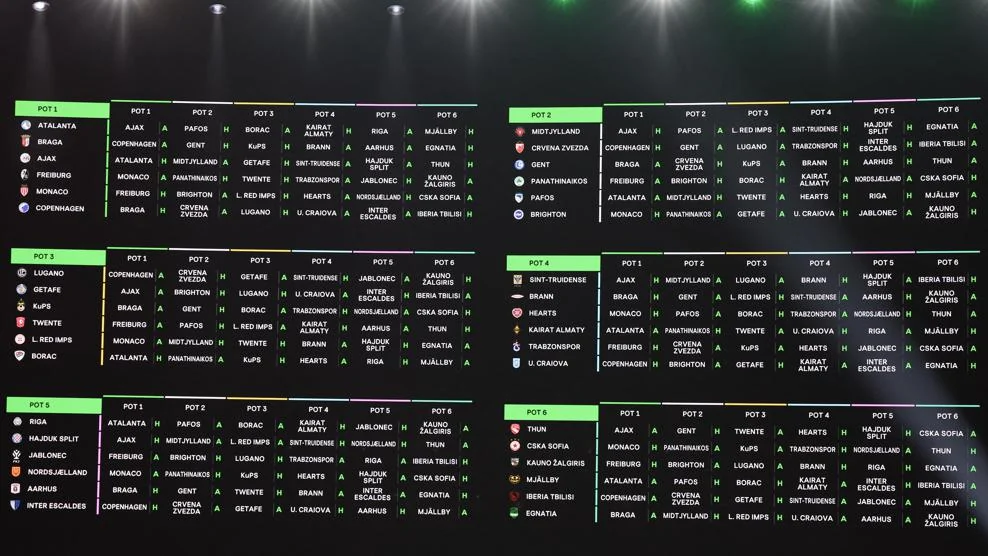
Every club appears in the same league table, yet no club meets all 35 rivals. Conference League teams were seeded into six pots and drew one opponent from each. Pots one and two, three and four, and five and six were paired to balance venues: from each pair, one match is at home and one away. The result is six distinct opponents and a three-three home-away split.
Europa League clubs were split into four pots and drew two opponents from each, playing one at home and one away. The pots aim to distribute different coefficient levels, but schedules are not identical. A team may face an in-form opponent away and a struggling one at home; another club can receive the reverse. Table points are directly comparable under the rules even when the routes to those points differ.
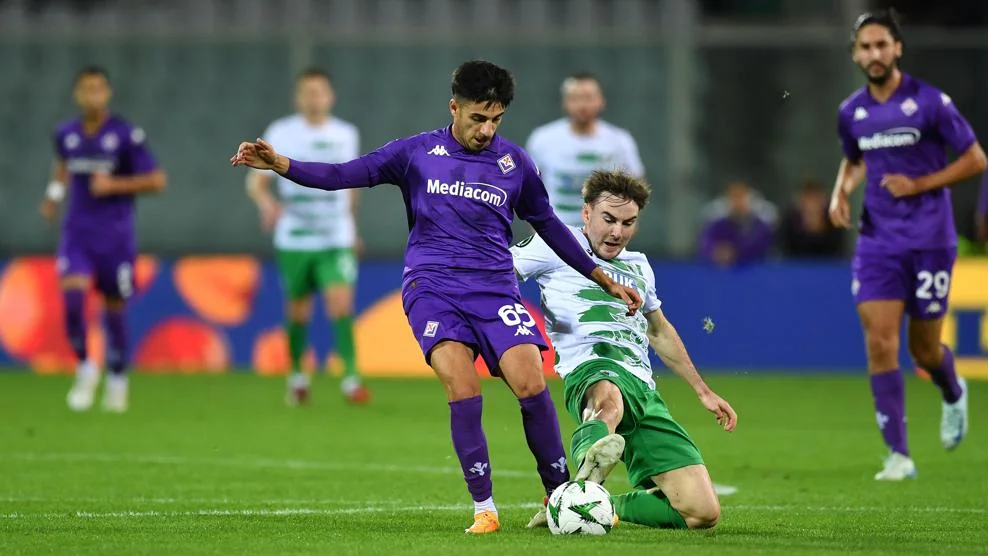
The same rank bands carry different pressure
Both competitions send first through eighth straight to the round of 16. Ninth through 24th must play an extra two-legged knockout tie, while 25th through 36th are out of Europe. There is no transfer from one league-phase table to the other. That makes the boundaries at eighth and 24th the numbers to watch on the final matchday.
In Conference League, one fixture represents one-sixth of the entire league-phase sample. In Europa League, it is one-eighth. A defeat is not mathematically fatal in either tournament, but Conference clubs have two fewer chances to replace the lost points and improve goal difference. A quick two-win start creates more leverage; a slow start removes options rapidly.
The calendars underline that difference. The 2026/27 Conference League league phase runs from 15 October to 17 December, finishing before the winter break. The Europa League begins on 16/17 September and continues with two January matchdays, ending on 28 January 2027. Conference clubs have a shorter, tighter autumn burst; Europa League clubs must preserve form across a longer span and the transfer-window period.
For fans, the simplest live-table habit is to follow points, goal difference and the two cut lines, not a traditional four-team group. Your club may sit beside a team it never plays. A goal elsewhere can still move both across eighth or 24th because all 36 schedules feed the same ranking. Use our Europa League table only for UEL; it does not display Conference League standings.
Knockouts, the trophy and what the winners earn
The league phase does more than remove 12 teams. It builds the knockout bracket and rewards higher finishes with rest, seeding and, in principle, the venue for the decisive leg. The trophy remains the final objective, while the champion also receives a route into the following season’s Europa League under UEFA’s qualification rules.
From a 36-team ranking to a fixed bracket
The top eight skip February and enter at the round of 16. Teams ranked ninth to 16th are seeded for the knockout phase play-offs against clubs placed 17th to 24th, with the seeded side normally at home in the second leg. The pairings follow rank corridors: ninth or tenth can meet 23rd or 24th, 11th or 12th can meet 21st or 22nd, and so on. This gives every late league-phase goal potential bracket value.
Eight play-off winners join the top eight in the last 16. The play-offs, round of 16, quarter-finals and semi-finals are all home-and-away ties decided on aggregate. The final is different: one match at a neutral venue, with extra time and penalties available if the score remains level. There is no second night to repair a tactical mistake.
2026/27 knockout calendar
- Play-offs: 18 and 25 February 2027
- Round of 16: 11 and 18 March
- Quarter-finals: 8 and 15 April
- Semi-finals: 29 April and 6 May
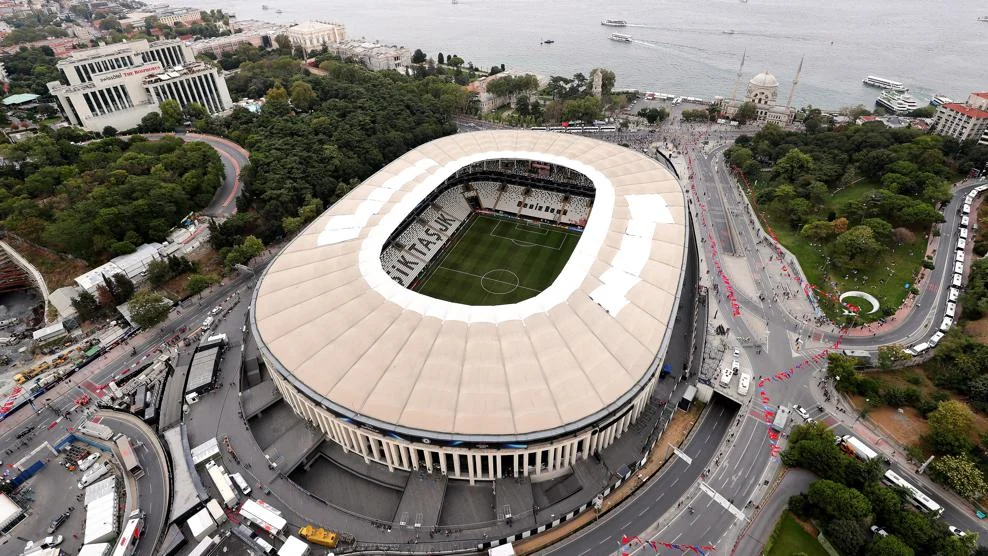
- Final: 2 June, Beşiktaş Park, Istanbul
A European trophy and a conditional Europa League place
Winning Conference League qualifies the champion for the next Europa League league phase if it has not already reached the Champions League or Europa League through domestic competition. The word “if” matters. A champion that already owns an equal or higher place does not occupy two entries; UEFA rebalances the access list for the unused berth.
That reward should not reduce the trophy to a stepping stone. A club has to survive a broad league phase and as many as five spring rounds, ending in a neutral-venue final. The honour belongs to that season and that competition. The next Europa League place is an additional sporting consequence. The Conference League winner does not play in the UEFA Super Cup, which is reserved for the Champions League and Europa League winners.
How to recognise and follow a UECL fixture
First check the competition label rather than trusting a search snippet. A current listing should say UEFA Conference League; an archive can legitimately use Europa Conference League. During the league phase, expect six opponents and one 36-team table. In February and later, check whether the listing is a first leg, second leg or the single final. An aggregate score beside a knockout match carries more meaning than the 90-minute score alone.
Then verify the local kickoff time and broadcaster for your country. Europa League and Conference League games can occupy the same Thursday window, and a television guide may abbreviate them as UEL and UECL. Team names alone are unreliable because a club can move between the competitions during summer qualifying. The official competition tag tells you which table and rules apply on that date.
Finally, keep the season label attached to the final year. The 2026/27 Conference League final is played in 2027. A search for “Conference League final 2026” refers to the previous 2025/26 season. Our Europa League calendar can help with UEL dates, while the UEFA Schedule blog carries explainers that keep the competitions distinct.
The useful mental model
Treat UECL as the short label, Conference League as the current name and Europa Conference League as the historical name. Follow summer transfers only until the league phase begins. Then follow one 36-team table for six matches, with eighth, 24th and 25th as the decisive boundaries.
The competition’s value is clearest in its range: established European clubs, first-time league-phase qualifiers and supporters from associations rarely visible in late spring all compete for the same trophy. Its connection to the Europa League shapes entry and the champion’s next-season reward, but its matches and honours stand on their own.
Matchnight discussion
Ask a question or share your thoughts with other fans. Comments are reviewed before they appear. Please keep it friendly and leave out personal details.
Read our privacy policy and comment guidelines.
Loading comments…