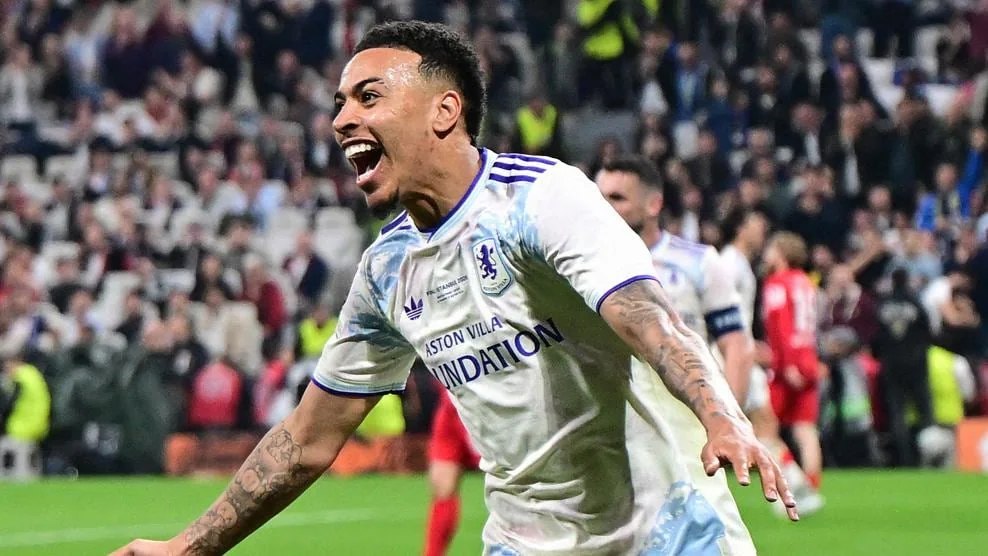
Aston Villa are the 2025/26 Europa League champions, while Sevilla remain the all-time record holders with seven titles. UEFA treats the UEFA Cup and Europa League as one continuous competition record, so the list below begins with Tottenham Hotspur in 1971/72 and runs through Villa's 2026 final win.
Use the complete season tables for a quick lookup, then compare the leading clubs, countries and last ten winners. The analysis also explains why older finals can show two scorelines, what changed with the 2009 rebrand, and the difference between consecutive dominance and a club winning again with a later generation.
The cutoff matters whenever this page is used as a reference. It includes every completed edition through 2025/26, while the 2026/27 tournament is still in progress. Club and country totals therefore reconcile to the same 55 champions rather than mixing a live season with finished history.
Every UEFA Cup and Europa League winner by year
UEFA's official roll of honour starts in 1971/72 and runs continuously through the competition's UEFA Cup and Europa League names. The tables below use season labels because a final played in May 2026 completes the 2025/26 edition. That distinction prevents a common search-result mistake: treating the final year as if it were the whole season.
The UEFA Cup era, 1971/72 to 2008/09
UEFA launched the UEFA Cup in 1971/72. Tottenham Hotspur won the inaugural edition, and Shakhtar Donetsk became the last champion under that name in 2008/09. These 38 editions include the two-legged-final era and the later single-match finals, but each still counts as one championship.
| Season | Champion | Season | Champion |
|---|---|---|---|
| 1971/72 | Tottenham Hotspur | 1990/91 | Inter |
| 1972/73 | Liverpool | 1991/92 | Ajax |
| 1973/74 | Feyenoord | 1992/93 | Juventus |
| 1974/75 | Borussia Mönchengladbach | 1993/94 | Inter |
| 1975/76 | Liverpool | 1994/95 | Parma |
| 1976/77 | Juventus | 1995/96 | Bayern München |
| 1977/78 | PSV Eindhoven | 1996/97 | Schalke 04 |
| 1978/79 | Borussia Mönchengladbach | 1997/98 | Inter |
| 1979/80 | Eintracht Frankfurt | 1998/99 | Parma |
| 1980/81 | Ipswich Town | 1999/00 | Galatasaray |
| 1981/82 | IFK Göteborg | 2000/01 | Liverpool |
| 1982/83 | Anderlecht | 2001/02 | Feyenoord |
| 1983/84 | Tottenham Hotspur | 2002/03 | Porto |
| 1984/85 | Real Madrid | 2003/04 | Valencia |
| 1985/86 | Real Madrid | 2004/05 | CSKA Moskva |
| 1986/87 | IFK Göteborg | 2005/06 | Sevilla |
| 1987/88 | Bayer Leverkusen | 2006/07 | Sevilla |
| 1988/89 | Napoli | 2007/08 | Zenit |
| 1989/90 | Juventus | 2008/09 | Shakhtar Donetsk |
The Europa League era, 2009/10 to 2025/26
The rebrand arrived in 2009/10, when Atlético de Madrid won the first final carrying the Europa League name. Aston Villa are the current champions at this article's 15 September 2026 cutoff after beating Freiburg 3–0 in Istanbul. For the match story and route through the knockouts, read our 2025/26 knockout-stage review.
| Season | Champion |
|---|---|
| 2009/10 | Atlético de Madrid |
| 2010/11 | Porto |
| 2011/12 | Atlético de Madrid |
| 2012/13 | Chelsea |
| 2013/14 | Sevilla |
| 2014/15 | Sevilla |
| 2015/16 | Sevilla |
| 2016/17 | Manchester United |
| 2017/18 | Atlético de Madrid |
| 2018/19 | Chelsea |
| 2019/20 | Sevilla |
| 2020/21 | Villarreal |
| 2021/22 | Eintracht Frankfurt |
| 2022/23 | Sevilla |
| 2023/24 | Atalanta |
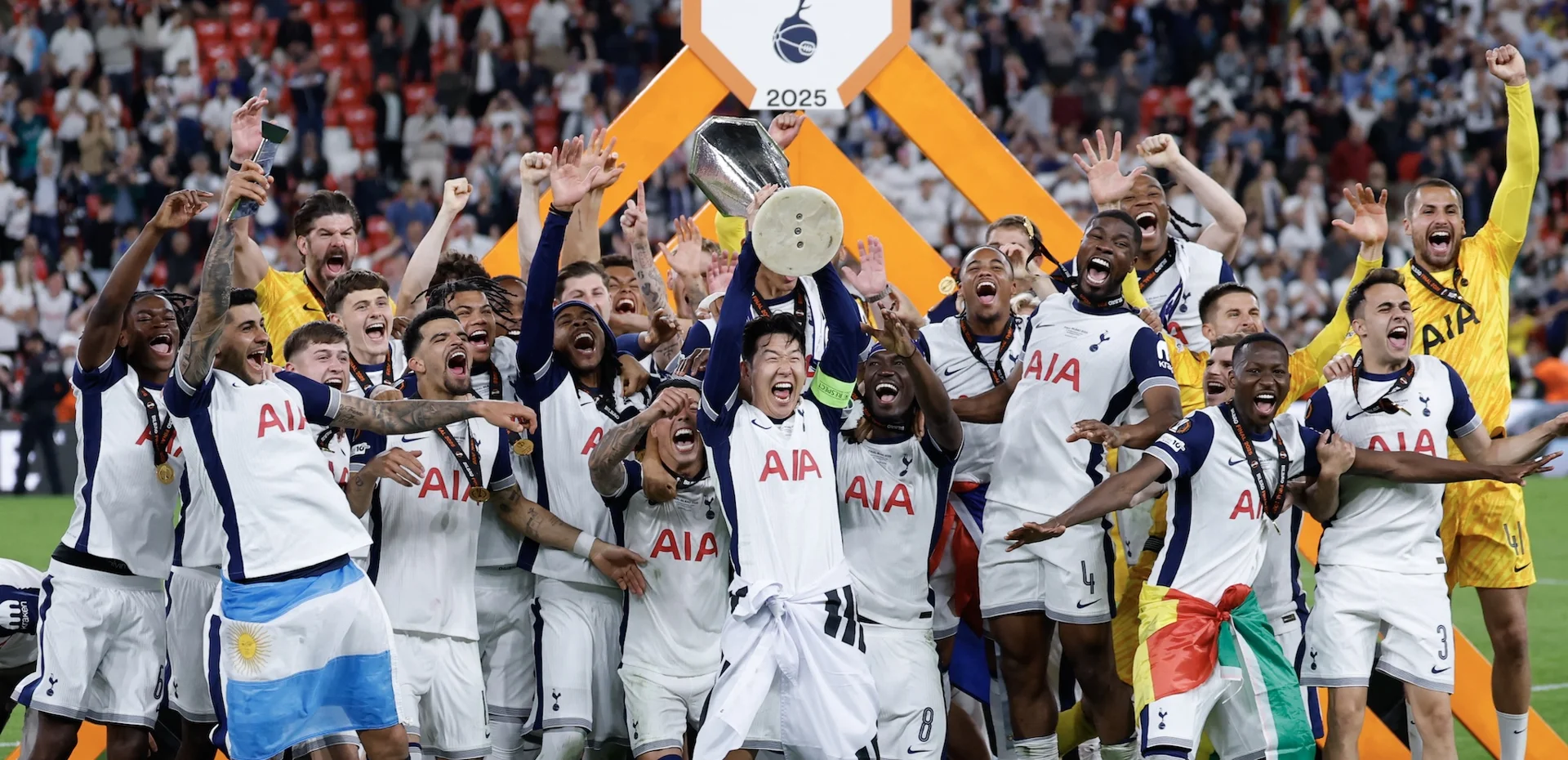
| 2024/25 | Tottenham Hotspur |
| 2025/26 | Aston Villa |
Count check: 38 UEFA Cup editions plus 17 Europa League editions equals 55 completed seasons. The name changes at 2009/10; the historical record does not restart.
Which club has won the Europa League most often?
Sevilla are the record winners with seven UEFA Cup/Europa League titles. No other club has more than three. That gap is the clearest fact in the club ranking, but the list should be read as an honours table rather than a timeless verdict on which team was strongest. It combines more than five decades, several formats and very different generations.
Sevilla's seven-title benchmark
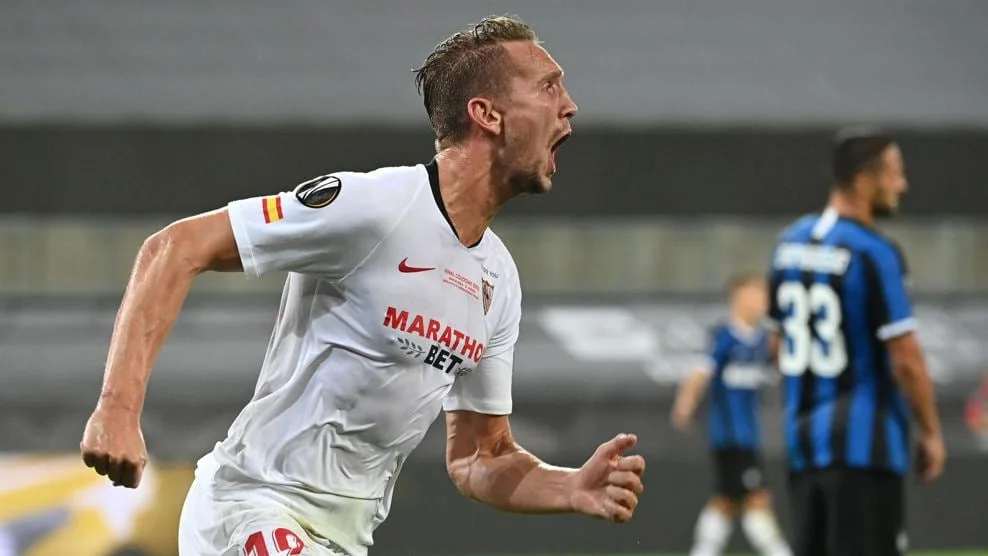
Sevilla's wins came in 2005/06, 2006/07, 2013/14, 2014/15, 2015/16, 2019/20 and 2022/23. They converted all seven of their final appearances through this article's cutoff. The description “seven from seven” therefore concerns finals reached; it does not mean Sevilla won the tournament every time they entered.
The middle of that sequence is unique. Sevilla won three consecutive editions from 2013/14 through 2015/16, the only club to complete a three-season championship run. They had already become the first side to retain the trophy under the Europa League name, then extended the defence once more in Basel in 2016.
The three-time and two-time winners
Five clubs sit on three championships: Atlético de Madrid, Inter, Juventus, Liverpool and Tottenham Hotspur. Tottenham joined that tier by winning the 2024/25 edition. Eight more have won twice: Borussia Mönchengladbach, Chelsea, Eintracht Frankfurt, Feyenoord, IFK Göteborg, Parma, Porto and Real Madrid.
Record
7
Sevilla
Three titles
5 clubs
Atlético, Inter, Juventus, Liverpool, Tottenham
Two titles
8 clubs
From Mönchengladbach to Real Madrid
These tiers also provide a useful arithmetic check. Seven Sevilla titles, 15 among the five three-time winners and 16 among the eight two-time winners account for 38 editions. Seventeen different one-time champions supply the remaining 17, bringing the competition total to 55.
Europa League winners by country
Spanish clubs have won the competition most often, with 14 titles through 2025/26. England follows with 11 and Italy with 10. For this table, a trophy belongs to the winning club's association in that season, and the club breakdown is shown beside every total so the calculation can be checked rather than taken on trust.
| Country | Titles | Winning clubs and titles |
|---|---|---|
| Spain | 14 | Sevilla 7; Atlético 3; Real Madrid 2; Valencia 1; Villarreal 1 |
| England | 11 | Liverpool 3; Tottenham 3; Chelsea 2; Ipswich 1; Manchester United 1; Aston Villa 1 |
| Italy | 10 | Inter 3; Juventus 3; Parma 2; Napoli 1; Atalanta 1 |
| Germany | 7 | Mönchengladbach 2; Eintracht Frankfurt 2; Leverkusen 1; Bayern 1; Schalke 1 |
| Netherlands | 4 | Feyenoord 2; Ajax 1; PSV 1 |
| Portugal | 2 | Porto 2 |
| Russia | 2 | CSKA Moskva 1; Zenit 1 |
| Sweden | 2 | IFK Göteborg 2 |
| Belgium | 1 | Anderlecht 1 |
| Türkiye | 1 | Galatasaray 1 |
| Ukraine | 1 | Shakhtar Donetsk 1 |
The table reveals both depth and concentration. Spain's lead is built heavily on Sevilla's seven, while England's 11 championships are spread across six clubs. Italy has five winning clubs, and Germany also has five. At the other end, Sweden's two titles both belong to IFK Göteborg and Portugal's two both belong to Porto.
What this table does not show: it is not a current UEFA coefficient ranking, it does not count runners-up, and it does not claim that the country with the most historical trophies has today's strongest league. It answers one precise question: where the 55 winning clubs were affiliated when they lifted the trophy.
The last 10 Europa League winners
The last ten completed editions at the 15 September 2026 cutoff run from 2016/17 to 2025/26. The result column gives the score after extra time where applicable; a penalty shoot-out is shown separately because its kicks do not become part of the match score.
| Season | Winner | Runner-up | Final result |
|---|---|---|---|
| 2025/26 | Aston Villa | Freiburg | 3–0 |
| 2024/25 | Tottenham Hotspur | Manchester United | 1–0 |
| 2023/24 | Atalanta | Bayer Leverkusen | 3–0 |
| 2022/23 | Sevilla | Roma | 1–1; Sevilla won 4–1 on penalties |
| 2021/22 | Eintracht Frankfurt | Rangers | 1–1; Frankfurt won 5–4 on penalties |
| 2020/21 | Villarreal | Manchester United | 1–1; Villarreal won 11–10 on penalties |
| 2019/20 | Sevilla | Inter | 3–2 |
| 2018/19 | Chelsea | Arsenal | 4–1 |
| 2017/18 | Atlético de Madrid | Marseille | 3–0 |
| 2016/17 | Manchester United | Ajax | 2–0 |
There are nine different champions in these ten seasons, not ten: Sevilla won in both 2019/20 and 2022/23. That recent variety sits beside Sevilla's commanding all-time record. It also produced first competition titles for Villarreal in 2021, Atalanta in 2024 and Aston Villa in 2026, while Tottenham's 2025 success was their third.
This is a rolling list. Once another final is completed, the oldest season drops out of the “last 10” window. Using the season labels alongside the final-year results makes the boundary explicit and keeps the list comparable with UEFA's official archive.
How the competition and its final changed
A winner in 1972 and a winner in 2026 occupy the same official honours list, but they did not navigate an identical tournament. Two changes matter most when reading the archive: the move from a home-and-away final to a neutral-site match, and the UEFA Cup's rebrand as the Europa League.
Two-legged finals before 1998
The final was played over two legs from 1971/72 through 1996/97. Each finalist hosted one match, and the competition rules used the aggregate outcome to determine the champion. That is why a historic record may show a first-leg score, a second-leg score and a combined aggregate rather than the single result familiar to modern viewers.
Tottenham's inaugural victory over Wolverhampton Wanderers is a useful example: Spurs won 2–1 away and drew 1–1 at home, taking the tie 3–2 on aggregate. The 1996/97 final between Schalke and Inter was the last played in that format. The clubs won one leg 1–0 apiece before Schalke prevailed in the shoot-out.
Inter then beat Lazio 3–0 at Parc des Princes in Paris in May 1998 in the first one-match, neutral-venue UEFA Cup final. From that point, the score attached to a final describes one match, with extra time and penalties used when required. Historical rules still need to be read edition by edition; a current rule should not be projected backwards across the whole two-legged era.
The 2009 rebrand did not reset the record
The UEFA Cup became the UEFA Europa League for the 2009/10 season. The name, branding and competition structure changed, and Atlético de Madrid became the first champion of the renamed tournament by beating Fulham 2–1 after extra time in Hamburg.
What did not change was the historical lineage. UEFA's own winners pages count titles from both names together. Sevilla's 2006 and 2007 UEFA Cup wins therefore belong beside their five Europa League-era successes. Liverpool's three, Juventus's three and Inter's three likewise remain complete totals rather than being split at 2009.
The practical reading rule
Use “UEFA Cup” when describing an edition through 2008/09 and “Europa League” from 2009/10 onward. Use the combined UEFA Cup/Europa League record when comparing all-time champions.
What the winners list reveals about repeat success
Most champions appear once, and even famous winners rarely lift the trophy in consecutive seasons. The record shows two different kinds of repeat success: a short dynasty that survives an immediate title defence, and a club returning with a new generation years or decades later. Those achievements should not be treated as the same phenomenon.
Dynasties are rare — and Sevilla are the exception
Only Real Madrid and Sevilla have won this competition in consecutive seasons. Real Madrid took the 1984/85 and 1985/86 UEFA Cups. Sevilla first retained the trophy in 2006/07, then built the only three-title streak in tournament history by winning 2013/14, 2014/15 and 2015/16.
That does not prove a single recipe for winning. Entry routes, formats, opponents and squad circumstances have changed. It does show how unusual it is to carry a successful European campaign into the following season and navigate another knockout path. Sevilla's streak is even more distinctive because no other club reached three consecutive championships.
There is one strong personnel thread in the recent record. Unai Emery coached all three Sevilla victories in that run, Villarreal's first title in 2021 and Aston Villa's 2026 championship. That gives him five wins as a coach through the cutoff. It is evidence of repeated tournament success under different club conditions, not a claim that coaching alone explains every result.
Winning with different generations
A gap between titles tells a different story. Liverpool won in 1973 and 1976, then returned in 2001. Tottenham's 1972 and 1984 victories preceded their 2025 title by more than four decades. Eintracht Frankfurt waited from 1980 until 2022. These are club honours connected by identity and history, not one uninterrupted team dynasty.
Other multi-era winners have shorter but still meaningful gaps. Porto won in 2003 and 2011; Chelsea in 2013 and 2019. Juventus's three titles arrived in 1977, 1990 and 1993, while Inter's came in 1991, 1994 and 1998. The all-time totals compress those stories into one number, so the year-by-year list remains important.
Two useful readings of a multiple winner
- Immediate continuity: the club successfully defended its title in the next edition.
- Institutional return: different squads and coaches brought the same club back to the top later.
The first is exceptionally rare; the second is more common among the multi-title clubs. Keeping the distinction visible prevents a seven-, three- or two-title total from suggesting continuous dominance across every year between wins.
The questions fans ask about Europa League champions
The tables answer the full historical query, while these shorter answers resolve the naming and date questions that most often cause confusion. Every answer uses the competition record through 15 September 2026.
Who won the first UEFA Cup?
Tottenham Hotspur won the first UEFA Cup in 1971/72. The inaugural final was an all-English, two-legged tie against Wolverhampton Wanderers. Tottenham won the first leg 2–1 at Molineux and drew the return 1–1 at White Hart Lane, taking the trophy 3–2 on aggregate.
That format explains why the first champion cannot be attached to one standalone final score or a neutral venue. Both legs formed the final. Tottenham later won the 1983/84 UEFA Cup and the 2024/25 Europa League, giving the club three titles across the two names.
Who won the first Europa League after the rename?
Atlético de Madrid won the 2009/10 Europa League. They beat Fulham 2–1 after extra time in Hamburg on 12 May 2010. Diego Forlán scored Atlético's two goals, including the late extra-time winner.
It was the first final staged under the Europa League name, not the first season in the competition's complete history. Atlético's 2010 title is therefore listed after Shakhtar Donetsk's 2008/09 UEFA Cup title, and before Porto's 2010/11 win, without a break in the honours line.
Who are the current Europa League champions?
Aston Villa are the current champions at the cutoff. Villa beat Freiburg 3–0 at Beşiktaş Park in Istanbul on 20 May 2026 to win the 2025/26 edition. That was the club's first UEFA Cup/Europa League title.
A search for “Europa League winner 2026” points to the same answer, but 2025/26 is the accurate season label. Our 2025/26 knockout review covers the final and Villa's route in more detail.
Has any club won three Europa League titles in a row?
Yes. Sevilla are the only club to win three consecutive editions. Their run covers 2013/14, 2014/15 and 2015/16, with final victories over Benfica, Dnipro and Liverpool. It came entirely under the Europa League name.
Real Madrid won two successive UEFA Cups in 1984/85 and 1985/86, while Sevilla also won back-to-back in 2005/06 and 2006/07. Neither sequence reached three. The distinction matters when “in a row” is being compared with total titles accumulated in separate periods.
Do UEFA Cup titles count as Europa League titles?
Yes, for the official all-time competition record. UEFA treats the Europa League as the continuation of the UEFA Cup and includes both names in its club totals, season archive and records. That is why Sevilla have seven rather than five, Liverpool have three rather than zero, and Tottenham's total includes wins in 1972, 1984 and 2025.
Precise writing still preserves the historical name. A club that won before 2009/10 won the UEFA Cup in that season; a club that won from 2009/10 onward won the Europa League. Combining them for an all-time count does not erase what the competition was called when the match took place.
The most reliable way to read the honours list is to keep season, competition name and counting method together. Sevilla lead the unified record, Spain lead the country totals, and Aston Villa close the completed sequence at 2025/26. Future finals will change the current champion and the rolling last-ten table, but they will extend—not replace—the UEFA Cup and Europa League history shown here.
For a quick answer, start with the season tables. For comparison, use the club and country sections with their stated cutoff. That approach keeps a historic UEFA Cup success, a modern Europa League victory and a final decided on penalties in their proper context while preserving one coherent competition record for supporters, researchers and future season updates.
Matchnight discussion
Ask a question or share your thoughts with other fans. Comments are reviewed before they appear. Please keep it friendly and leave out personal details.
Read our privacy policy and comment guidelines.
Loading comments…