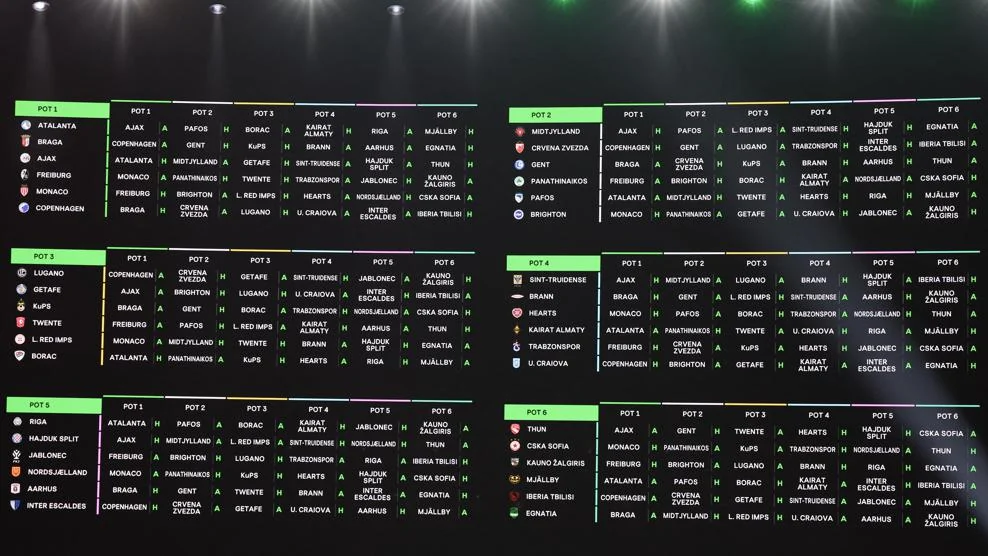
The 2026/27 UEFA Conference League field is set, the league-phase draw is complete and all six matchdays now have fixtures. Thirty-six clubs from 30 associations will share one table, but each will face only six opponents. That makes a team list useful only when it is paired with the draw logic, home-and-away allocation and the table cut lines that shape every result.
This guide is built for supporters planning their autumn: who qualified, how the six pots actually worked, which contenders received revealing assignments, and which dates deserve space in the diary. Facts and fixtures are checked through 7 September 2026. UEFA can amend a venue or kick-off, so use the official match listing again before travel.
Who qualified for the 2026/27 Conference League?
The league phase contains 36 clubs from 30 national associations. Atalanta, Ajax, Monaco, Brighton, Braga and Copenhagen provide familiar reference points, while Inter Club d'Escaldes gives Andorra its first representative in a UEFA group stage or league phase. The range is the competition's defining feature: one table joins clubs whose domestic environments, budgets and European histories are radically different.
Every place was earned through qualifying
Unlike the Europa League, the Conference League had no direct league-phase entrants. Twenty-four clubs won Conference League play-off ties, and 12 transferred after losing Europa League play-offs. That distinction matters. Brighton, Ajax and Monaco still had to survive a two-leg August tie; Hearts required penalties, and Jablonec overturned Rangers after extra time and a shoot-out. The 12 transfers arrived with the disappointment of losing a Europa tie but the security of an immediate place here.
The Conference qualifying competition began on 7 July and ended on 27 August. Teams entered at different stages under the access list, so their workloads were unequal. A first-round survivor may have played eight European qualifiers; a later entrant played fewer. When the league phase opens, “qualified” describes a destination rather than a common preseason.
The national spread is broader than the list of headline clubs
Denmark supplies Aarhus, Copenhagen, Midtjylland and Nordsjælland, the largest national group. The Netherlands and Belgium each have two, as does Switzerland. England, Italy, Spain, Germany, France and Portugal each have one. The rest stretches from Kazakhstan to Gibraltar and Georgia to Finland.
This breadth changes travel and matchup preparation. A side that meets Kairat Almaty away faces a journey and climate question unlike a visit to Getafe. A club travelling to Inter Escaldes must deal with a historic occasion in Andorran football, not merely a low coefficient. Smaller European records can reflect fewer opportunities as much as present quality.
UEFA described the list as provisional pending final admission and any licensing or disciplinary issues. Fans should preserve that caveat when booking travel. The article uses the sporting field confirmed on 28 August; official club and fixture notices remain decisive if circumstances change.
How the six-pot Conference League draw worked
The Conference League league phase looks like the Europa League's 36-team table, but its opponent allocation is different. Conference clubs play six matches rather than eight. UEFA split the field into six pots of six using club coefficients, and every team drew one opponent from each pot. A Pot 1 side therefore still plays another Pot 1 side; the label does not shield it from the strongest coefficient band.
One opponent came from every pot
Atalanta, Braga, Ajax, Freiburg, Monaco and Copenhagen formed Pot 1. Pot 2 contained Midtjylland, Crvena Zvezda, Gent, Panathinaikos, Pafos and Brighton. Getafe and Twente appeared in Pot 3; Hearts and Trabzonspor in Pot 4; Hajduk Split and Nordsjælland in Pot 5; and the final band included Thun, CSKA Sofia, Kauno Žalgiris, Mjällby, Iberia Tbilisi and Egnatia.
The coefficient measures European results over its reference period. It is useful for seeding but should not become a current power ranking. Brighton's Pot 2 place and Getafe's Pot 3 place, for example, reflect their UEFA record, not a verdict on how their squads compare to every club above them in August 2026. Conversely, Ajax's Pot 1 history does not remove the evidence of a difficult 9-5 qualifying aggregate against Sion.
Paired pots balanced the venues
UEFA paired Pots 1 and 2, Pots 3 and 4, and Pots 5 and 6 when assigning venues. In each pair, a club received one home match and one away match. That guaranteed three home and three away fixtures. It did not guarantee that the hardest opponent came home or that the longest journey fell in a convenient domestic week.
This is a subtle but important point when comparing draws. A team might host a Pot 1 opponent yet travel to a dangerous Pot 2 side, then receive its lowest-pot opponent away in unfamiliar conditions. Counting pot numbers alone strips out crowd, pitch, climate and travel. Schedule strength is the interaction between opponent and venue, not the sum of six seed labels.
Restrictions made a simple-looking draw technically complex
Same-association meetings were barred in principle, and no club could draw more than two teams from any other single association. UEFA also prevented Gibraltar–Spain pairings and added a restriction against repeating the same home fixture for three consecutive seasons. A digitally executed process, reviewed by an external auditor, handled these interlocking conditions.
The completed draw produced 108 matches across six matchdays. For supporters, the clean reading is six opponents, three venues at home and three away. The software is part of how the allocation remained valid; it is not a sporting advantage for any club. Difficulty still has to be judged through the football each opponent brings.

Which Conference League contenders received the most revealing draws?
A famous badge is a useful starting point, but this draw asks a more interesting question: which clubs can solve six very different assignments without the safety of a return game? Ajax, Atalanta and Brighton all have enough pedigree or resources to attract attention. Their routes, however, demand different kinds of football. Reading those demands is more useful than publishing a premature favourites list before a league-phase ball has been kicked.
Ajax: heavyweight home nights, uncomfortable trips
Ajax's Amsterdam programme contains Atalanta, Getafe and Thun. The first two immediately test opposite qualities: Atalanta can turn a match into a sequence of intense individual duels, while Getafe are capable of making rhythm and territory difficult to establish. Away, Ajax visit Midtjylland, Sint-Truidense and Hajduk Split. That is a compact lesson in modern Conference League travel: a well-drilled Danish side, an unfamiliar Belgian contest and a fiercely charged night in Split. Ajax reached this stage by beating Sion, but their name buys no points in a table shared by 36 teams.
Atalanta: the top seed still has work to do
Atalanta entered Pot 1 as the No. 1 seed. Pafos, Kairat Almaty and Mjällby come to Bergamo; the Italian club travel to Ajax, Borac and Riga. That allocation looks manageable until the calendar and geography enter the calculation. An away game in Amsterdam carries obvious sporting weight, while Bosnia and Latvia present distinct surfaces, climates and match atmospheres. Atalanta's task is to impose their pace without turning patient European games into unnecessary transitions. Their draw offers opportunity, but also punishes complacency.
Brighton: an attractive home slate and three tactical away tests
Brighton host Monaco, Universitatea Craiova and Kauno Žalgiris, with trips to Panathinaikos, Getafe and Jablonec. Monaco at home is the obvious marquee night. The away schedule may tell us more: Athens brings pressure from the stands, Getafe can reduce a game to second balls and restarts, and Jablonec offer the kind of less familiar Czech assignment that punishes slow preparation. Brighton's Premier League resources create expectations, yet their first Conference League campaign will be judged by how quickly they learn these different European rhythms.
Fan's reading
Do not compare these clubs by counting recognisable opponents. Compare travel, home leverage and stylistic variety. The league table rewards six independent results, so a contender can survive one headline defeat if it consistently handles the supposedly quieter fixtures.
Six Conference League dates and the fixtures worth circling
The league phase is unusually concentrated: six Thursdays from 15 October to 17 December 2026. That makes momentum volatile. Two good results in seven days can launch a club toward the top eight; two poor ones can turn the rest of autumn into a chase for the play-off places. UEFA lists kick-offs in Central European Time, generally 21:00 unless marked earlier, so supporters should convert the time and recheck the listing close to matchday.
22 October: Ajax vs Atalanta
The clearest heavyweight test arrives on Matchday 2. Ajax's possession and home initiative meet an Atalanta side comfortable turning space into repeated duels. It is only one game in a single table, yet it gives every contender an early benchmark for what top-eight quality may look like.
10 December: Brighton vs Monaco
By Matchday 5, this attractive tie should carry hard numerical consequences. Both clubs will know whether they are defending a direct last-16 position or scrambling to avoid a February play-off. The contrast between Brighton's collective patterns and Monaco's transition threat gives the game substance beyond its billing.
Do not skip the difficult away nights
Hajduk Split versus Ajax opens the campaign at 18:45 CET on 15 October, a useful warning that atmosphere and urgency arrive before any favourite has settled. Brighton finish away to Panathinaikos on 17 December. Those are exactly the fixtures that expose whether a technically strong visitor can manage noise, stoppages and changes of momentum. Elsewhere, Monaco host Freiburg on 22 October and Getafe welcome Brighton on 5 November, two pairings that should reveal how supposedly leading sides respond when neither receives an easy territorial advantage.
Why the closing Thursday feels different
All 18 Matchday 6 games fall on 17 December. Ajax host Getafe, Atalanta receive Mjällby and Brighton travel to Panathinaikos among a full board of simultaneous decisions. Fans should watch the live table as well as their match: one late goal can move a club across the eighth-place line, into the ninth-to-24th play-off band or out of Europe entirely. That shared finish is the closest this format comes to a traditional final group night, except the consequences ripple through 36 clubs rather than four.
How to read the 36-team Conference League race
Every club appears in one table even though no club plays the same schedule. UEFA awards three points for a win and one for a draw across six single-leg matches. The three bands are simple: first to eighth advance directly to the round of 16, ninth to 24th enter a two-legged knockout phase play-off, and 25th to 36th are eliminated. The meaningful table is therefore a map of cut lines, not a conventional group in which every rival meets twice.
Places 1–8
Direct round of 16
Skip February's play-off and receive a bracket position shaped by league ranking.
Places 9–24
Knockout play-off
Higher finish improves the pairing and normally brings the second leg at home.
Places 25–36
European campaign ends
There is no transfer into another UEFA competition after the league phase.
Goal difference is active currency
When clubs are level on points, goal difference and then goals scored lead UEFA's separation criteria, followed by away goals, wins and away wins. That gives a late second or third goal real value even in a comfortable-looking match. After all six games, the collective results of a club's opponents can also separate otherwise level records. Fans cannot control that strength-of-schedule factor, but they can avoid a common mistake: assuming two equal point totals must produce equal positions.
The order also changes how a supporter should interpret an early table. Between Matchdays 1 and 5, teams that remain level through those first five sporting criteria can share the same rank and appear alphabetically. At the end, opponent records, disciplinary points and eventually club coefficient supply further separation. A club shown eighth in November is therefore occupying a useful snapshot, not holding a tiebreak it has permanently won. The practical response is to value positive margins while resisting false precision before every opponent has finished.
Finishing position still matters after qualification
Ninth and 16th both reach the play-offs, yet they do not receive equivalent paths. UEFA pairs ninth or tenth with 23rd or 24th, while 15th or 16th meet 17th or 18th; seeded teams normally play the return leg at home. The ranking continues to shape the fixed knockout bracket. Top-four league finishers carry a second-leg-home advantage into a potential quarter-final, and the top two into a potential semi-final; a team that eliminates one inherits that bracket position. So the final Thursday is about much more than merely staying above 24th.
That makes first versus eighth and ninth versus 16th meaningful even when each pair shares an immediate destination. A top-eight place removes two February matches from an already crowded season. A higher position within that band can then place the second leg of a later tie at home, where a club knows exactly what result it needs. For the play-off teams, ninth and tenth draw from the lowest qualifying pair while 15th and 16th face clubs much closer in the table. The reward for continuing to attack on Matchday 6 is built into the route, not just the final ranking graphic.
Best way to follow: track points, goal difference and the three cut lines after every matchday. Add opponent strength and bracket position only as the table settles. That keeps the picture clear without pretending a six-game race is predictable in October.
Keep the official list close
Use UEFA's confirmed fixture list for last-minute schedule checks. Come back to this guide when the table begins moving: the opponent mix explains why equal point totals may represent very different journeys.

Matchnight discussion
Ask a question or share your thoughts with other fans. Comments are reviewed before they appear. Please keep it friendly and leave out personal details.
Read our privacy policy and comment guidelines.
Loading comments…