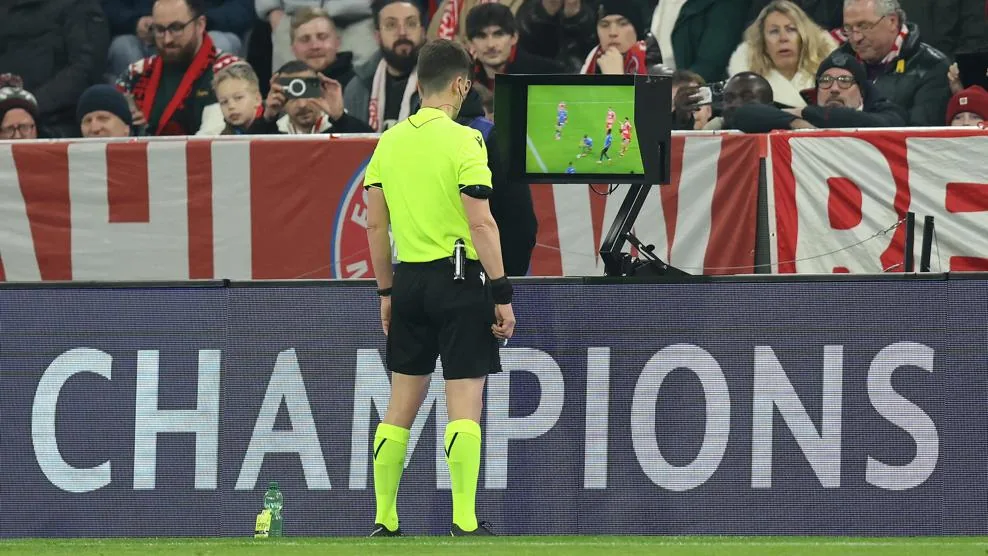
UEFA wants VAR to intervene less often in marginal, subjective situations during 2026/27—and to explain the line more clearly when it does intervene. The core “clear and obvious” test remains, but IFAB has also expanded a few tightly defined protocol categories, while UEFA has launched the public Clear Line video library and a standard monitor-review sequence.
For Europa League fans, the important distinction is between a new Law, a protocol amendment and UEFA’s interpretation guidance. This guide separates them, applies the framework to handball and offside debates, and tests whether it addresses the complaints supporters make most often.
The short answer: restraint, context and clearer evidence
UEFA’s message for 2026/27 is not “use more technology.” It is to make VAR intervention narrower, faster and easier to justify. The video official should correct a blatant on-field error or a serious incident that the referee clearly missed. If several slow-motion angles and a long debate are required merely to prefer a different interpretation, the original decision probably has not crossed that threshold.
That direction matters in the Europa League because one Thursday can contain 18 matches, officials from different domestic cultures and supporters arriving with different expectations of handball or physical contact. UEFA wants the same decision framework to travel with its refereeing teams. In July 2026, its refereeing department and chief refereeing officers from all 55 member associations backed a common approach, with referees kept at the centre of decision-making.
For a supporter, the promised change is best understood as intervention discipline. A check will still take place in the background for relevant incidents. The question is whether the evidence exposes a clear mistake, not whether a replay can uncover any possible argument against the call. That should reduce the most frustrating kind of review: a technically elaborate search that ends by replacing one plausible judgement with another.
Guidance is not the same as a new Law
Three separate things are easy to collapse into a single “VAR overhaul.” The International Football Association Board, or IFAB, writes the Laws of the Game and the VAR protocol. UEFA runs its competitions and instructs its officials on applying that framework. Clear Line is UEFA’s public library of examples intended to show how those interpretations work.
The distinction prevents two common misunderstandings. First, UEFA has not invented a special handball law for the Europa League. Second, a call that remains debatable is not proof that the guidance was ignored. Football laws include judgement, and UEFA itself acknowledges that no two incidents are identical. The practical test is whether officials use the correct threshold and process consistently, not whether every fan reaches the same verdict.
What “clear and obvious” should look like in 2026/27
“Clear and obvious” describes the error threshold, not a promise that every review will be visually simple. A penalty decision can involve the location of contact, its force, the defender’s action and what the referee actually saw. The VAR first checks whether the incident falls inside a reviewable category, then asks whether the available evidence makes the on-field decision plainly wrong.
UEFA’s July guidance puts a useful brake on that exercise: lengthy, microscopic reviews are often evidence that the threshold has not been met. That does not create a stopwatch rule. A complicated factual problem may take time to resolve, while a subjective incident can be clear from one angle. The important discipline is not to keep searching until the video room finds a reason to intervene.
Normal speed before the microscope
A still frame is excellent for locating contact and poor at expressing football movement. It can make a natural running arm look unnaturally extended, transform a glancing challenge into a planted stamp or hide how quickly the ball travelled. Slow motion can establish the point of contact, yet it also magnifies an impact and removes the speed at which the player had to react.
UEFA’s standard four-step monitor process makes the balance explicit. Officials identify the alleged offence with a clear angle, conduct a technical assessment—typically with two or three half-speed replays—then return to a wider angle at normal speed to read the build-up, intensity, dynamic movement and aftermath. The final image should support the decision, but it should not replace the sequence that gives the image meaning.
So “normal speed before the microscope” is a principle of interpretation, not a literal reordering of UEFA’s four steps. Technical detail locates what happened; match-speed context tells the referee what that action meant. Fans should be wary when a broadcast shows only the most incriminating freeze-frame and omits the wider movement.
Why the referee remains central
The VAR recommends a review; the referee owns the final judgement in subjective cases. That matters because the official on the field has seen the temperature of the match, the players’ movement and the incident’s proximity, while the video official supplies angles that may reveal a missed fact. Keeping that division clear avoids turning the pitch-side monitor into ceremonial confirmation.
It also explains why “go to the monitor” usually signals a serious recommendation without legally predetermining the outcome. The referee is expected to look at the relevant evidence, apply the Law and either change or retain the decision. UEFA’s preference for referees with authority is compatible with VAR only when the technology corrects clear errors rather than quietly lowering the bar for a second opinion.
The VAR protocol changes fans may actually notice
The 2026/27 IFAB amendments expand a few tightly defined review situations. They do not allow the video official to revisit every caution, throw-in or corner. The common thread is a rare, clearly demonstrable mistake with a major consequence—or, for one optional corner provision, an error that can be fixed instantly before play restarts.
Clearly wrong second yellow cards and mistaken identity
VAR may now assist when the referee shows a clearly incorrect second yellow card and therefore sends a player off. The consequence is critical: a mistaken caution becomes an erroneous red card and changes the number of players. The limit matters just as much. If a player who already has a caution commits another merely cautionable offence that the referee misses, VAR cannot step in to manufacture the second yellow. The system corrects a clearly wrong dismissal; it does not police every booking.
Mistaken identity has also been clarified. If the referee penalises an incident but cautions or sends off the wrong player—even a player from the wrong team—the VAR may identify the correct offender. In that review category, the purpose is to fix identity, not to reopen the underlying judgement. The offence itself can be reviewed only if it independently relates to a goal, penalty or red-card situation covered by the protocol.
These are sensible expansions because the evidence is usually concrete. A replay can show which player made the challenge or whether the second caution was based on a plainly false premise. They should not generate a new stream of marginal reviews if officials respect the word “clearly.”
The optional corner-kick correction
IFAB also permits competitions to opt into VAR help for a clearly incorrectly awarded corner, including where the ball actually went out over the touchline. The correction must be immediate and must not delay the restart. If the attacking team takes the corner quickly, the decision cannot be dragged back after the fact.
This provision is narrower than the headline “VAR can review corners” suggests. It does not invite a pitch-side review of every disputed touch. It is designed for an obvious error that the video official can communicate almost at once. It also applies to a wrongly awarded corner, not every wrongly denied one, because the protocol is trying to stop an incorrect restart from producing a match-changing event without creating a new delay at each goal-line decision.
Adoption caveat: the corner correction is a competition option under IFAB’s protocol. Supporters should not assume it operates in every Europa League match until UEFA’s competition instructions or match communication confirm its use.
That caveat illustrates the broader hierarchy. IFAB creates the permitted protocol; UEFA decides how eligible options are implemented and trains its officials; the referee team applies them in a match. A broadcast graphic should state when an optional intervention is active. Without that confirmation, a viewer cannot fairly accuse a VAR of ignoring a power the competition may not have adopted.
Handball: why similar pictures can produce different decisions
Handball produces the sharpest consistency complaint because television freezes two incidents at the moment of contact and asks why only one became a penalty. UEFA’s Clear Line guidance starts with two legal questions: did the player deliberately touch the ball, or did the hand/arm position make the body unnaturally bigger? The answer depends on movement, not a universal silhouette.
Officials are directed to consider whether the arm moved toward the ball, how far the player was from the kick, whether a deflection changed the flight, whether a teammate played the ball and whether the defender first directed the ball onto their own arm. Those facts can make two superficially similar screenshots legally different. A close-range deflection into an arm justified by the action is not equivalent to an arm held away from the body to block a cross.
Arm position must be read with the movement
A sliding defender is the clearest example. An arm on or moving toward the ground may support the body naturally as the player reaches for the ball. The same low arm can be an offence if the player is not genuinely trying to play the ball and instead creates a larger barrier. The freeze-frame contains the location; the complete movement supplies the reason.
Clear Line also explains that the protocol works in both directions. VAR should recommend a penalty when clear footage shows deliberate movement toward the ball or an unjustified arm making the body bigger. It should recommend cancelling a penalty when the arm is close to the body, plainly natural for the movement, or contact follows a natural loss of balance. If there is no clear proof that the ball hit the arm—or real doubt about whether the position was natural—the VAR should not intervene.

This is where “consistency” needs a realistic definition. It should mean that officials ask the same questions and treat materially similar movements alike. It cannot mean every ball-to-arm contact produces the same outcome, because the Law deliberately distinguishes deliberate action, an unjustified barrier and a natural consequence of movement.
Supporters can still challenge whether an official read those facts well. The constructive version of the argument is specific: identify the distance, arm movement, deflection and body action, then compare them with a Clear Line example. “His arm was away from his side” is not enough by itself, and neither is “he had no time.” The full test is why the arm occupied that space and whether clear video makes the on-field decision untenable.
Factual calls are different from judgement calls
Not every VAR decision uses the same route. Some questions are objective: the ball crossed the line or it did not; contact occurred inside the penalty area or outside it. Others require football judgement: was the contact careless, did an offside-positioned player interfere with an opponent, or was an arm position justified by the player’s action?
That division affects both the intervention threshold and what supporters see. UEFA’s Clear Line guide says the VAR should correct factual situations when the footage supplies the answer. The information can normally be passed to the referee without an on-field review. A subjective penalty recommendation is different: the referee generally needs to see the action and apply the Law at the monitor.
Offside, ball out and offence location
An attacker’s position at the relevant touch can be measured, and whether that player then touches or plays the ball is usually visible. But offside law can still involve judgement when the question is interference: did the player challenge an opponent, obstruct the goalkeeper’s line of vision or make an obvious action that affected a defender’s ability to play the ball? A precise line cannot answer all of those questions.
The same split appears around the penalty area. Video can establish that a defender’s contact was centimetres outside the box. That factual location changes a penalty to a free-kick. Yet footage showing contact does not automatically prove a foul; the intensity and consequence may remain matters for the referee. Fans should separate “where?” from “what did it mean?” before judging the review time.
Clear Line also identifies ball-out decisions in the attacking phase and certain penalty-kick facts, such as goalkeeper encroachment, as objective situations. These can still take time if the decisive camera angle is blocked or the correct restart frame must be located. “Factual” means the Law has a binary answer once the fact is established, not that every stadium has perfect evidence within one second.
This distinction provides a fairer test of the 2026/27 guidance. A marginal factual correction may legitimately use precise technology. A subjective intervention should require persuasive evidence that the referee’s judgement was clearly wrong. Complaints often arise when broadcasters describe both processes simply as “VAR overturns it,” hiding the different question that was actually answered.
How supporters can use UEFA Clear Line
UEFA Clear Line is a public video library containing more than 150 refereeing scenarios. It exposes guidance that previously felt remote from supporters: examples of when VAR should intervene, when the on-field call should stand and which factors officials are expected to weigh. UEFA says the library is intended for match officials, clubs, players, commentators and fans, and will evolve when new clarification is needed.
The most useful way to use it is category first, clip second. After a disputed Europa League incident, identify the real question: handball, holding, serious foul play, attacking offence, offside involvement or a factual boundary. Read the stated factors before searching for a visually similar frame. Then watch the complete reference movement and compare the relevant facts—distance, speed, point of contact, player action and match consequence.
That order matters because highlight culture works backwards. A viral still arrives with a verdict already attached, and supporters hunt for confirmation. Clear Line is more educational when it changes the question from “does this look bad?” to “which element of the Law makes intervention necessary?” It can also explain a silent check. When no clear evidence disproves the referee’s judgement, allowing play to continue is an application of the protocol, not proof that nobody looked.
The library should not be treated as football case law. One example does not bind every later incident merely because the arm or boot occupies a similar pixel. Camera perspective, force, movement and the referee’s original information differ. UEFA’s own launch statement says no two incidents are identical and occasional mistakes remain inevitable. The examples supply a common reasoning framework, not a machine that removes judgement.
Clear Line can nevertheless improve accountability. Commentators can name the relevant factor instead of guessing what the video room saw. Clubs can challenge a decision using the guidance rather than an isolated screenshot. Supporters can ask whether the intervention threshold was met, whether the correct decision category was used and whether the final explanation matches the pictures.
Save the landing page before matchday rather than trying to find it during a heated stoppage. After the game, compare the incident calmly and look for any official explanation. The tool’s success will not be measured by ending debate; it will be measured by making debate more precise and by exposing when apparently similar calls were actually assessed through different criteria.
Will this answer the biggest fan complaints?
The most persistent complaints are not simply that decisions are wrong. Supporters object to waiting without information, seeing apparently similar incidents produce different outcomes and receiving a stadium message that says only “checking” or “decision” without the decisive reason. Online discussion after major European matches repeatedly centres on handball consistency and the absence of an explanation. Those posts demonstrate frustration, not a representative vote, but they identify the trust problem UEFA is trying to address.
What could improve
A higher intervention threshold can protect the match from unnecessary interruption. If the video official recognises that two plausible readings exist, the check can finish without sending the referee to the monitor. UEFA’s structured review sequence can also prevent an on-field review from becoming an unsystematic tour through every angle. The clearest angle identifies the event; technical replays establish detail; normal speed restores context; the final image supports the verdict.
Clear Line can improve the explanation after the decision. Instead of hearing that an arm was simply “natural,” a viewer can see whether distance, movement, deflection or a supporting action was relevant. Instead of treating every offside as a line-drawing exercise, commentary can separate position from interference. A shared vocabulary will not make a losing supporter happy, but it can make the decision intelligible.
Cross-border alignment is another real gain. Europa League officials and clubs arrive from domestic competitions with different conventions. Briefing all associations and competing clubs around one UEFA framework should reduce the chance that a routine contact is managed one way in one match and fundamentally differently in another. Success must be judged across a large sample, not selected clips.
What guidance cannot eliminate
No document supplies a perfect camera angle. Players can block the decisive contact, frame rates can complicate the exact moment of a touch, and a wide shot may show context while hiding detail. When evidence is inconclusive, the protocol favours the on-field decision. One group of supporters may interpret that restraint as common sense; another may call it VAR refusing to help.
Nor can guidance remove subjective boundaries. “Careless,” “excessive force,” “unnaturally bigger” and “interfering with an opponent” require trained judgement. UEFA can standardise the factors and examples without turning them into a formula. Rosetti has openly acknowledged that similar situations will sometimes be interpreted differently and that occasional mistakes are inevitable.
More restraint creates its own complaint. When VAR intervenes, fans ask why it overruled the referee; when it stays silent, they ask why technology failed to correct the call. The answer must therefore be procedural: was the incident reviewable, was the evidence clear, and was the correct standard applied? Universal agreement is not a realistic benchmark.
The harder transparency problem also remains in the stadium. A public library helps after the match, but supporters standing behind a goal need timely information during a stoppage. Clear screen wording, a reason category and—where competition rules permit—better communication of the final decision would address that experience more directly. UEFA’s 2026/27 guidance is a useful foundation; the quality of live explanation will determine whether it feels like change.
A matchday checklist for reading a VAR incident
Begin with the referee’s original decision. The protocol asks whether that call contains a clear error; it does not ask the video official to choose between two equally supportable outcomes. A silent check may already be under way, so the absence of a monitor visit does not mean VAR ignored the incident.
- Name the review category. Is the incident connected to a goal, penalty, red card, mistaken identity or another specifically permitted 2026/27 situation? VAR cannot solve a problem outside its protocol merely because replay exists.
- Separate fact from judgement. Offside position, ball out of play and offence location may have binary answers. Force, deliberate action and interference often require the referee’s football judgement.
- Watch the whole movement. Use the tight angle to locate contact, then a wider normal-speed view to assess intensity, distance, body action and the sequence around it. Do not allow the freeze-frame to become the incident.
- Ask what makes the original call clearly wrong. “I would give it” is not the same claim. Identify the piece of evidence that removes a reasonable alternative interpretation.
- Check the protocol limit. A missed possible second yellow is different from a clearly wrong second yellow that caused a dismissal. An optional immediate corner correction is different from reviewing every disputed goal-line touch.
- Read the final communication carefully. “Check complete” means the threshold was not met. An on-field review means the VAR recommended that the referee reassess; the referee still owns the subjective decision.
After the match, use Clear Line to compare the relevant factors, not just the visual shape. If UEFA, the club or a referee body publishes an explanation, read it before deciding that two clips received opposite standards. Official explanations can still be criticised, but they establish which Law and evidence the officials say they applied.
This checklist will not turn a supporter into the match official or drain emotion from a 90th-minute penalty. It does provide a better basis for criticism. The most useful question in 2026/27 is no longer simply “was VAR involved?” It is whether the system intervened only inside its remit, used match context rather than microscopic preference, and communicated a decision that the evidence could support.
The real test begins with the matches
Fewer microscopic interventions, a repeatable review sequence and an open example library are meaningful changes in approach. They are not a promise of perfect decisions. Judge UEFA’s 2026/27 direction over many Europa League incidents: whether subjective reviews genuinely require clear evidence, whether similar facts receive the same reasoning, and whether supporters are told enough to understand the call.

Matchnight discussion
Ask a question or share your thoughts with other fans. Comments are reviewed before they appear. Please keep it friendly and leave out personal details.
Read our privacy policy and comment guidelines.
Loading comments…