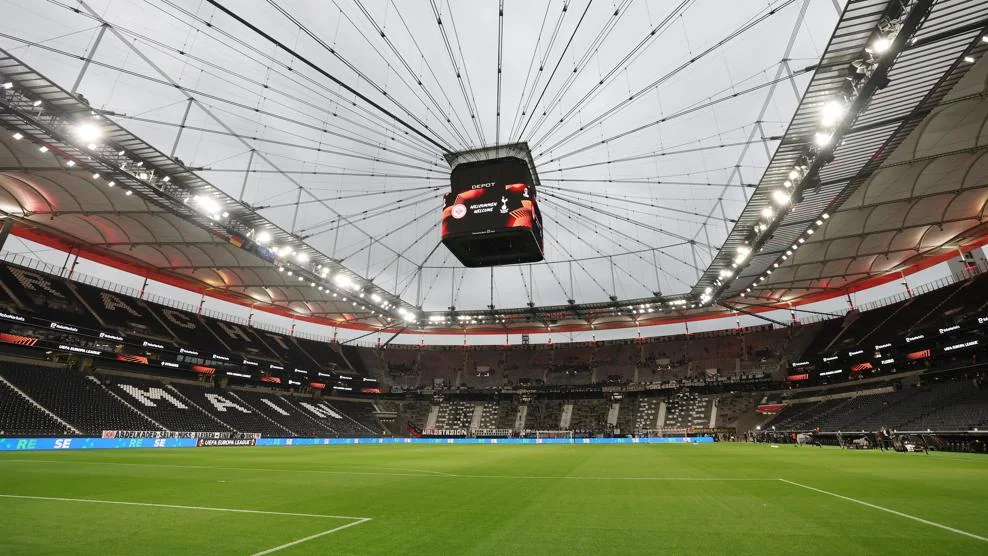
The 2026/27 UEFA Europa League league phase runs from 16 September 2026 to 28 January 2027, followed by knockout football from February and the final at Stadion Frankfurt on 26 May 2027. This guide explains more than the dates: it shows how an eight-opponent schedule, one 36-team table and a rank-shaped bracket change what every matchday means.
For an individual kick-off, use the today schedule. For the season's architecture, start here.
The 2026/27 Europa League calendar at a glance
The useful short answer is this: the league phase starts on 16 September 2026, its eighth and final matchday is on 28 January 2027, and the final is in Frankfurt on 26 May 2027. Qualifying had already begun on 9 July, so this is a competition that occupies almost eleven months even though most supporters first encounter it in September. UEFA's official season overview is the authority for these dates and also warns that they can change.
| Stage | Dates | What fans should notice |
|---|---|---|
| League phase, MD1–MD4 | 16/17 Sep; 15 & 22 Oct; 5 Nov | The opening four games include an unusually long pause before Matchday 2. |
| League phase, MD5–MD8 | 26 Nov; 10 Dec; 21 & 28 Jan | Two January games can transform the final table after the winter break. |
| Knockout play-offs | 18 & 25 Feb 2027 | Only teams ranked ninth to 24th enter this extra two-leg round. |
| Round of 16 to semi-finals | 11 Mar–6 May 2027 | Three two-legged rounds compress the field from 16 clubs to two. |
| Final | 26 May 2027 | A single match at Stadion Frankfurt decides the trophy. |
That sequence is more revealing than a flat list of fixtures. A club can play three league-phase matches in 22 days between 15 October and 5 November, when domestic schedules are also busy, yet then has 42 days between Matchdays 6 and 7. Coaches therefore have to build two mini-campaigns: six games before Christmas and a two-game January finish. The January dates are especially unforgiving for teams returning from a domestic winter break or losing players in the transfer window.
Supporters planning a trip should distinguish a competition date from a confirmed appointment. UEFA's fixture list normally uses 21:00 CET with selected 18:45 starts, but the published club, venue and local-time details remain the information to follow. The quickest way to resolve that difference is to use the site's Europa League calendar for the broad view, then check today's match page close to the date. In Asia, an evening game in Europe may appear after midnight on the following calendar day; the competition matchday label and your local date can therefore differ without either being wrong.
The calendar also tells us when pressure changes. September is about establishing a base against unfamiliar opponents. November and December reward squads that can rotate without losing structure. January becomes a race for rank as well as qualification, because eighth and ninth are separated by an entire knockout round. From February onward, every date is paired with a second leg until the one-match final. Reading the schedule this way turns it from a diary into a map of where a season can bend.
How the eight-match league phase shapes the schedule
Eight opponents, one table
Every club plays eight matches, but it does not play every club around it in the table. The 36 entrants are split into four seeding pots of nine, and the draw gives each side two opponents from every pot: one at home and one away. UEFA's 2026/27 draw regulation also prevents same-association meetings in principle and limits a club to two opponents from any other association.
That structure matters when comparing schedules. A Pot 1 club does not receive eight theoretically weaker assignments; it must play two Pot 1 opponents too. Nor does a team get a conventional return fixture against the same opponent. Home and away balance exists across the eight games, but each individual pairing happens once. This creates 144 different match-ups across the phase, rather than the repeated home-and-away pattern of the old four-team groups. It also means “strength of schedule” is a legitimate fan debate: two clubs level on points may have reached that total against meaningfully different combinations of opponents.
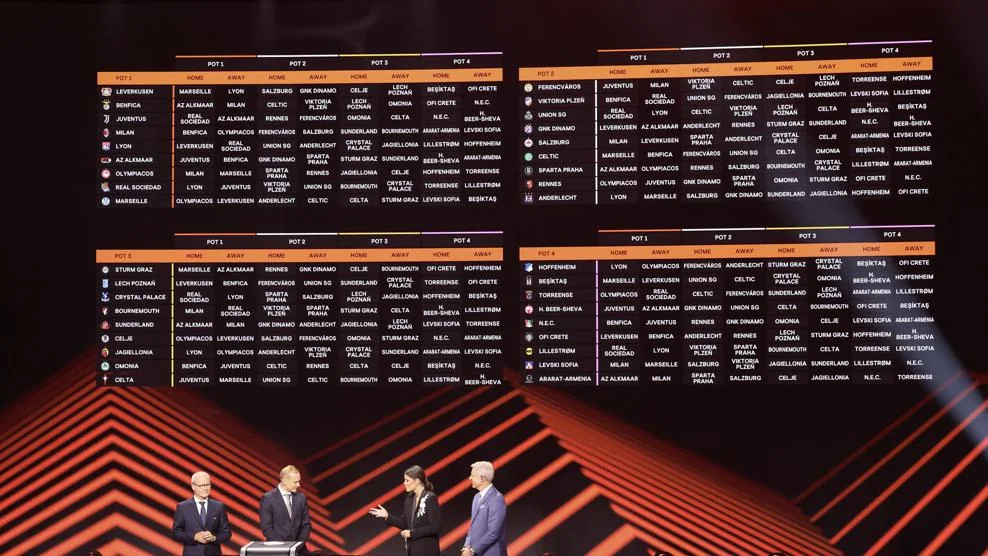
The table nevertheless has hard consequences. The top eight advance directly to the round of 16. Clubs ranked ninth through 24th enter February's knockout play-offs, while those in 25th to 36th are eliminated. When teams are level on points, goal difference and other official tie-breakers become important; supporters should use the current Europa League table rather than assume head-to-head results settle every tie. With eight different opponents, a “six-pointer” is less literal than it was inside a four-team group, although beating a rival near the same rank still changes both clubs' prospects at once.
Why January matters more than it looks
Matchdays 7 and 8 arrive on 21 and 28 January after six games have established a recognisable table. Those nights are not merely about qualifying. Finishing eighth instead of ninth removes two February fixtures; finishing 16th rather than 17th decides whether a club is seeded in the play-off draw. A manager protecting a thin squad may therefore pursue one more goal even after the result of a match seems safe, because goal difference can determine which rank band the team occupies.
The final league-phase night intensifies that arithmetic because all 18 games are designed to be played together. Fans following one club often need to watch several live scores: a late equaliser hundreds of kilometres away can move their team from a direct round-of-16 place into the play-offs. The useful schedule habit is to check the table before kick-off, note the two boundaries at eighth/ninth and 24th/25th, then follow the results page as matches finish.
This format also changes how a poor start feels. Two defeats do not put a team in a simple four-club hole; six different opponents remain, and movement across the middle of a 36-team ranking can be rapid. The reverse is equally true. A bright September does not secure a February holiday. January's back-to-back matchdays test preparation, winter recruitment and the ability to restart at European speed. The schedule rewards a club that treats all eight dates as one campaign, while still adapting its risk to the rank line it is chasing.
How qualifying produced the 36-team league phase
Direct places and Europa League qualifiers
The league phase did not begin as a closed list. Thirteen clubs had direct places, while 52 teams took part in Europa League qualifying between 9 July and 27 August. Twelve survived that route. The remaining 11 league-phase places went to teams defeated in the Champions League play-off round. That 13–12–11 split is the clearest way to understand why the final 36-team field could not be complete until the end of August.
Europa League qualifying itself ran through four two-leg windows: 9 and 16 July, 23 and 30 July, 6 and 13 August, then the play-offs on 20 and 27 August. These were knockout ties decided on aggregate, not matches in a league table. A search for a “qualifiers table” can therefore mislead. The useful records are the bracket, first- and second-leg scores and aggregate result. UEFA's complete qualifying review makes that distinction visible.
The late-August results also explain why a fan cannot treat the June access list as the final schedule. Clubs enter at different rounds according to their domestic route and the association access list. A side that starts in July can play eight qualifying legs before its first league-phase game; a direct entrant waits for September. Those workloads are radically different. Early qualifiers may arrive tactically sharp but physically taxed, while direct entrants have more preparation time and less European evidence for opponents to analyse.
Champions League transfers
The 11 Champions League play-off losers are not consolation extras with no bearing on the competition. They have just played high-stakes two-leg European ties and can add substantial quality to the Europa League field. Their arrival can alter the perceived difficulty of the four draw pots, even though seeding is based on club coefficient rather than a pundit's judgment of current form. It is one reason the Europa League identity becomes clearest only after both competitions finish qualifying.
The route continues downward too. Teams beaten in the Europa League play-offs move into the Conference League league phase, while sides eliminated in earlier rounds transfer to the corresponding Conference League qualifying stage. For supporters, the practical lesson is to follow a club's competition label carefully after elimination. Losing a tie may end its Europa League schedule but not its European season.
Once those routes closed, UEFA could draw the complete field on 28 August and publish exact league-phase fixtures. That is why the calendar has two layers: stage dates can be known months ahead, whereas named opponents, venues and kick-off slots arrive later. A reliable season guide should preserve that distinction instead of presenting an early planning grid as if it were a final fixture list.
The knockout road from February to May
Play-offs are a penalty for finishing ninth to 24th
February's knockout phase play-offs are easy to confuse with summer qualifying. They are a separate stage for the 16 clubs that finish ninth to 24th in the league phase. The top eight wait in the round of 16; the bottom 12 are out. A club in ninth therefore remains alive, but it must play on 18 and 25 February while a club in eighth rests, trains and focuses on its domestic calendar.
League position still matters inside that middle band. UEFA's Article 19 bracket rules pair ninth and tenth with 23rd and 24th, 11th and 12th with 21st and 22nd, and so on. Seeded clubs normally host the second leg. The draw chooses between a limited set of positions; it does not throw all 16 names into one unrestricted bowl. A finish of ninth can thus deliver both a lower-ranked corridor and the second leg at home, while 24th means surviving the league only to face one of its strongest non-automatic qualifiers.
Those ties are home and away, decided by aggregate score. A narrow first-leg defeat is not the same as elimination, and the old away-goals shortcut should not be applied. If aggregate scores are level after the second leg, the competition's extra-time and penalty procedure decides the winner. Fans checking knockout results should read the aggregate line rather than treating either individual score as the final verdict.
The seeded bracket after the league phase
The eight league-phase leaders enter on 11 and 18 March. They are paired by rank for the round-of-16 draw: first and second occupy one pair, third and fourth another, through seventh and eighth. Their possible opponents come from the relevant play-off corridor. The bracket therefore rewards an excellent league phase beyond merely skipping February. Positions one to four are due to play quarter-final second legs at home, while positions one and two carry that advantage into the semi-finals.
A team that eliminates a seeded club inherits its bracket position; the competition does not recalculate seeds after every upset. This gives supporters a readable road to Frankfurt once the bracket is set. It also sharpens January decision-making: a late goal can affect the side of the draw, the quality range of possible opponents and the venue order of a future second leg.
After the round of 16, the calendar is regular but demanding: quarter-finals on 8 and 15 April, semi-finals on 29 April and 6 May, then 20 days before the final. Each two-leg round asks a different tactical question. First legs often reward control because the tie remains open; second legs force teams to respond to an aggregate state. The one-match final removes that safety net. By May, the schedule that began with eight unrelated league opponents has become a fixed corridor in which every earlier rank advantage can still matter.
The Frankfurt final and a practical fan calendar
What is confirmed
The 2026/27 Europa League ends at Stadion Frankfurt on Wednesday 26 May 2027. That date belongs to the 2026/27 season even though the match is played in the next calendar year, a detail that prevents a surprising amount of search confusion. UEFA's official final guide identifies the venue as Eintracht Frankfurt's home and notes that it staged five games at EURO 2024, including Portugal's round-of-16 shoot-out win over Slovenia.
The stadium is experienced at moving tournament crowds. It has its own railway station and, during EURO 2024, UEFA advised supporters about S7, S8 and S9 services. That is useful geographic context, not a confirmed 2027 transport plan. Special service patterns, ticket inclusion, fan meeting points and security perimeters may all be different for this final. Supporters should use the final-specific travel guidance when UEFA and local organisers publish it rather than copy instructions from an older event.
The sporting reward extends beyond the trophy. The winners receive a place in the 2027/28 Champions League league phase if they have not already qualified through their domestic competition, plus a place in the 2027 UEFA Super Cup. That can change the stakes for a club whose league season has gone badly: by late May, one match may offer a route into Europe's top competition that domestic results no longer provide.
How to plan without guessing
Put three kinds of date in separate columns. First are fixed competition dates: the final and each knockout window. Second are match-specific details such as a club, venue and kick-off time. Third are supporter arrangements including ticket sales, allocations, fan zones and transport. Only the first category is substantially known at the start of the league phase. Treating the other two as confirmed can produce expensive mistakes.
A sensible planning rule
Save the date now; buy inflexible travel only when you understand the risk; use official ticket channels; and recheck the fixture after every draw. A social post or resale listing is not evidence that a public ticket window has opened.
For earlier rounds, the same discipline applies. Draw dates create possible opponents, while UEFA's subsequent scheduling confirms the appointment. Domestic broadcasters can then choose how they package the match, but they do not redefine its official kick-off. Keep the site's season calendar for the long view and the today page for the close-to-kick-off view.
The route to Frankfurt is deliberately demanding: eight league games, perhaps a February play-off, then three more two-legged rounds. A top-eight club needs seven knockout matches including the final; a play-off participant needs nine. That gap is why January rank has physical value as well as prestige. The schedule gives supporters a set of dates, but it also records the rewards earned across the season: fewer matches, stronger bracket positions and, at the end, one night in Frankfurt.
The schedule takeaway for supporters
Mark the eight league dates first, then treat rank eight, rank 24 and every draw as decision points. The official calendar establishes the frame; confirmed fixture pages supply the club, venue and local time. That habit keeps a supporter ahead of genuine changes without turning every provisional detail into a promise.
Matchnight discussion
Ask a question or share your thoughts with other fans. Comments are reviewed before they appear. Please keep it friendly and leave out personal details.
Read our privacy policy and comment guidelines.
Loading comments…