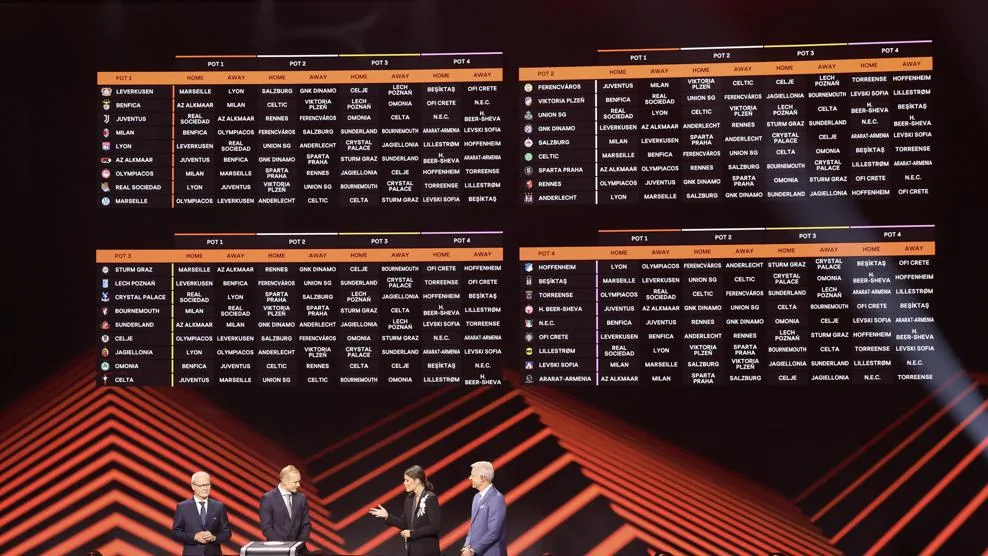
The 2026/27 Europa League league phase is set: 36 clubs, eight different opponents apiece and one shared table. Milan, Juventus and Benfica supply heavyweight recognition, England sends Crystal Palace, Bournemouth and Sunderland, and first-time European entrant Torreense gives the field its most improbable story. The list below is confirmed on sporting results as of 7 September 2026, while final admission remains subject to UEFA's normal licensing and disciplinary processes.
This guide explains who qualified and how, then reads the pots and opponent allocations from a fan's point of view. It does not turn August coefficients into a prediction. The aim is to show why some routes were harder than others, where schedule difficulty hides, and which clubs bring the most distinctive questions into Matchday 1.
The 36-team Europa League field at a glance
The 2026/27 UEFA Europa League league phase contains 36 clubs from 22 national associations. That is the useful starting point, but the number alone disguises how varied this field is. Milan, Juventus, Benfica, Marseille, Celtic and Lyon bring names associated with major European nights; Torreense, Ararat-Armenia, Celje and OFI Crete arrive with a very different scale of resources and expectation. All 36 share one table, yet they did not take one common road to get there.
This is the third season of the league-phase format. Each club receives eight different opponents rather than meeting three group rivals home and away. The field therefore needs to be read as a network of individual schedules, not eight or nine mini-groups. A club's badge and reputation tell only part of the story: its entry route, coefficient pot, travel burden and particular eight opponents shape the campaign much more directly.
The direct entrants
UEFA lists 13 direct places. Twelve came through domestic access positions, while Crystal Palace entered as the 2025/26 Conference League winner. England's other representatives are Bournemouth and Sunderland; Italy sends Milan and Juventus; Spain sends Real Sociedad and Celta; Germany has Hoffenheim and Leverkusen; France has Marseille and Rennes. AZ Alkmaar and Torreense complete that route. The inclusion of three English teams and three French teams is significant, but it does not give either country a collective advantage: clubs cannot face teams from their own association in this phase.
The Champions League transfers
Eleven teams entered after losing in Champions League qualifying: Celje, Celtic, GNK Dinamo, Hapoel Beer-Sheva, Levski Sofia, Lyon, N.E.C., Olympiacos, Sparta Praha, Sturm Graz and Union Saint-Gilloise. Calling them “drop-downs” can be misleading. They did not fall from the Champions League league phase; their transfer happened during qualifying. They also arrive having played high-stakes European ties before the Europa League draw, which can sharpen match rhythm while adding minutes and emotional wear.
The Europa League qualifying winners
The remaining 12 earned their places through Europa League qualifying: Anderlecht, Ararat-Armenia, Benfica, Beşiktaş, Ferencváros, Jagiellonia, Lech Poznań, Lillestrøm, OFI Crete, Omonia, Salzburg and Viktoria Plzeň. These are the survivors of two-leg ties rather than clubs protected by a direct berth. Their presence gives the competition much of its geographical range and removes the lazy assumption that every lower-coefficient team is inexperienced. Several have substantial European histories; others have just completed the biggest qualifying run in club history.
The full list was described by UEFA as provisional on sporting grounds, subject to final admission and any licensing or disciplinary matters. For a fan planning travel or tickets, that small-print point matters. The safest approach is to use the official list as the reference and then check the site's Europa League teams page for club-by-club navigation once the tournament begins.
How clubs reached the league phase
The entry route is more than administrative detail. It changes how a squad arrives in September. A direct entrant can build preseason around domestic opening weekends; a qualifier has already lived through elimination football; a Champions League transfer must reset quickly after losing a tie. Those different journeys explain why an apparently glamorous team may begin unevenly while a less familiar qualifier looks tactically settled.
Direct access bought planning time
Domestic league and cup performance supplied 12 direct entrants, with the Conference League champion occupying the thirteenth protected place. Direct access removed four possible Thursday ties from a club's summer and allowed recruitment departments to work with a guaranteed league-phase income and calendar. The trade-off is competitive sharpness. Their first Europa League match on 16 or 17 September may be their first continental examination of the season, while some opponents have been playing European football since July.
Europa League qualifiers survived a four-round funnel
UEFA records 52 clubs in Europa League qualifying between 9 July and 27 August. The first round started with 12 teams; other clubs entered later according to the access list and coefficient system. Every tie was played over two legs. The 12 play-off winners reached the Europa League league phase, while the 12 defeated play-off sides moved into the Conference League league phase. That safety net did not make the ties gentle: a season's competitive level and a major revenue difference could still turn on one poor away leg.
The results show how varied those passages were. Anderlecht beat Kairat Almaty 6-0 on aggregate and Lech Poznań overwhelmed Thun 9-2. Omonia had to overturn a first-leg defeat to eliminate Sint-Truiden 4-3 overall; Viktoria Plzeň recovered from 3-0 down against Crvena Zvezda, winning the return after extra time and the tie 5-4. Lillestrøm also required extra time. Those cases are a better measure of qualifying strain than a simple “Q” beside a team name.
Champions League transfers arrived by a different door
The other 11 places went to teams eliminated during Champions League qualifying. That route creates a peculiar psychological profile. Celtic, Lyon or Olympiacos may have built a squad for the Champions League and then had to accept the Europa League within days. The sporting upside is obvious: they have faced opponents selected through UEFA's seeded qualifying system and should be close to match fitness. The difficulty is reframing the objective without allowing disappointment to contaminate the next European week.
Seeding in qualifying came from club coefficients, and clubs from the same association could not be drawn together. UEFA could also form smaller groups for operational reasons. Fans should therefore avoid reading a qualifier's path as a pure open bracket in which every possible opponent was available. It was a controlled draw with sporting and political constraints. The league phase changes the mechanism, but understanding that earlier filter helps explain why several experienced European sides arrived through paths that look surprisingly complicated on paper.
What the four pots actually meant in the draw
The quickest way to misread this Europa League draw is to treat the pots like the old group-stage seeds. Pot 1 did not protect Leverkusen, Benfica or Juventus from every other Pot 1 club. Every team was assigned two opponents from each of the four pots, including its own. A Pot 4 entrant therefore faced the same broad strength bands as a Pot 1 entrant: two from the top band, two from Pot 2, two from Pot 3 and two from Pot 4.
Coefficients built the pots, not a preseason power ranking
The nine places in each pot were set by UEFA club coefficients established at the start of the season. That is a record of European performance over the relevant coefficient period, not a judgment on a club's current starting XI. It explains apparent oddities: Crystal Palace, Bournemouth and Sunderland sat together in Pot 3 despite Premier League resources, while coefficient-rich regulars such as AZ Alkmaar and Olympiacos occupied Pot 1. The pots reward European history and continuity; they cannot capture a transformative summer window or a newly promoted squad's present momentum.
Every allocation had four home and four away fixtures
For each pot, one opponent was assigned at home and one away. That creates a useful symmetry without creating identical schedules. Facing Milan at home and Leverkusen away is a different football and travel problem from hosting Real Sociedad and visiting Marseille, even though both combinations contain two Pot 1 opponents. Home advantage, journey length, domestic matches on either side and the order of fixtures all sit outside the pot label.
There were also constraints. Clubs from the same association could not meet in principle during the league phase, and a team could draw no more than two opponents from any other association. UEFA used a fully digital process, checked by an external auditor, to fit those rules together across 36 clubs. The result was 144 matches rather than a conventional bracket produced by pulling one ball after another.
The calendar adds another layer to draw difficulty
The regulations say a team should not play more than two consecutive home or away league-phase matches. They also aim to give every club one home and one away date across the first two matchdays and again across the last two, although UEFA can make exceptions. That matters because the final league-phase night is simultaneous and the January restart can punish teams that return slowly from winter breaks.
A sensible draw assessment therefore asks three questions: who are the eight opponents, where are the hardest games, and when do those games fall? Pot arithmetic answers only the first in broad terms. Use the site's Europa League calendar to see the dates, then judge the sequence alongside each club's domestic schedule. A famous opponent may be the headline; three awkward away trips in six weeks may be the deeper competitive problem.
The headline clubs and heavyweight fixtures
Milan and Juventus make the 2026/27 field look unusually grand, but a good preview must go beyond counting European trophies. The league phase rewards eight-match consistency, squad rotation and points gathered against every pot. Reputation can make an away ground louder and opponents more conservative; it cannot guarantee that a side handles Thursday travel, Sunday league duty and a tactically awkward opponent three days later.
Milan, Juventus and Benfica carry history into unfamiliar routes
Milan's opponent list is a miniature tour of the competition's range. They meet Benfica, Olympiacos, Ferencváros and Salzburg, then Sunderland, Bournemouth, Ararat-Armenia and Levski Sofia. The home-and-away detail changes the texture: Benfica come to Milan, while the Italians travel to Salzburg and Sunderland. Bournemouth also visit Milan, creating the sort of fixture that would have looked implausible when the English club was climbing through the lower divisions.
Juventus share the Italian spotlight but have a different examination. The draw includes Real Sociedad and Celta from Spain, plus opponents with strong home identities. Benfica must balance a marquee trip to Milan with away dates at Viktoria Plzeň, Omonia and N.E.C. For all three, control of transitions will matter. Favourites often face opponents willing to defend compactly and attack quickly into the space left by advancing full-backs. Breaking that first line without exposing the rest defence is more revealing than possession percentage.
England's trio arrive with three different European stories
Crystal Palace are the only one of the three carrying a UEFA title into the season. Their Conference League win supplied an automatic Europa League place and a recent memory of managing two-leg knockout ties. Bournemouth and Sunderland qualified through sixth and seventh place in the Premier League. They bring domestic intensity and significant resources, but neither can borrow Palace's experience of a full modern UEFA campaign.
The fixtures make that distinction visible. Bournemouth host Milan and travel to Real Sociedad and Celta, assignments that demand patience against sides comfortable manipulating the ball between midfield lines. Sunderland's meeting with Milan is a cultural event as well as a match, but their points target will be shaped just as strongly by the games around it. Palace have the burden of being treated as established European opposition after winning the lower competition.
For supporters, the most interesting contest may be between depth and identity. A club with a settled pressing structure can trouble a more expensive squad that rotates six players. Yet a thin squad can lose intensity when injuries and domestic demands arrive. That is why this guide avoids a fixed favourite ranking before Matchday 1. Use the current Europa League table once matches begin, then judge whether the performances behind the points look sustainable.
The outsiders who make this field distinctive
The lower pots should not be reduced to anonymous obstacles for famous clubs. They contain some of the season's clearest human stakes: a first European campaign, a national breakthrough, or eight dates that can change a club's finances and profile. The useful question is not whether an outsider can reproduce a fairy tale on demand. It is what sporting problem that club presents, especially at home, and whether its squad can repeat the intensity across eight league-phase matches.
Torreense arrive through a route that barely seemed possible
Torreense describe 2026/27 as their first season in European competition. They reached it by winning the Portuguese Cup while playing outside the top flight, beating Sporting 2-1 after extra time in the final according to AS. That combination makes them a genuine historical outlier, but “Cinderella” is not a tactical description. Opponents still have to deal with a team whose season can be organised around these eight fixtures and whose players know that every European appearance carries unusual weight.
The practical challenge works both ways. A smaller squad must absorb travel and recovery without allowing a European night to damage its domestic promotion campaign. Its usual ground may also require UEFA-specific operational arrangements. Meanwhile, visitors cannot expect the emotional temperature of a routine league match. For Torreense supporters, a game such as the home meeting with Ararat-Armenia is not filler between glamour dates; it may be the most plausible route to points and the evening on which European ambition becomes competitive reality.
Ararat-Armenia earned an eight-match national landmark
Ararat-Armenia came through the Europa League play-off by defeating Universitatea Craiova 2-1 on aggregate. Their schedule opens at home to Sparta Praha, takes them to Jagiellonia and Torreense, and closes at Milan. That final trip is an extraordinary reward, yet the opening home dates may matter more to their table position. A compact block, disciplined restarts and quick attacks after turnovers can narrow a resource gap in one match; the difficulty is maintaining that organisation against eight different opponents.
There are comparable stories across the field. OFI Crete won its play-off 5-0 on aggregate, Lillestrøm needed extra time, and Celje arrived from Champions League qualifying. Each has a distinct route and should be judged on its own evidence. A small coefficient may indicate limited recent UEFA results, but it says nothing by itself about the current coach's pressing triggers, set-piece routines or a new forward's movement.
This is why the outsider layer improves the Europa League. The format puts clubs with radically different histories in one table while giving each a balanced set of pot bands. It does not equalise budgets. It creates eight opportunities to turn preparation, atmosphere and a specific matchup into points. Fans following an unfamiliar opponent can start with the team directory, then read its recent results rather than relying on badge recognition.
How to follow one team without losing the wider picture
The new format asks supporters to hold two views at once. Your club has an eight-match mini-story, with four home games and four away games. Its actual fate is decided in a 36-team table against clubs it may never play. Watching only your team's line of results can therefore create false comfort. Ten points might look healthy until the table compresses; a narrow defeat can damage goal difference even if the performance felt encouraging.
Start with the individual route. Save the eight dates from the Europa League calendar and note the kick-off time in your own zone. Pay special attention to the two January matchdays: teams return from different domestic breaks, transfer windows are open and late squad changes can alter the apparent difficulty of a fixture drawn in August. The first league-phase week is split across Wednesday and Thursday; the remaining dates are principally Thursdays.
After every matchday, switch to the league-phase table. Places one to eight advance directly to the round of 16. Ninth through 24th enter a two-leg knockout play-off, adding two matches to an already crowded season. The bottom 12 are eliminated from Europe. That makes the boundary around eighth place almost as important as the line at 24th: avoiding February's play-off can protect recovery time and improve the later bracket position.
Goal difference is the first final tiebreaker after points, followed by goals scored and then away goals scored. Deeper criteria include wins, away wins and the collective performance of a team's league-phase opponents. The lesson for fans is simple: a late fourth goal can retain value, and results elsewhere may matter even when the clubs involved are not direct opponents. Do not project a qualification total as if it were fixed; 36 interlocking schedules create a distribution, not a traditional group's neat head-to-head race.
On matchday, the site's today page gives the immediate slate, while results restores the wider context afterward. Use the tools for changing scores and times; use this guide for the structure behind them. That division keeps the information useful: an editorial preview should explain why a fixture matters, while a schedule should remain the fastest answer to when it starts.
The 36 names make a striking poster, but the competition will be decided by matchups and sequencing. Direct entrants had time; qualifiers have rhythm; Champions League transfers have to turn disappointment into focus. Pot 1 contains famous clubs and proven European performers, yet every one of them must face two opponents from its own band. Pot 4 includes modest coefficients, not eight automatic wins.
The best early judgment is therefore provisional. Watch how teams defend transitions, rotate after domestic games and handle hostile away grounds. Then let the shared table reveal whether those impressions are becoming results. The field is unusually broad, and that breadth is exactly what makes an eight-game league phase worth following beyond the biggest badges.
Matchnight discussion
Ask a question or share your thoughts with other fans. Comments are reviewed before they appear. Please keep it friendly and leave out personal details.
Read our privacy policy and comment guidelines.
Loading comments…